
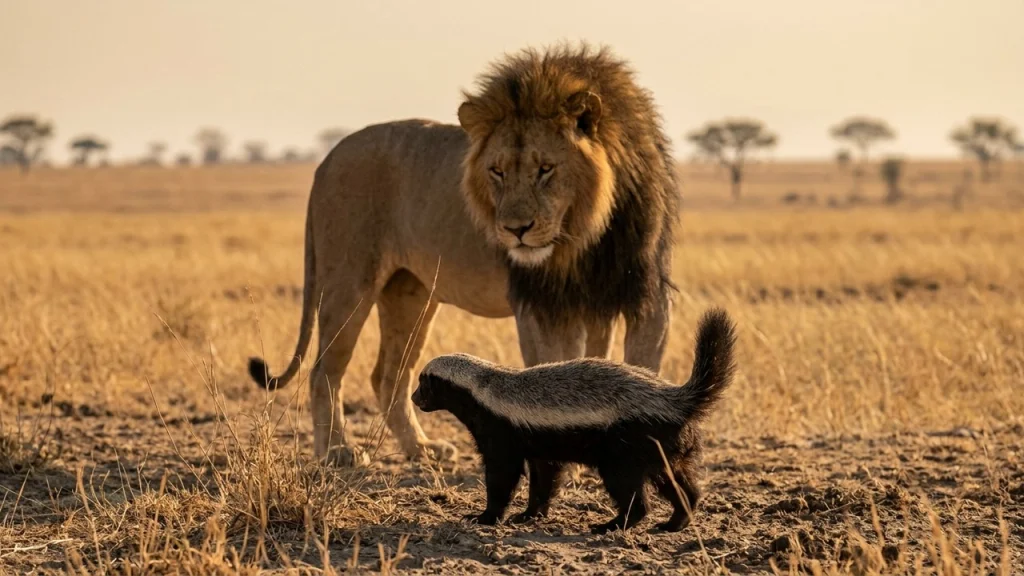
No, a honey badger cannot kill a healthy adult lion. The weight gap alone rules out that outcome, because an adult lion carries far greater bulk, reach and muscle than a small mustelid. That physical gulf decides any direct clash before it begins.
What a honey badger can do is survive. It defends itself with unusual skill and often forces lions to abandon an attack. Field observations show lions tend to kill only old and feeble individuals of this species, since firm grips fail on younger animals.
Why the size gap makes a kill impossible
The honey badger carries the scientific label Mellivora capensis and belongs with badgers, otters, weasels and related carnivores in Mustelidae. This placement explains its low-slung build and meat-focused habits, not power against giant cats. Taxonomy here signals a small-bodied predator specialized for digging and raiding, rather than for bringing down large mammals.
This stocky hunter combines a flattened torso with short sturdy limbs and extended front claws built for excavation and self protection. Those tools excel at tearing open burrows, logs and hives. They do not provide leverage to topple an animal far heavier than itself.
Body measurements underline the mismatch. The torso spans 60 to 70 cm, so the whole animal remains below knee height on a person. Zoo records list adult weight as 13.6 to 30 pounds. Such proportions suit speed in tunnels and brush, not combat with a big cat.
Lions sit in Felidae as Panthera leo within the roaring cats. That lineage produces large skulls, shearing teeth and forelimbs designed to grapple. The classification points to a predator of large hoofed mammals, a very different ecological role from the badger.
Adult female lions weigh 270 to 400 pounds, while adult males weigh 330 to 570 pounds. In other words, even a small lioness outweighs a heavy badger by a wide margin. This mass drives every aspect of a direct clash, from bite force to ability to absorb punishment.
Lions also carry frames built to destroy. They possess dense muscular torsos plus forceful front legs, fangs and jaw strength suited for dragging down and dispatching victims. A swipe or bite calibrated for zebra-sized game delivers far more trauma than a small mammal can return.
Overall length reinforces the same point. Total length spans 2.4 to 3.3 m, including a tail of 0.6 to 1.0 m. That reach lets a lion control distance, pin a small opponent and avoid damaging bites.
How a honey badger turns defense into survival
Skin that slips and teeth that punish
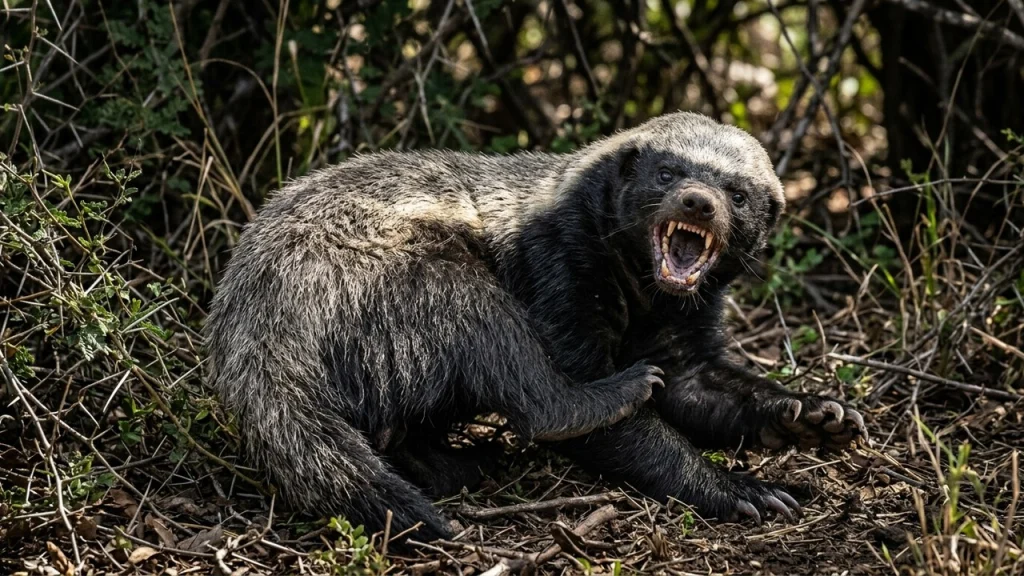
Loose armor defines this mustelid. Its hide feels dense yet baggy, so it can rotate inside its own skin and snap at a foe clutching the scruff. The maneuver turns a classic killing grip into an opening for a counterbite.
The hide also resists punctures remarkably well. It can endure honeybee stings, porcupine spines and even dog bites without serious injury. That toughness buys time during a mauling and often convinces a larger attacker that the meal costs too much effort.
Smell, bluff and full frontal charges
Chemical deterrence adds another layer. When scared or cornered, the animal releases a potent anal discharge described as a stink bomb, instead of spraying like its skunk cousin. The sudden odor shocks the nose, interrupts the attack sequence and signals that the target will not submit quietly.
Bold counterattack completes the display. These badgers regularly rush toward aggressors rather than fleeing. A charge, loud vocal display and erect tail make a small animal look risky and unpredictable, which matters against a predator that calculates injury risk before committing.
How lions hunt animals far larger than badgers
Team hunters of open country describe lions well. They range across savannas and grasslands in Africa, cooperating during pursuits and sheltering offspring in prides. Group life lets them test herds, isolate vulnerable individuals and defend carcasses.
Lions also stand out socially among felids. They alone form big lasting bands termed prides. Membership provides extra eyes for spotting danger, extra hunters for encircling game and extra defenders for holding territory.
A typical band holds 3 to 30 lions and centers on related lionesses with their young plus several unrelated mature males. Numbers shift with food supply, but the core structure stays constant. A badger facing such a unit meets not one hunter but a network that shares information and reinforces success.
Hunting method favors the cat as well. Groups usually stalk together, yet one individual delivers the final grab. Coordination exhausts prey and creates openings, then explosive power finishes the job. A solitary badger cannot match that division of labor.
Lions routinely subdue victims heavier than themselves. That capacity comes from rushing, wrestling and suffocating rather than from matching size exactly. If they can drag down fleet-footed ungulates much larger than themselves, a small carnivore offers no mechanical obstacle when caught in the open.
Females perform most of the killing inside a pride. Their lighter build brings speed and agility, while males patrol and guard. This specialization means a badger encountered by foraging lionesses faces experienced killers, not casual chasers.
Diet data confirm the scale of normal lion prey. They focus on bulky beasts weighing 100 to 1,000 pounds, for example zebra and wildebeest. A honey badger falls far below that preferred range, so lions usually ignore it unless an easy opportunity appears.
Feeding capacity shows the same gulf. A male can consume roughly a quarter of his mass in one sitting, equal to about 140 pounds or 63 kilograms of flesh. One meal can therefore exceed the total bulk of several adult badgers combined.
Healthy adult lions face no other wild predators, although people, hunger and fights with rival lions still threaten them. This apex position means a badger cannot rely on another carnivore to intervene. Survival depends entirely on its own deterrents.
What a real encounter looks like in the wild
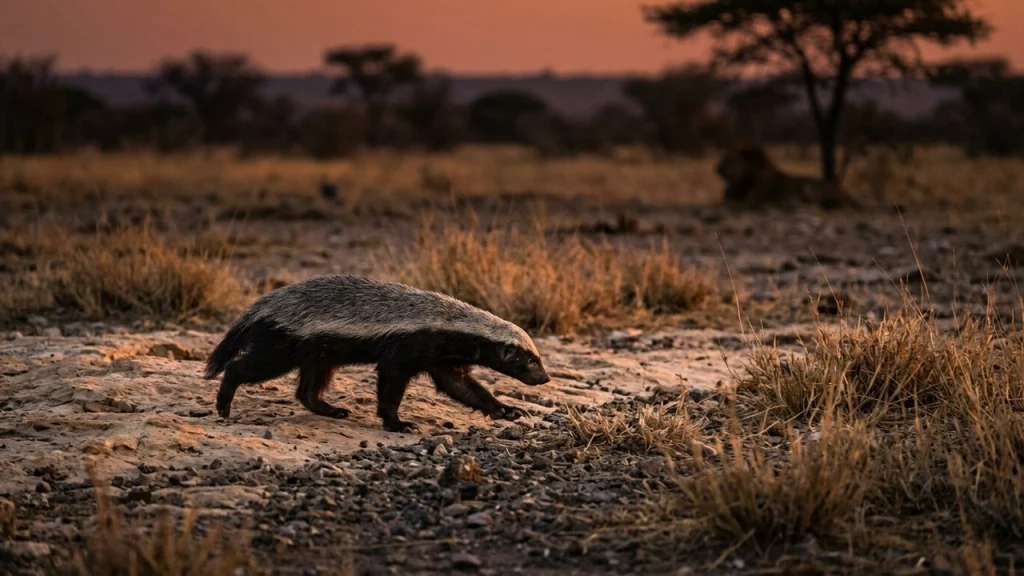
A small versatile forager meets a large specialist predator in these clashes. The badger eats mainly flesh, taking frogs, birds, snakes, small rodents and eggs, plus some plant matter. That menu keeps it in brush, burrows and rocky cover where it can dart to shelter.
Captured items span 2 to 2000 g, from tiny mice to large serpents. Such prey requires quick digging, pouncing and venom tolerance rather than prolonged wrestling. The skill set transfers well to escaping a big paw, because the badger already practices rapid twisting and biting at close quarters.
Probable tolerance to serpent toxins helps too, although researchers have not identified the precise physiological mechanism in this species. Field records show regular consumption of venomous snakes without fatal effects. Resistance to bites and stings supports the broader pattern of shrugging off damage that would disable many mammals of similar bulk.
Daily life also shapes encounters. These mustelids live alone and wander widely instead of defending a small patch. Females often cover around 10 km daily, while males may roam up to 27 km daily. Wide roaming increases the chance of meeting lions but also means the badger knows many burrows and escape routes.
Lifespan reflects that risky routine. Free living individuals often persist between 7 and 8 years, with injuries and predation cutting life short. Captive care removes those pressures and extends survival dramatically. The short wild tenure shows that deterrence works often but not forever.
When deterrence succeeds, the lion simply leaves. Dense fur, baggy hide, odor, noise and retaliatory bites raise handling costs beyond the value of a small carcass. When deterrence fails, the victim tends to be elderly or weakened, exactly the class lions are reported to kill.
Why the legend persists but the outcome rarely changes
Stories celebrate fearlessness because the badger truly stands its ground against lions, leopards and hyenas. Observers remember the charge, the growl and the sudden smell, then assume the little fighter could win. Biology tells a narrower story of successful escape, not successful predation.
In short, the honey badger wins by not losing. It cannot kill a lion, but its build, chemistry and behavior let it survive meetings that would doom most animals of its size.
- Bulk, reach and pride support favor the lion in a sustained fight
- Slippery hide, odor and countercharges favor the badger in a brief escape
- Hunger, age and injury decide which badgers become vulnerable
That survival skill, not killing power, earns its reputation.