

The short answer: Africa, Arabia and southern Asia
The honey badger, also called the ratel, ranges over most of sub-Saharan Africa and the Arabian Peninsula. It also lives on the Indian subcontinent, so its distribution spans two continents.
Its habitat is just as wide. The species is a habitat generalist, found from arid desert outskirts to rainforests. That flexibility explains how one animal can occupy so much of the map.
Where honey badgers live in Africa and Asia

Across Africa, the range covers most of the continent south of the Sahara. In Asia, zoo experts list the following areas:
- The Caspian Sea region of western Asia
- Turkmenistan
- Afghanistan
- Nepal
- Western India
The Arabian side of the range includes parts of several countries, among them Israel, Jordan, Iraq, Iran, Saudi Arabia and Oman. Combined, these regions make the honey badger one of the more widely spread members of its family.
Places where they are missing
Honey badgers are historically absent from the driest parts of the Sahara Desert. They are also missing along the Mediterranean coast, so the northern edge of Africa is largely off the map.
Habitats a honey badger can use
Honey badgers use a wide variety of habitats on land. They turn up in these main settings:
- Forests in tropical and subtropical zones
- Thorn forest
- Open woodland
- Forests or grassland along rivers
- Dry steppe, rocky hills and desert
Still, they mostly live in dry areas, although they also turn up in forests and grasslands. They can live from sea level up to 4,050 meters, so mountains do not stop them either.
Every habitat must offer one thing: shelter. Honey badgers need places to hide, such as burrows or rock crevices.
How honey badgers make a home
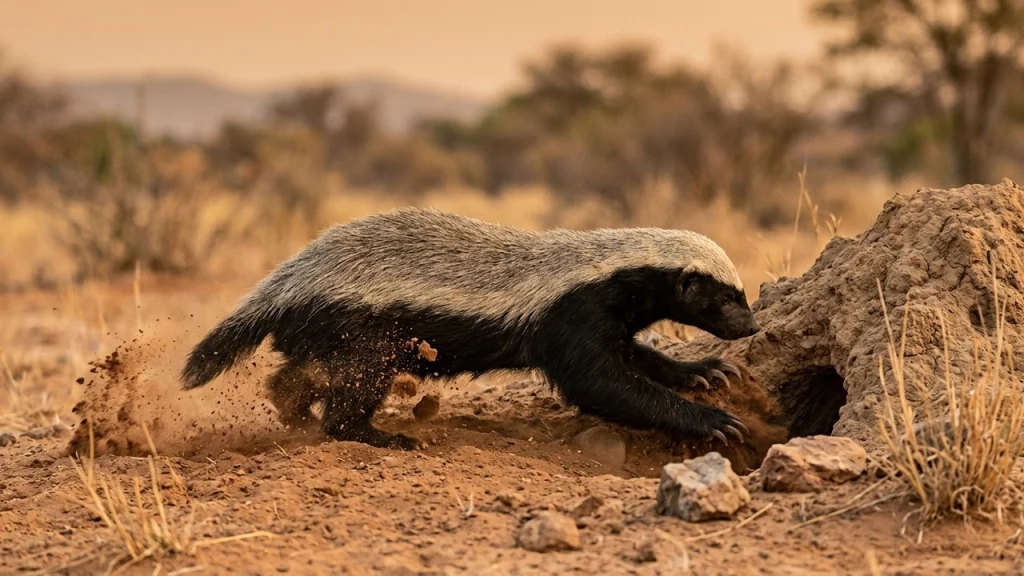
Digging their own burrows
Using long claws, a honey badger digs a burrow up to 3 meters long and 1.5 meters deep. The tunnel ends in a chamber where the animal rests.
Borrowing other shelters
Digging is hard work, so honey badgers also use what they find. They move into rock crevices, spaces under tree roots, old termite mounds and aardvark dens. They also occupy burrows left by animals such as Cape foxes and springhares.
Daily life inside the range
Being nocturnal, honey badgers are secretive and hard to watch in the wild. By day they mostly sleep, curled into a ball that shields the face and belly.
Honey badgers are mostly solitary, and their loose home ranges often overlap. Each animal covers a large range and travels daily to forage. Their opportunistic feeding lets the diet shift with seasonal prey supply, which suits a life on the move.
Adults measure 60 to 70 cm in body length and weigh 8 to 12 kg. African animals are slightly larger than Asian ones.
Is the honey badger’s range shrinking?
The IUCN Red List rates the species Least Concern, because it has a broad range and is not a dietary specialist, even though the population is declining. Numbers vary by region, but honey badgers are not common anywhere.
Human activity is probably the largest threat. Because home ranges are so large, tracking these animals and planning their conservation is very hard. Botswana’s population is listed on CITES Appendix III.