
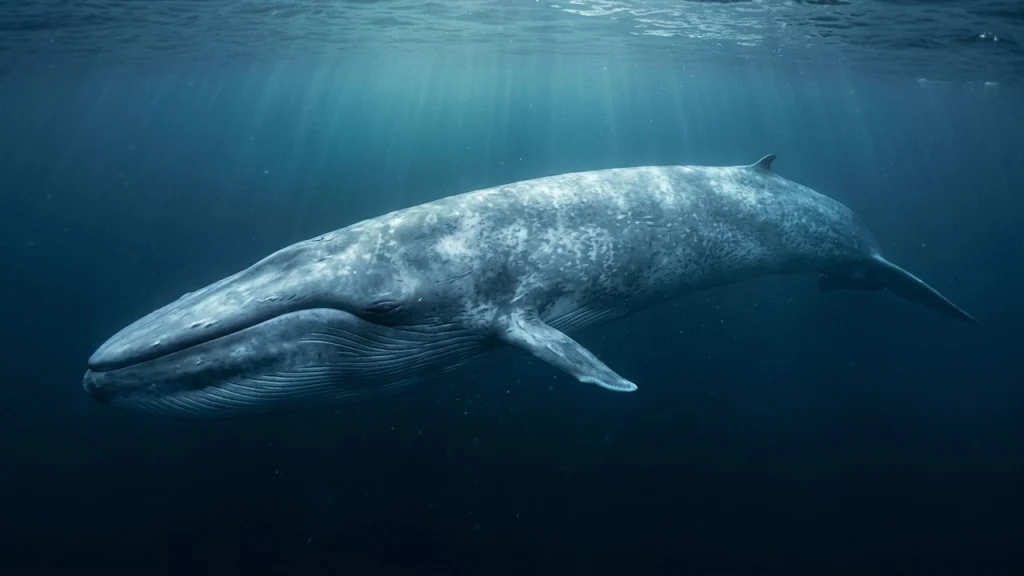
Yes, blue whales can reach and exceed 100 years of age in their natural oceanic habitats. Biologists have documented that a southern hemisphere blue whale (Balaenoptera musculus) reached 110 years old. Across wild populations, the average lifespan of these marine mammals falls between 80 to 90 years. Surviving for a century requires enduring harsh polar seas, high metabolic demands, and long annual migrations.
Comparative surveys confirm that these giant mammals rank among the longest-surviving species on Earth. Among surveyed marine mammals ranging in survival from 18 to 110 years, B. musculus demonstrated the longest longevity. Their survival past the century mark highlights remarkable adaptations, from waxy ear archives to advanced cellular defenses.
Reading the rings in earplugs and skeletal markers
Determining the chronological age of a free-ranging ocean giant presents unique scientific challenges. Researchers determine the age of deceased whales by counting the layers built inside their wax-like earplugs. These dense plugs accumulate inside the auditory canal, producing a durable structural record that lasts well after death.
Because the wax earplug operates as a natural matrix that preserves chemical profiles over time, scientists can analyze chronological records at a 6-mo resolution. This resolution allows researchers to reconstruct lifetime chemical exposure, dietary shifts, and hormonal baselines.
When earplug samples are degraded or unavailable, scientists inspect other biological structures. Beyond earplugs, biologists assess longevity in large cetaceans by examining ovarian scars in mature females, color changes in ocular lenses, and ridges along baleen plates. These supplementary anatomical clues help biologists corroborate age estimates across ocean basins.
Colossal proportions and Peto’s paradox
Across mammalian species, body dimensions correlate intimately with life expectancy. Statistical evaluations reveal that body mass and body length show a significant positive correlation with maximum lifespan across species.
This size benefit is especially clear when comparing cetacean suborders. Baleen whales attain greater dimensions in both length and mass than toothed whales in Odontoceti, aligning with longer maximum lifespans.
As the largest extant mammal on the planet, the blue whale averages 136 000 kg in adult body weight and maintains a maximum lifespan of 110 years. Historical scientific records confirm an exceptional specimen reaching 33.5 m in length, while the heaviest documented individual weighed 190,000 kg.
Maintaining immense bulk across a century raises fundamental questions regarding cancer risk. Even with cell counts approximately 1000 times greater than human bodies possess, large whales experience an unexpectedly low cancer risk throughout extended lifespans. Under standard biological models, trillions of dividing cells should increase tumor probability.
This intriguing observation forms the foundation of a famous biological concept. This pattern illustrates Peto’s paradox, which observes that massive, long-lived animals do not display higher lifetime cancer incidence than tiny, short-lived organisms. Massive whales solved this challenge through genetic mechanisms protecting tissues against cellular decay.
Molecular studies show that cetaceans carry enhanced tumor suppression systems. To safeguard longevity, the p53 pathway drives tumor suppression by directing target genes that trigger cell cycle arrest and induce programmed cellular apoptosis. Halting damaged cell cycles prevents tumors, preserving organs over a century of life.
Anatomy of a centenarian ocean giant
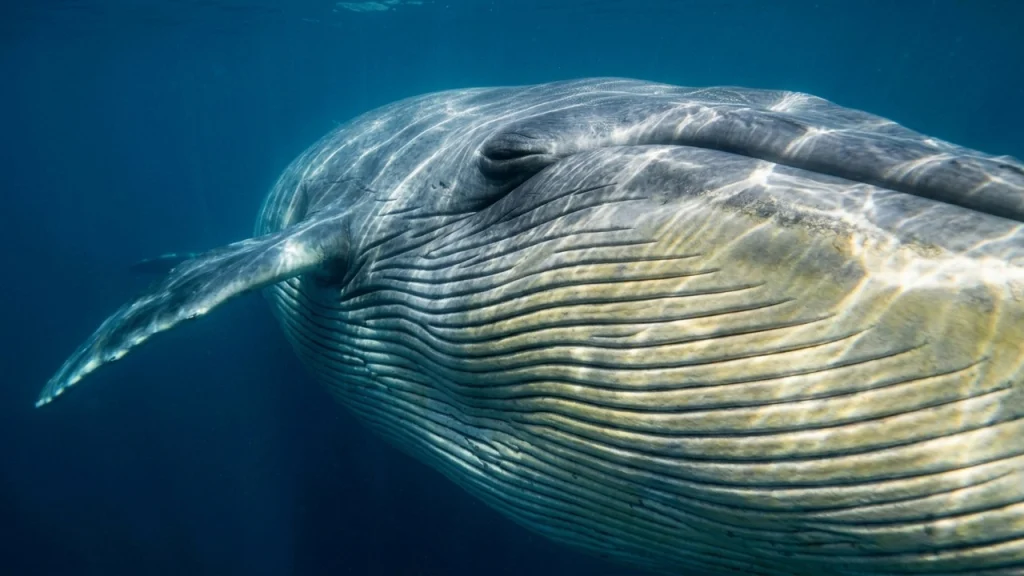
Sustaining a century-long existence requires anatomical features adapted for extreme energetic efficiency. Adult females typically surpass males in size, averaging 27 m in head-body length compared to 25 m for mature males.
In contrast to the animal’s enormous body length, one external feature is surprisingly modest. Despite the animal’s colossal frame, its dorsal fin remains remarkably small at only about 35 cm.
The skin on the underside often carries a distinctive visual marker created by marine life. Microscopic organisms frequently coat the ventral surface to impart a yellowish tinge, earning the species the historical moniker of sulphurbottoms.
Engulfing swarms of marine organisms requires an elastic throat structure. Along the underside, 50-90 throat grooves stretch backward from the chin past the navel, expanding during engulfment feeding.
Life cycle from polar calf to ocean elder
A female carries a developing calf through an estimated pregnancy lasting approximately 10 to 12 months.
Nourished by maternal milk, the young calf grows rapidly during its initial months of life. Calves nurse for over half a year before weaning occurs around 6 to 7 months while traveling toward polar feeding corridors.
Adolescents spend multiple seasons feeding and growing before entering the reproductive population. Young blue whales typically reach sexual maturity between 5 to 15 years.
Modern chemical sampling of earplug laminae provides direct physical timelines for wild individuals. Reconstructed testosterone timelines from earplug tissue revealed that an individual male reached sexual maturation at approximately 10 y of age. This technique links growth layers with pubertal surges, dating maturity accurately.
Surviving for decades also exposes an animal to fluctuating oceanic and environmental conditions. Endocrine tracing throughout the life of that male whale indicated a doubling of baseline cortisol concentrations. Tracking cortisol accumulation reveals how individual whales experienced physiological stressors.
Fueling a century of life on tiny crustaceans
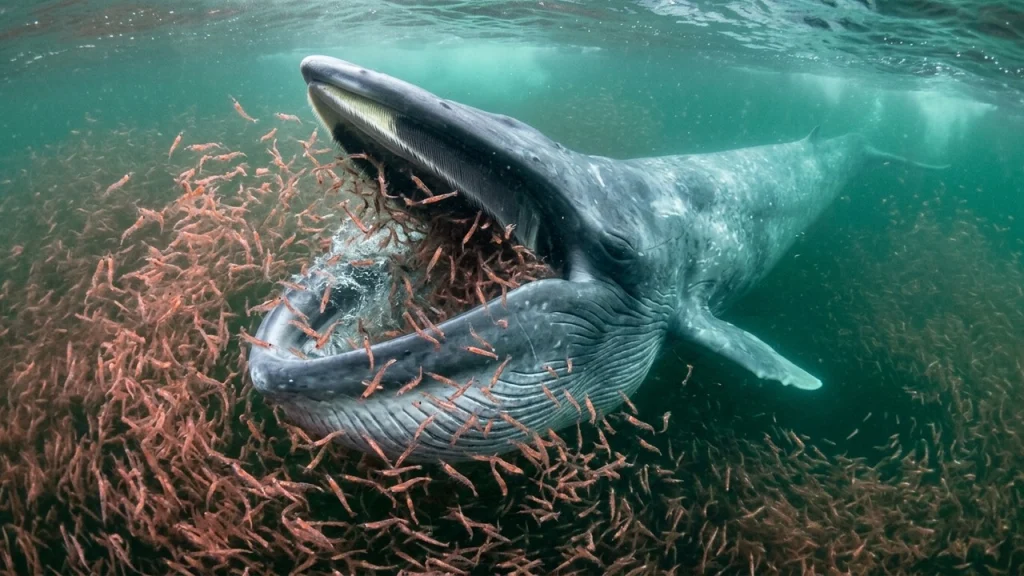
Fuelling an immense body across a century requires consuming vast quantities of high-energy food. These gentle giants nourish their bulk by sieving vast quantities of seawater through baleen plates suspended from the upper jaw.
During summer feeding peaks in icy polar waters, food consumption reaches extraordinary levels. During periods of peak summer feeding, the largest adults can consume up to 6 tons of krill daily.
Even during standard foraging windows, blue whales process enormous volumes of prey each day. Under normal foraging conditions, mature individuals typically consume 3 to 4 tons of krill daily. This strategy delivers sufficient energy to maintain organ systems over a century.
Prey selections reflect geographical distribution across different ocean basins:
- In southern polar foraging grounds, their diet centers on Euphausia superba, an abundant planktonic crustacean measuring less than 7 cm.
- Across northern oceans, herds consume crustaceans like Thysanoessa inermis and Meganyctiphanes norvegica alongside minor amounts of small fish.
Acoustic communication across oceanic basins
Navigating open oceans and maintaining social connections over ten decades requires sharp senses. While their olfactory and visual senses remain comparatively weak, their auditory perception is exceptionally keen.
Blue whales generate some of the most powerful vocalizations in the natural world. Producing deep groans, moans, and low pulses, blue whale calls can travel across open water to reach listeners up to 1,000 miles away under favorable oceanographic conditions.
Efficient swimming mechanics further preserve vital metabolic energy across a century of travel. When cruising and feeding, blue whales travel at about 5 miles an hour, though they can surge beyond 20 miles an hour in brief sprints.
Surviving modern ocean hazards into old age
Across global ocean basins, scientists divide blue whales into distinct geographical populations. Modern cetacean taxonomy divides the global population into five currently recognized subspecies.
Historic commercial exploitation drastically altered the age demographic of oceanic herds. Uncontrolled industrial whaling severely depleted oceanic stocks during the early 1900s, leaving living populations at a small fraction of historical numbers despite current global gains.
Today, recovering populations encounter new human-made threats as they navigate coastal and pelagic zones. Collisions with maritime ship traffic and accidental entanglement in commercial fishing gear remain the primary threats confronting the species.
Sources
- NOAA Fisheries: Blue Whale
- Animal Diversity Web: Balaenoptera musculus (blue whale)
- Frontiers in Genetics: Life Expectancy in Marine Mammals Is Unrelated to Telomere Length but Is Associated With Body Size
- Proceedings of the National Academy of Sciences: Blue whale earplug reveals lifetime contaminant exposure and hormone profiles
- Zoological Research: Evolution of p53 pathway-related genes provides insights into anticancer mechanisms of natural longevity in cetaceans