
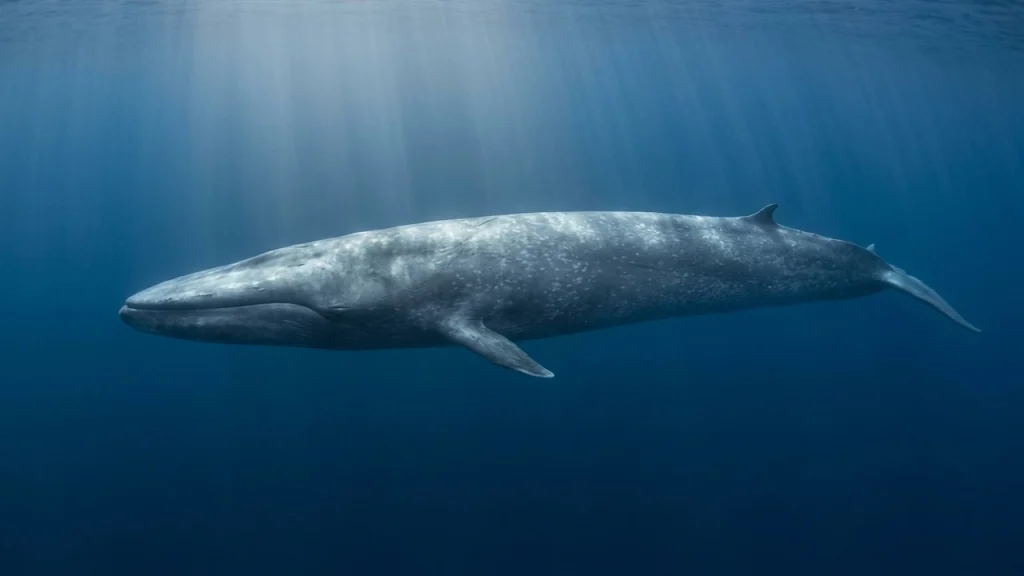
A blue whale cruises at about 5 miles an hour and can burst to more than 20 miles an hour in brief sprints. Blue whale swimming velocity shifts dramatically depending on whether the animal cruises across ocean basins or bursts forward in an explosive sprint.
These remarkable sprint bursts push the absolute physical limits of what Earth’s largest animal can generate underwater. ‘Racing’ blue whales reach about 7.5 m/s, with faster bursts, often while performing very low breaches. These high-speed maneuvers demand extraordinary physical exertion that cannot last long. Biophysicists suggest that forward velocity may be limited by muscular power output alongside hydrodynamic constraints on lunate tail propulsion.
Cruising velocity and energetic constraints
Sustaining high speeds in water requires immense metabolic power, especially for creatures of titanic proportions. In northern basins like the North Atlantic and North Pacific, adults measure up to about 90 feet while exceeding 100,000 pounds, whereas Antarctic giants reach up to about 110 feet while weighing more than 330,000 pounds. Propelling such enormous bulk through a dense liquid medium demands an energy-conserving traveling gait during migrations. Consistent with Mysticete dimorphism, females are generally larger than males of the species.
Because long journeys span thousands of miles between polar feeding areas and tropical nurseries, maintaining a moderate cruising speed prevents premature exhaustion. Across the globe, these massive cetaceans inhabit all oceans except the Arctic. Their hydrodynamic, torpedo-shaped profiles reduce profile drag, enabling efficient swimming during long oceanic transits.
Kinematics of high-speed predatory lunges
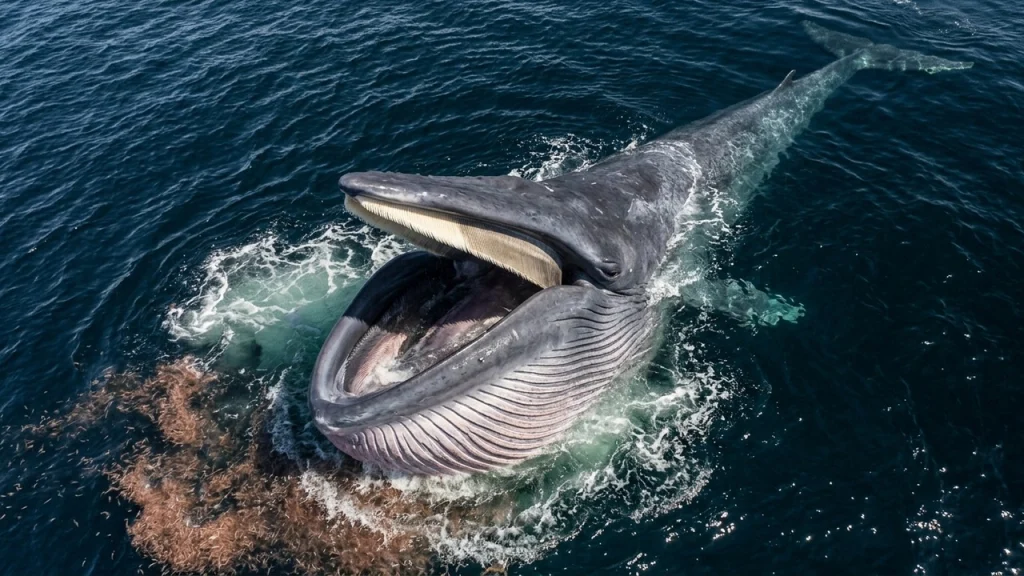
Beyond sustained cruising, speed plays a vital role in how blue whales capture their prey. As rorquals, they utilize a specialized feeding method known as intermittent lunge feeding. During feeding rushes, engulfment speeds reaching up to 5 m s −1 easily outrun fleeing krill (<1 m s −1 ). A documented 25.2 m individual achieved 5.7 m/s during its fastest lunge, consuming an estimated 9.5 MJ in that single burst.
High-resolution aerial observations provide fine-scale measurements of these dynamic feeding strikes near the surface. Drone observations show that the mouth starts opening at 3.33 m s −1 during strike, expanding to a widest gape angle of 33° approximately 1.5 s after strike. Sensory instruments verify that highest speed coincided with mouth opening, whereas peak deceleration coincided with maximum gape. The total duration of the lunge event, measured from mouth opening until full closure, spans 4.14 s.
Water engulfment and hydrodynamic drag
Opening the jaws at high velocity creates enormous hydrodynamic resistance, causing rapid deceleration. During a single feeding surge, an adult whale engulfs about 80 m 3 of water in 7 s, while a continuous ram feeder like a bowhead whale would need 25 s to filter the same volume. This rapid intake allows the whale to capture dense aggregations before the swarm scatters. Because of immense drag during throat expansion, the energetic cost of engulfment is estimated up to 50 times baseline metabolic levels of a similarly sized land mammal.
Once the engulfment phase concludes, the animal decelerates sharply and returns to an energy-saving posture. After engulfing the swarm, the whale rights its body and descends at a mean relative speed of 1.22 m s −1, waiting until 2:26 min after the preceding breath to resurface. This slow descent allows the animal to process the captured prey while recovering from the intense metabolic burst.
Foraging strategies and dive mechanics
Blue whales must balance extreme energy expenditures against the caloric return of each feeding plunge. Although krill forms the primary diet of blue whales, small fish and copepods occasionally supplement their food intake. To forage, these rorquals filter feed by swimming toward dense schools with open jaws while inflating their expandable throat pleats. After shutting their jaws, they push the trapped water out using the tongue, allowing fringed baleen plates to retain the prey.
Because lunging consumes substantial oxygen reserves, whales carefully assess patch quality before committing to multiple strikes. When encountering dispersed prey, foraging whales minimize oxygen use by curtailing the number of lunges performed during each dive. Conversely, feeding individuals maximized energy intake by ramping up lunge rates when pursuing dense swarms of prey, despite heavy oxygen expenditure. This flexible behavioral strategy lets the animal manage its energy budget as prey density changes during deep foraging dives.
Depth and respiration cycles
Locating dense aggregations often requires deep exploration into the water column. Foraging occurs mostly at depths less than 100 m, though harpooned animals have dived as deep as 500 m. These dive profiles highlight the species’ capability to manage pressure and oxygen depletion during deep plunges.
After completing a foraging sequence below the surface, the whale must return to the air to replenish its oxygen stores. Routine dives last from 10-20 minutes, followed by ventilation intervals punctuated by 8-15 blows at the surface. Upon exhaling forcefully, the vertical spout can reach almost 10 m into the air. These tall blows clear stale air from massive lungs before the whale prepares for another descent.
Long-distance migrations and acoustic communication
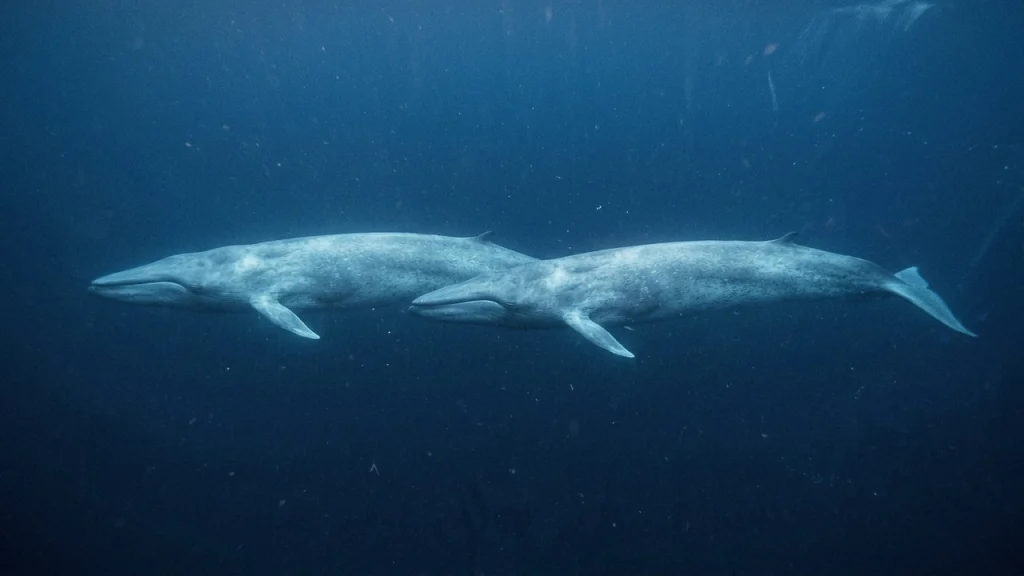
Swimming speed is closely tied to annual life-history patterns across global ocean basins. Populations typically spend summers feeding in cold polar regions before embarking on lengthy migrations toward warm equatorial seas for the winter. These seasonal movements align with fluctuating ice cover and local peaks in marine productivity.
Calving occurs in tropical and subtropical waters where calm, warm conditions protect vulnerable young. Newborn calves arrive in warm, low latitude waters throughout the winter months following the migration from rich polar feeding grounds. Calves travel alongside their mothers, gradually developing the muscle mass and endurance necessary for polar voyages.
Maintaining contact across vast ocean basins requires specialized acoustic adaptations. Producing resonant pulses, groans, and moans, their powerful low-frequency calls are thought to carry across distances of up to 1,000 miles away in favorable ocean environments. These deep vocalizations allow traveling whales to coordinate movements and locate mates across vast oceanic expanses.
Human impacts, speed limits, and conservation
While blue whales can accelerate swiftly in short bursts, their cruising velocity makes them vulnerable to modern industrial shipping. Collisions with vessels cause fatal injuries across their habitat, with elevated risk near busy shipping lanes and ports where fast-moving cargo ships transit. Heavy commercial traffic frequently overlaps with coastal upwelling zones where krill gathers in high concentrations.
To protect these endangered cetaceans, maritime authorities implement speed regulations in designated whale corridors:
- Vessel speed restrictions: To safeguard swimming whales, wildlife managers advise mariners to reduce speeds to 10 knots or less across transit corridors.
- Reduced strike mortality: Lower shipping speeds provide traveling whales more time to detect and evade oncoming hulls.
- Entanglement mitigation: Heavy commercial equipment poses another hazard, as individuals can become entangled in fishing gear and drag heavy ropes or become anchored in place.
- Habitat monitoring: Tracking shipping corridors helps authorities redirect commercial traffic away from critical foraging areas.
Historical commercial whaling inflicted catastrophic damage on global blue whale numbers. While natural speed once offered safety, maritime inventions and steam vessels between 1860-1920 allowed whalers to hunt the swift mammals. Intensive commercial operations decimated populations, resulting in an estimated total kill of 350,000 animals during the twentieth century. Unregulated hunting caused catastrophic declines, placing the species on the edge of extinction by the 1960’s.
Today, strict international protections and maritime vessel speed limits support the slow recovery of these marine giants. Understanding how fast blue whales swim, forage, and migrate provides crucial biological data for designing safer shipping corridors and ensuring their long-term survival.
Sources
- NOAA Fisheries: Blue Whale | NOAA Fisheries
- Animal Diversity Web: Balaenoptera musculus (blue whale)
- eLife Sciences Publications, Ltd: Energetic and physical limitations on the breaching performance of large whales
- American Association for the Advancement of Science: Blue whales (Balaenoptera musculus) optimize foraging efficiency by balancing oxygen use and energy gain as a function of prey density
- PeerJ, Inc.: Insight into the kinematics of blue whale surface foraging through drone observations and prey data