
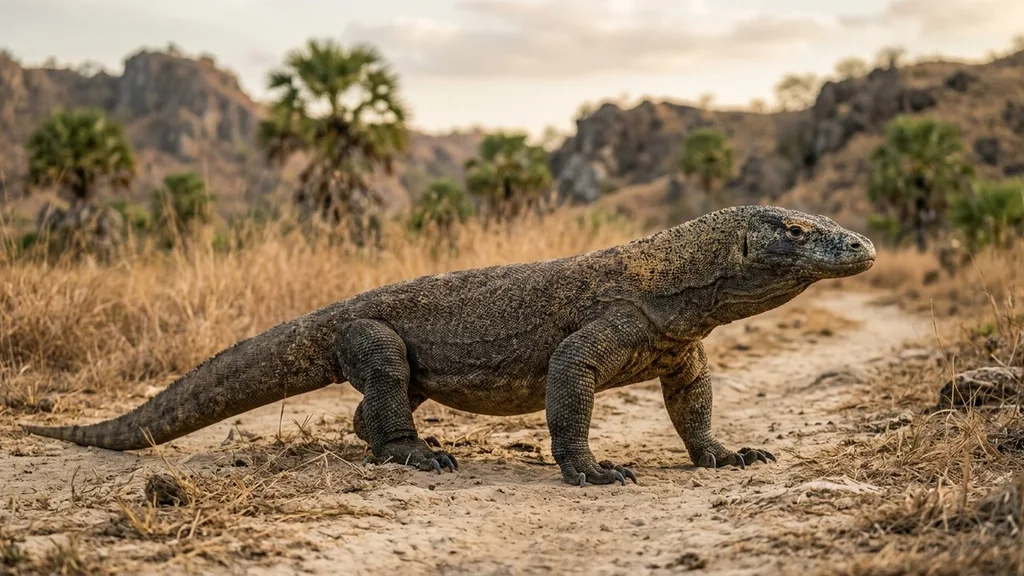
A wild Komodo dragon lives roughly 30 years, according to the Smithsonian’s National Zoo, which adds that researchers have not yet settled the question. San Diego Zoo Wildlife Alliance gives a similar ceiling, putting the maximum at 30 years in their native islands.
That average hides a striking split between the sexes. Long-term field research suggests females rarely pass about 31 years, while males keep growing until around 62 and probably survive well beyond that. In zoos, males have a median life expectancy near 20 years.
Komodo dragon lifespan at a glance
The numbers below come from zoo fact sheets, a zoo news release and a peer-reviewed field study:
- Wild dragons in general: about 30 years, with the science still open
- Wild females: oldest known individuals around 31 years
- Wild males: final adult size reached at about 62 years, with a longer life likely
- Males in human care: median life expectancy of about 20 years
- A notable zoo elder: Murphy, a male at the Smithsonian’s National Zoo, reached 26
The Komodo dragon (Varanus komodoensis) is the largest and heaviest lizard on Earth, and it is also one of the few lizards whose bite delivers venom. Its size and long life are linked: like other big reptiles, it grows for decades rather than stopping at adulthood.
Why male and female Komodo dragons age so differently
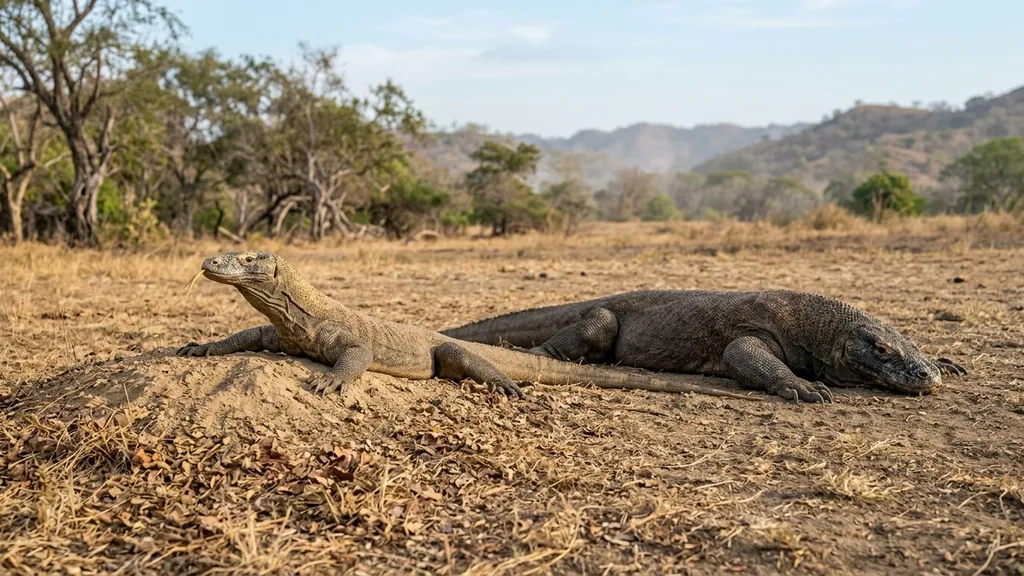
The clearest picture of wild longevity comes from a field study published in PLoS ONE by Laver and colleagues. The team measured growth in 400 individually marked dragons that were captured between 2002 and 2010.
Growth curves reveal the gap
Up to roughly 7 years of age, males and females are about the same size. After that, their paths split. Males keep adding length until they level off at around 62 years, and the authors think they can outlive that point. Females never hit a size plateau at all: the oldest ones the team caught, at about 31 years, were still getting bigger when they vanished from the records.
No females turned up beyond that age, which the researchers read as a sign that females are simply gone from the population by then. Across the two sexes, the difference in life expectancy works out to about 30 years.
The high price of nesting
The explanation lies in reproduction. The study estimates that females mature somewhere between 8 and 11 years, judged from the smallest females seen nesting. From that point on, most of their energy goes into eggs rather than growth.
Nest guarding is especially draining. The largest females are often in poor condition because they go without food for long stretches while watching over their nests. The Smithsonian notes that eggs incubate for about nine months, and a female may stay on top of the nest to defend the clutch.
Males, by contrast, pay far lower reproductive costs and face no predators as adults, which the authors link to their better survival. San Diego Zoo Wildlife Alliance adds that females skip breeding in some years, using these breaks to rebuild the reserves spent on producing eggs.
A dangerous start to life
Surviving to old age is only possible for dragons that make it through a perilous childhood. Once the eggs hatch, the mother offers no care at all, and the young are on their own.
Life in the trees
The early years are the riskiest stage, since hatchlings are eaten by a range of predators, including adult Komodo dragons. To escape cannibalistic elders, the young climb into trees and live there. According to San Diego Zoo Wildlife Alliance, they come down to the ground once they reach about 4 feet (1.2 meters) in length, at around 4 years of age.
Growing into a giant
By their fifth birthday, young dragons reach about 55 pounds (25 kilograms) and an average length of 6.5 feet (2 meters). At that point they start taking bigger prey, such as goats, wild boars and deer, with deer being the favorite. Growth never fully stops: the Smithsonian notes that dragons keep getting slowly bigger for their entire lives.
This steady growth explains the size of wild adults, which usually weigh about 154 pounds (70 kilograms). The largest verified dragon measured 10.3 feet (3.13 meters) and tipped the scales at 366 pounds (166 kilograms). Since males keep growing for decades longer than females, the heaviest individuals tend to be males.
How long Komodo dragons live in zoos
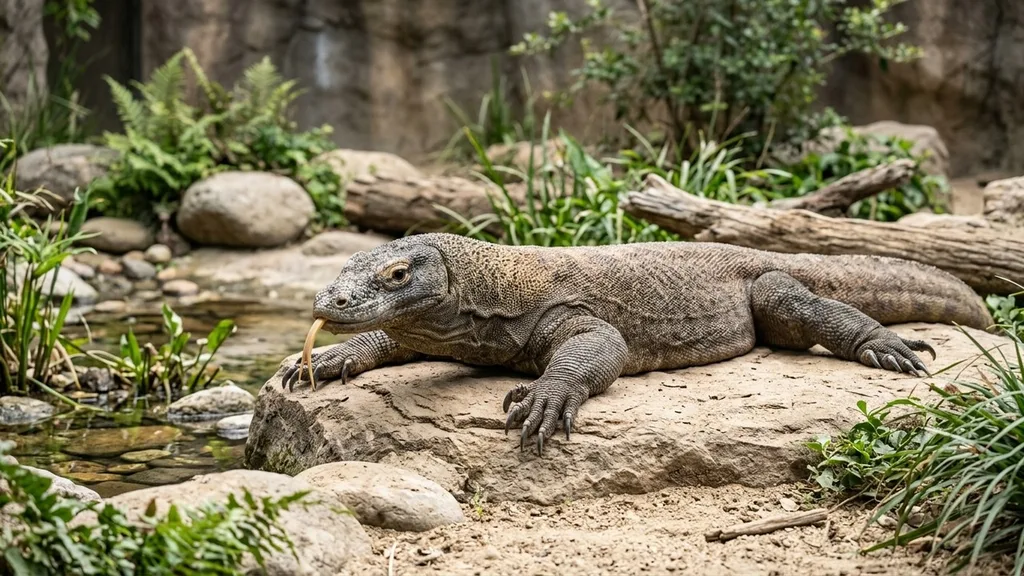
Captive dragons do not outlive their wild relatives. The Smithsonian’s National Zoo reports that male Komodo dragons in zoos have a median life expectancy of about 20 years.
Murphy, a male at the Smithsonian, shows what a long zoo life looks like. Born at Zoo Miami, Florida, in October 1998, he died on December 23, 2024, at 26 years old. In his final years he suffered from degenerative joint disease in his knees, elbow and ankles, and fluid had built up around his heart.
Why lifespan matters for Komodo dragon conservation
A long life and a late start to breeding make any species slow to recover from losses. The Laver study points out that this longevity has broad effects on population dynamics, and that the early deaths of females could tilt wild populations toward a surplus of males.
A shrinking population
The Komodo dragon is now listed as Endangered by the International Union for Conservation of Nature. San Diego Zoo Wildlife Alliance reports that the wild population fell from 5,000 to 3,500 between 1981 and 2021, a 30% drop over 40 years that moved the species up from Vulnerable. As of 2021, those dragons were split into eight subpopulations on six islands, with almost 70% living on Komodo and Rinca.
Threats ahead
Rising seas pose a new danger: between 30 and 70% of the dragon’s native range could disappear by 2040. Protection has helped. Komodo National Park, created in 1980, and strict laws against poaching have shielded the dragons, although illegal hunting has not stopped entirely.
The bottom line on Komodo dragon longevity
Most sources put the wild lifespan of a Komodo dragon at around 30 years, but sex makes a big difference. Females burn through their reserves producing and guarding eggs and seldom live past about 31, while males can pass 62. In zoos, males typically live about 20 years, with exceptional individuals like Murphy reaching their mid-twenties.
Sources
- Smithsonian’s National Zoo and Conservation Biology Institute: Komodo dragon
- Smithsonian’s National Zoo and Conservation Biology Institute: Elderly Komodo Dragon Dies at the Smithsonian’s National Zoo and Conservation Biology Institute
- San Diego Zoo Wildlife Alliance: Komodo Dragon
- Animal Diversity Web, University of Michigan Museum of Zoology: Varanus komodoensis (Komodo dragon)
- PLoS ONE (via PubMed Central): Life-History and Spatial Determinants of Somatic Growth Dynamics in Komodo Dragon Populations