
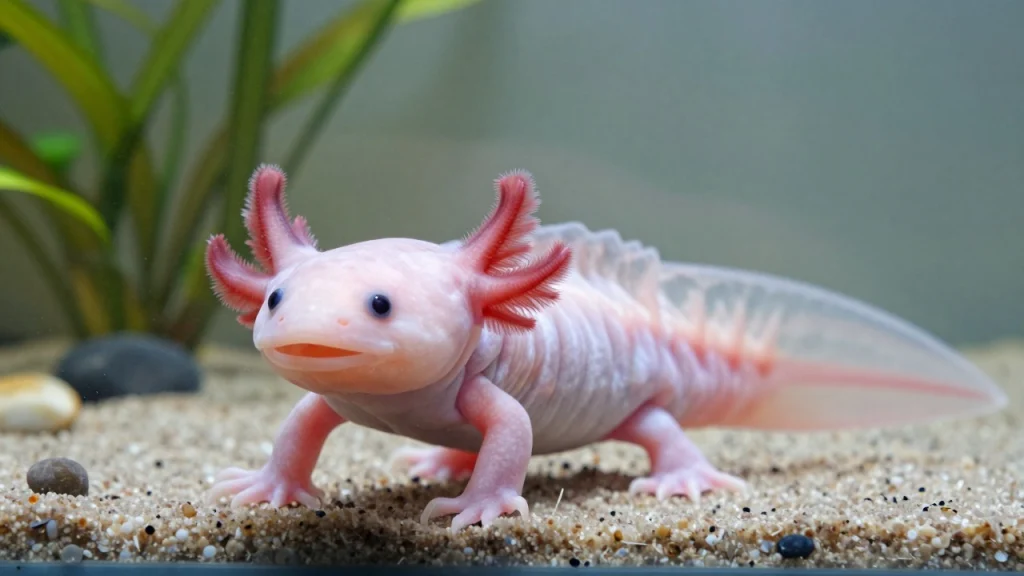
An axolotl can bite, and it does so often, but the bite is a feeding reflex rather than an attack, and a person is never the target. Zoological references record no negative effect of this species on humans at all. What a bite produces is a startling pinch from tiny teeth, not a wound worth treating.
The interesting part of the question is that the risk runs in the opposite direction. The axolotl is the fragile one. Its skeleton is mostly cartilage, its skin lets chemicals pass straight through, and the same reflex that can snap at a fingertip is what leads axolotls to bite each other’s limbs off. The animal doing the biting is the one worth handling carefully.
Why the bite happens at all
The strike starts with detection, not intent. Axolotls can sense electrical fields, and they combine that sense with vision and chemical cues to find prey and read their surroundings. A moving object in open water reads as a meal, so the feeding response fires on motion rather than on identity.
That reflex is strong in juveniles. Laboratory researchers describe young axolotls as suction feeding voraciously whenever they sense food items moving nearby, and in crowded bowls, food and the limbs of their own siblings often end up in the same spot in the water. When that happens the appendage gets pulled in and damaged. The same mechanism that turns a wiggle of food into a swallowed meal turns a sibling’s limb into a casualty.
A bite is a feeding strike, not a display of temper. There is no defensive routine built around biting, and the strike ends the moment whatever moved is inside the mouth.
What the teeth are built to do
Teeth are present, but zoo biologists describe them as underdeveloped, and the same accounts still call the axolotl an effective predator. It hunts by inhaling food rather than chewing it, drawing down worms, crustaceans, insect larvae, mollusks and even small fish. Gravel comes along with the meal and does the grinding, the way birds use grit to break food down.
A developmental study of axolotl dentition describes the arrangement in detail. The teeth sit in two arcades, with single rows on the premaxillary, maxillary and dentary bones, and multiple rows of vomerine, palatine and coronoid teeth behind them. The back of the mouth is the business end: tooth patches at the rear grip the prey once it has been drawn in, then release, reorient and re-grip it repeatedly until the animal manages to swallow. Holding and repositioning a wriggling meal in water is the whole job, which is why the meal is swallowed whole and gravel does the grinding.
So the honest answer to the original question is a qualified one. The teeth are small, they are built for gripping, and the mouth closes quickly because the animal is trying not to lose its food. It is a pinch, not a puncture.
Scale: what a bite has to work with
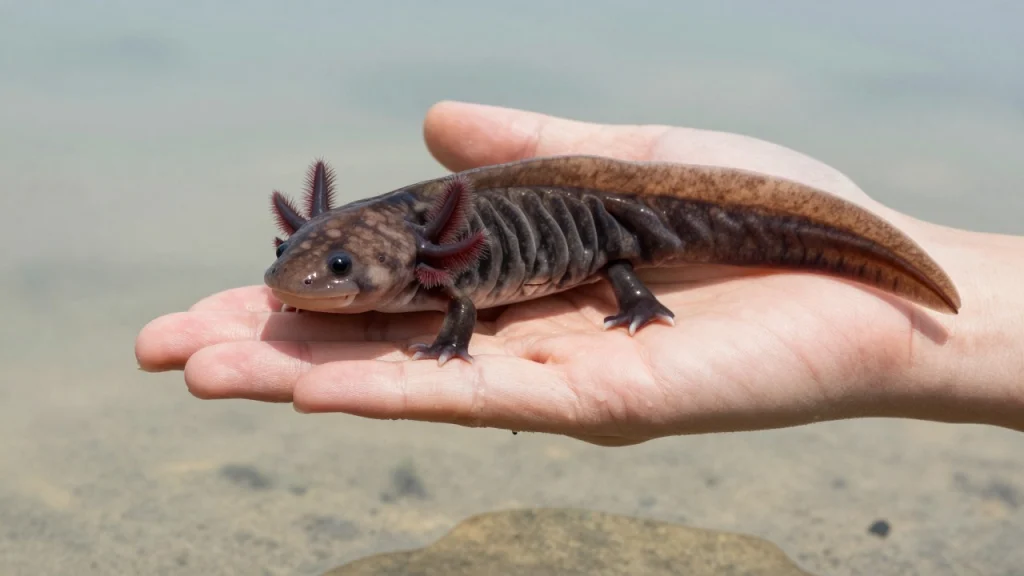
Size sets the ceiling on what any bite can do. Axolotls average 20 cm (9 inches) in length, and exceptional individuals exceed 30 cm (12 inches). The head itself measures 40 to 46 mm, so the whole biting mechanism is compact. Adults are light animals: males typically weigh about 125 to 130 g, and females about 170 to 180 g.
Nothing about that build is designed for breaking skin on a hand. Consider what the clamp is actually for. An axolotl sharing a pond has to hold onto prey that fights back, and it must keep a fish or worm pinned against a mouth that swallows without chewing. Against a human finger, the same mechanism delivers a brief, startling pinch and little else.
When axolotls really do hurt each other
The clearest evidence about the bite comes from animal-to-animal data rather than human reports, and it shows a serious weapon once scaled down to salamander size. A survey of a captive breeding colony found evidence of bite injury in 80% of the larvae at the moment they were moved from group housing into individual housing, and 65% of all limbs examined carried damage consistent with a recent bite rather than a faulty regrowth. Roughly half of the 717 adults surveyed also showed limb or digit abnormalities, including missing or extra digits and digits growing from unusual positions.
Regeneration is the axolotl’s answer to that damage, and it mostly works. Limbs regrow, sometimes with the wrong number of digits, and the same study estimated that only 43% of larvae that suffered a bite ended up with four normally formed adult limbs. The wound heals, the architecture does not always come back right. Researchers also report larger larvae opportunistically cannibalizing smaller ones, which places the species at the top of its own food chain.
The pattern is explained by density. When many animals share a small volume of water, a sibling’s movement becomes indistinguishable from prey movement, and the suction feeding reflex does what it was built to do.
The predator with almost no enemies
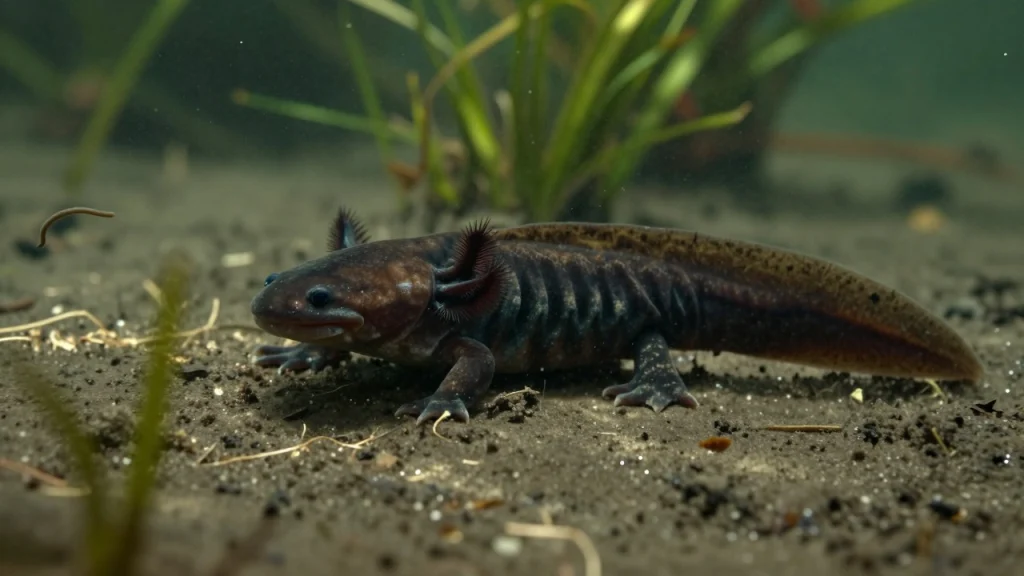
Wild axolotls have few native predators. Native crayfish and introduced fish eat larvae and juveniles, and herons and storks will take adults on occasion, but the species evolved in high altitude lakes where it sat at the top of the food web. It was the top predator of its own environment, eating anything it could catch, including its own kind.
That history explains the light build. An animal with no large predators to fear and a soft body to protect has little reason to invest in a heavy skull or a powerful bite. Instead it invests in a wide head, feathery external gills, a finned tail and a striking ability to repair itself, and it relies on camouflage rather than armor. In the wild its dark brown or black coloring blends with lake silt.
Where axolotls live, they are mostly still and mostly hidden. Adults and larvae rest on the bottom of the lakes and canals and walk rather than race, swimming with an eel-like undulation of the body and tail built for maneuvering through submerged vegetation. They shelter by day in mud and among aquatic plants, and they become active at night, when hunger makes the feeding reflex far more likely to fire.
Handling risk runs the other way
Experts advise against unnecessary handling of axolotls, and the reason is the animal’s own vulnerability. Their skin is permeable, so natural oils and even soap residue can harm it, and much of the body is cartilage, which turns an injury to them into something far more serious than it looks. An axolotl held roughly out of the water is a soft-bodied animal in a fragile state, and that is a bigger concern than anything its teeth can do to a person.
Feeding is the moment to be careful, and the care needed is about hygiene rather than pain. Because a feeding response can be triggered by a moving finger, food is best offered with a tool and hands are best kept out of the tank during a session. A mouth that closes on any nearby movement is why a feeding session needs some space around it.
A species whose bite is the least of its problems
The name comes from the Nahuatl language of the Aztecs, and the word has been translated as water dog, water servant, water sprite and water slave among others, all of them tied to the Aztec god Xolotl, who is said to have transformed himself into this animal. The permanent larval look of the animal is misleading in exactly the way the question about biting reveals, because the mouth that worries people is a feeding tool built for gripping pond prey.
The real pressures sit elsewhere. The Xochimilco and Chalco lake system that once held the species has been drained and fragmented, and axolotls now survive at only three isolated sites in southern Mexico City. Researchers assessing the population estimated roughly 50 to 1,000 adults left in the wild, which is why the IUCN Red List places Ambystoma mexicanum in the Critically Endangered category and why trade is governed under CITES Appendix II.
Habitat has been lost and degraded, the water is polluted, and the city keeps expanding. Fish introduced into the lakes now compete with axolotls and eat their young. Wild axolotls can live 10 to 15 years, so a population that small cannot rebuild on its own. In captivity longevity runs shorter, with expected laboratory longevity of 5 to 6 years.
The answer to the original question is therefore plain. An axolotl bite is a pinch from small, gripping teeth, delivered by reflex and aimed at food, and it is not a danger to people. The caution that is warranted runs the other way, toward a fragile animal that should not be picked up.
Sources
- San Diego Zoo Wildlife Alliance: Axolotl | San Diego Zoo Animals & Plants
- Animal Diversity Web: Ambystoma mexicanum (Salamandra ajolote)
- National Geographic: Axolotl | National Geographic
- San Diego Zoo Wildlife Alliance Library: Axolotl (Ambystoma mexicanum) Fact Sheet
- Frontiers in Cell and Developmental Biology: Oral and Palatal Dentition of Axolotl Arises From a Common Tooth-Competent Zone Along the Ecto-Endodermal Boundary
- Regeneration (Wiley): Probability of regenerating a normal limb after bite injury in the Mexican axolotl (Ambystoma mexicanum)