
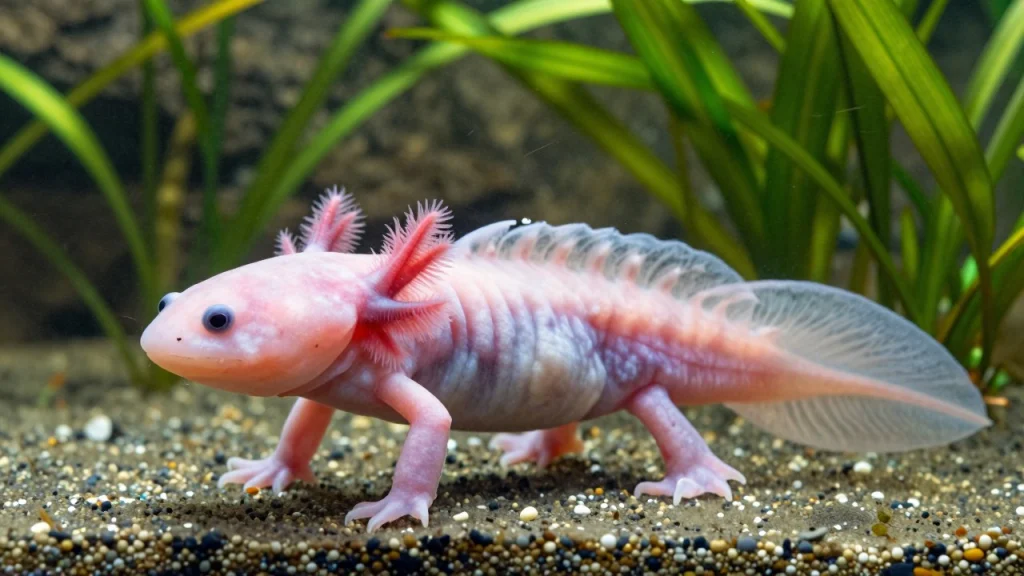
The Mexican axolotl, Ambystoma mexicanum, spends its whole life in water as a freshwater salamander, and that fully aquatic plan explains why fingers injure it so fast.
Specialists recommend leaving these animals untouched except during essential care, because chemical uptake through the skin, a soft body structure, heat and drying outside water, and a sharp stress reaction act together during even brief contact.
Short answer: contact injures skin, body and stress balance
The main problem is permeable skin. The outer covering allows water and gases to move inward and outward, so residues from human skin, lotion, sunscreen and soap can enter the circulation and poison the animal. Dry fingers also drag across mucus and surface cells, which opens tiny wounds where fungi and bacteria settle.
The second problem is a soft, cartilage-supported body. The skeleton stays largely flexible rather than hard and bony, so a squeeze or a slip from the palm can bruise tissue, bend gill stalks or tear the tail fin. Feathery outer gills look sturdy in photos, yet they work as delicate respiratory sieves with a large surface for gas transfer, and pressure collapses them.
The third problem is rapid physiological stress. Laboratory work that simulated transport and routine holding found hormonal shifts that lasted for hours, which shows that lifting means more than momentary fright. Together, contamination, mechanical damage and stress explain the simple guidance to watch axolotls instead of holding them.
Skin that lets the surroundings in
Amphibian skin differs completely from reptile scales or mammal hide. It stays thin, moist and glandular, and it remains open to water and gases at all times. That design supports breathing and salt balance in lakes, but it also means the animal cannot block dissolved substances.
In lakes, the same openness helps an axolotl take up oxygen through the surface while its gills and rudimentary lungs assist. Out of water, the mechanism reverses into a liability, because evaporation strips moisture and heat within minutes. Warm, dry palms therefore deliver two insults at once: unwanted chemicals move inward, while water and coolness move outward.
This vulnerability matters more for axolotls because adults never switch to a tougher terrestrial hide. They keep larval traits for life, a pattern biologists call neoteny, so the surface stays baby-soft for years. A brief rinse cannot undo damage once oils or detergents coat the filaments, and repeated touches gradually erode disease resistance.
A soft aquatic body with exposed breathing gear
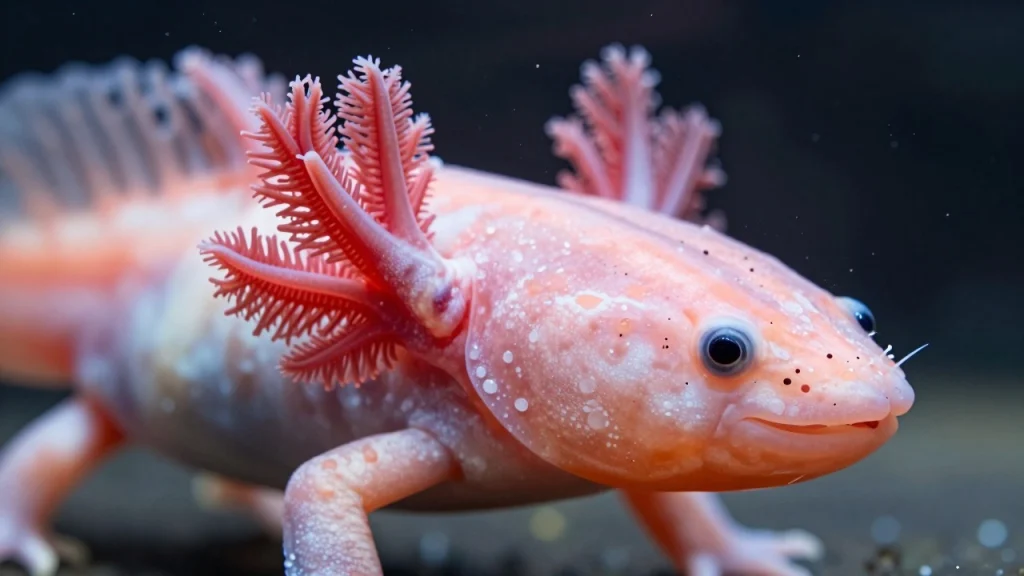
An adult axolotl carries a broad, flattened head, a long muscular tail and a fin fold along much of the body. Branched gill crowns extend behind the head, and webbed feet help it walk across mud rather than swim long distances. The whole arrangement suits still canals and lake bottoms, not lifting or petting.
The species skips full transformation to land life. It becomes reproductively mature while keeping juvenile gills, tail fin and aquatic habits. Functional lungs develop, yet the animal still relies heavily on outer gills and skin breathing. Damage to those structures forces harder work from the lungs and heart, which reduces feeding and growth.
Size increases the risk during careless handling. Zoo records describe adults from 6 to 18 inches long, with a weight span of 2 to 8 ounces and a median captive expectancy of 10 to 15 years. A creature that light and elongated twists easily when startled, and a fall from hand height can injure the spine or jaw. Long life also means injuries and infections accumulate rather than resolve in one season.
The same regenerative talent that made the species famous in laboratories does not make touch safe. Axolotls can regrow limbs and portions of heart and spinal cord without heavy scarring, and research colonies value that capacity for medical study. Regrowth still demands weeks of clean water and extra energy, so triggering it through rough contact wastes resources needed for normal survival.
Handling raises stress hormones within minutes and hours
Controlled experiments show that routine holding acts as a genuine biological stressor, not only a behavioral scare. Scientists designed a trial to mimic everyday transport and laboratory holding by lowering water depth, agitating containers and lifting animals briefly from water. They described that approach as relevant to mild or moderate challenges during handling and experiments.
Blood samples told a clear story. Adrenaline and dopamine rose within 10 minutes after the challenge and then fell back, which matches a fight-or-flight surge that raises heart rate and mobilizes energy. Cortisol, a slower steroid linked to prolonged strain, stayed elevated and peaked around five hours later. The two-phase pattern means an axolotl may look calm after release while its internal chemistry remains disturbed.
In nature, stress chemistry helps an animal escape predators, then recover. Repeated activation has the opposite effect because appetite drops, immune defense weakens and wound healing slows. Calm behavior after touching therefore gives unreliable reassurance.
Field observations fit the laboratory result. Wild axolotls hunt by ambush, waiting quietly for invertebrates and small fish, then snapping prey with suction. They occupy a high position in their local food web, yet they react to introduced predatory fish by hiding and reducing movement. A large hand overhead reads as a predator cue, so the animal freezes or thrashes, and both responses raise injury risk.
Diet explains why hands should stay out of the tank for another reason. These carnivores eat worms and insect larvae, mollusks and small crustaceans, plus small fish captured by suction. Fingers smell like food during feeding time, which can provoke a bite, while food smells on fingers disrupt normal foraging. Observation from outside glass keeps feeding behavior natural.
Cool lake water versus warm dry hands
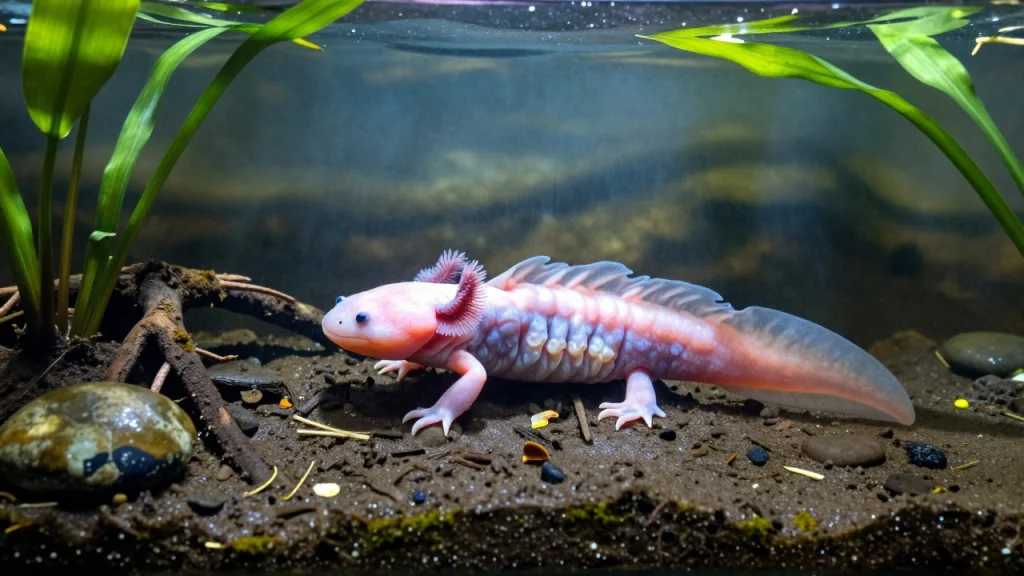
Axolotls evolved in high-elevation still waters, not in warm rooms. Field ecology describes them in slow-moving wetland waters around Xochimilco, where they prosper in cool conditions around 16 to 20 degrees Celsius. Vegetation, mud and spring flow buffer daily swings, and animals rest near the bottom during daylight.
As ectotherms, they draw heat from the environment instead of producing stable internal warmth. A human palm feels like a hot plate to tissue tuned for mountain lake coolness. Brief contact raises surface temperature, speeds metabolism unnaturally and accelerates water loss across exposed gills.
Air exposure adds drying stress. Gills need a constant water film to exchange gases, and skin breathing stops when mucus dries. Lifting an axolotl for photos therefore forces breath holding and buoyancy disruption, even if the animal appears to smile. The familiar grin reflects skull shape, not comfort.
Water chemistry magnifies the danger. Because uptake happens across the whole surface, chlorine, ammonia, metals and pesticides enter rapidly. Even freshly washed hands carry risk, so keepers who must move an animal for medical reasons use wet containers or soft fine nets and limit air time to seconds.
A rare population that cannot afford disturbance
Wild axolotls now survive only in a tiny portion of their former range. They remain native to the Xochimilco lake system near Mexico City, with records from Xochimilco and neighboring Chalco waters. Urban drainage and tourism have reduced former lakes and marshes to canals and remnant wetlands.
Numbers reflect that contraction. Current assessments list the species as critically endangered, with only 50 to 1,000 adults remaining in nature and a continuing downward trend. Small, fragmented groups lose genetic variety and recover slowly from added deaths. Surveys link decline to urban growth, sewage overflow, altered flows and predatory carp and tilapia introduced for food.
Habitat damage compounds handling harm. Authorities cite drying and contamination of canal networks as a leading pressure, driven by city expansion and visitor activity. Poor clarity reduces hunting success because axolotls detect prey visually among plants, while pollutants irritate gills and skin already stressed by contact.
Mexico protects the species as endangered, and international trade controls limit movement across borders. Photographing from boardwalks and supporting wetland restoration help more than any hands-on encounter.
How to watch and help without picking them up
Enjoyment does not require contact. A calm tank or canal-side view shows natural walking, gulping at the surface, gill flicking and ambush strikes when water stays cool, clean and planted. Bright lights, strong filters and sharp gravel cause chronic strain, so dim shelter, gentle flow and smooth hides support better viewing.
Use these low-impact habits around pets or during ecotourism:
- observe through glass or from a boat, and keep vibrations low
- keep hands, sunscreen, food and soap out of the water
- ask staff or guides to use a water-filled container if an animal must move for health checks
- support Xochimilco wetland cleanup, native plant cover and pesticide reduction
Axolotls reward patience. A quiet watcher sees hunting tactics and gill color shifts that a brief hold would hide, while the animal keeps its protective surface, stable temperature and normal hormone balance intact.
Sources
- National Geographic: Axolotl | National Geographic
- Detroit Zoo: Axolotl – Detroit Zoo
- U.S. Geological Survey: Axolotl (Ambystoma mexicanum) – Species Profile
- U.S. National Park Service: Amphibians – Yellowstone National Park
- Lab Animal (Nature): The adrenal stress response involves distinct dynamics of both cortisol and corticosterone in the axolotl salamander
- San Diego Zoo Wildlife Alliance Library: Population & Conservation Status – Axolotl Fact Sheet