
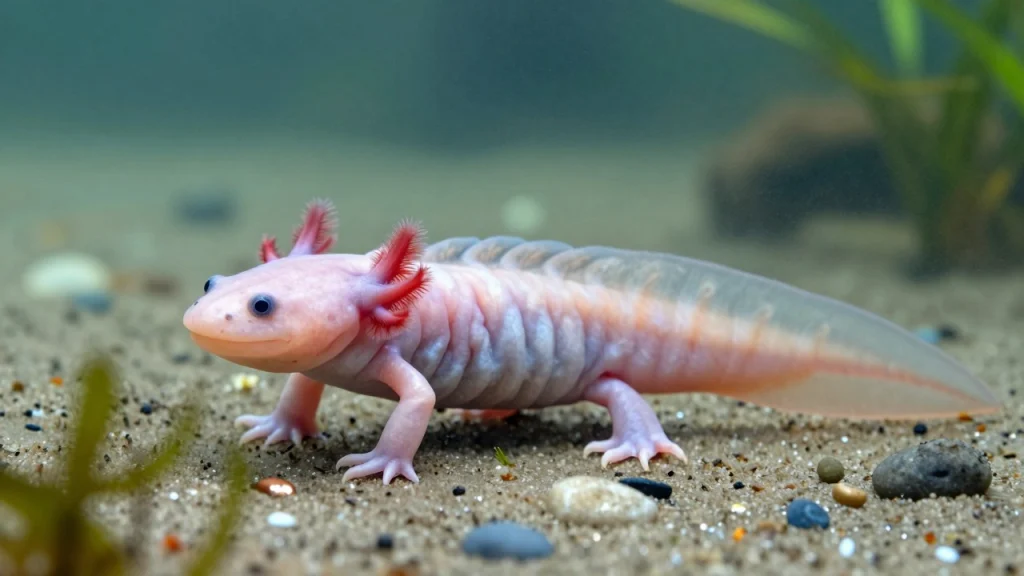
No, an axolotl cannot live out of water. This salamander stays aquatic from hatching to old age, exactly like a larva would. It never settles on land the way most of its relatives do.
The question is less obvious than it sounds, because the animal does have working lungs. Adults carry functional lungs and can also take in oxygen through the skin. Those tools exist, yet the axolotl’s whole body plan still points to a life underwater.
Why an axolotl stays in the water
The key is a trait called neoteny. Unlike most salamanders, axolotls hold on to youthful features after they reach adulthood. A salamander that normally leaves the water as it matures instead remains a kind of permanent juvenile.
That means an adult axolotl keeps the equipment of a larva:
- external gills
- a tail
- a fin along the body
- no movable eyelids
Each of these suits life in a lake. Feathery gills and a finned tail are designed for water, not for dry ground.
Gills do the main breathing work
Despite having lungs, an axolotl relies mostly on its prominent, feathery gills to breathe underwater. The lungs act as a backup rather than the main system. An axolotl may also rise to the surface now and then for a quick gulp of air.
That occasional gulp is not a step toward land. It simply adds a little extra oxygen to what the gills and skin already supply.
Delicate skin adds another limit
The skin of an axolotl is permeable, so substances pass through it easily. Even natural oils or leftover soap can harm it. For this reason, National Geographic advises against touching or handling these animals unnecessarily.
A body that absorbs so readily is well suited to water, where conditions stay steady. It is a poor match for the dry conditions outside a lake.
Can an axolotl ever turn into a land salamander?
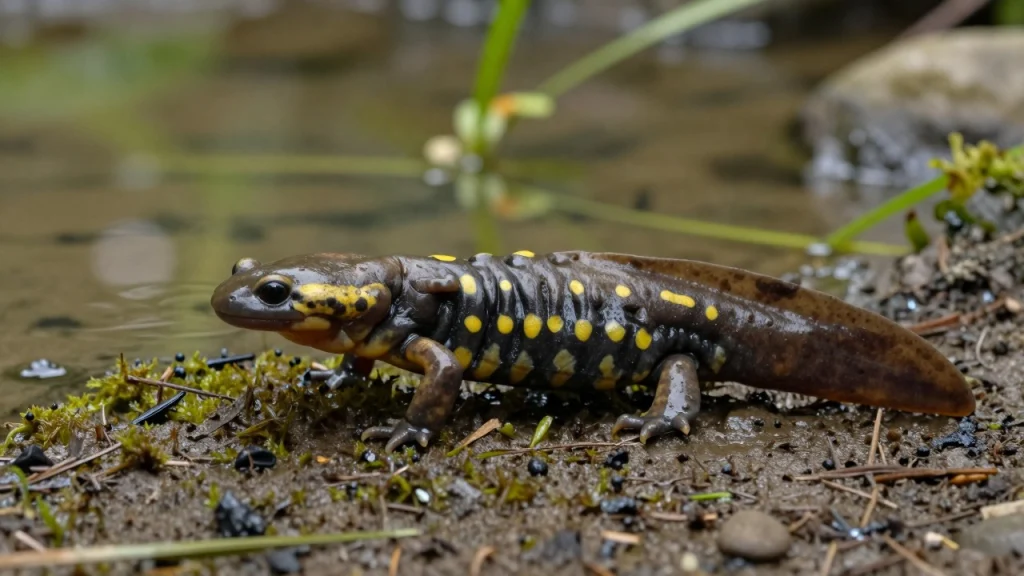
Sometimes a change is possible, but it is very rare in nature. In the wild, axolotls almost never go through metamorphosis, the large change in body shape that turns a larva into a land-going adult. Scientists can trigger it in captivity by giving thyroid hormones, and iodine can have a similar effect.
The result is not a healthy upgrade. Forcing the change can stress the animal and shorten its life, and experts strongly discourage it. In laboratories, most animals die soon after metamorphosis.
A theory for why they never grew up
One idea explains the pattern by their home. Their native lakes never dry up, unlike many other bodies of water. Because of this, axolotls had no pressure to swap aquatic traits, such as a tadpole-like tail, for land traits such as legs.
The still lakes axolotls call home
Axolotls are lentic, which means they live in still-water lakes rather than flowing rivers. Their natural range was in the lakes near Mexico City, and today that range has shrunk sharply. Lake Chalco has disappeared entirely after being drained for drinking water, and Lake Xochimilco is now little more than a scattering of canals and swamps.
Even the name hints at their watery life. The name comes from Nahuatl, the language of the Aztecs, and translates as “water dog.” People also call it the “Mexican walking fish,” although it is not a fish.
How they live day and night
During the day, axolotls burrow into aquatic plants and mud to avoid being eaten. At night they become active and hungry. They feed by suction, pulling in worms, tadpoles, insects and small fish.
Size and lifespan
An axolotl can reach 12 inches in length, but the typical adult is closer to 9 inches. The San Diego Zoo Wildlife Alliance lists a life span of 10 to 15 years. In laboratories, the expected longevity is 5 to 6 years, though a few animals have lived as long as 10 to 15 years.
Why the water matters for survival
Because axolotls cannot leave the water, damage to their lakes hits them directly. The species is listed as Critically Endangered on the IUCN Red List. According to an IUCN assessment reported by National Geographic, somewhere between 50 and a thousand axolotls remain in the wild.
According to the San Diego Zoo, the greatest danger to them is the urbanization and pollution of the freshwater lakes and ponds where they live. Predation by large fish that were introduced into the lakes has also contributed to their decline.
For an animal that cannot walk away from a polluted or drained lake, clean and stable water is the whole habitat. That is why conservation work focuses on restoring the lakes themselves.