
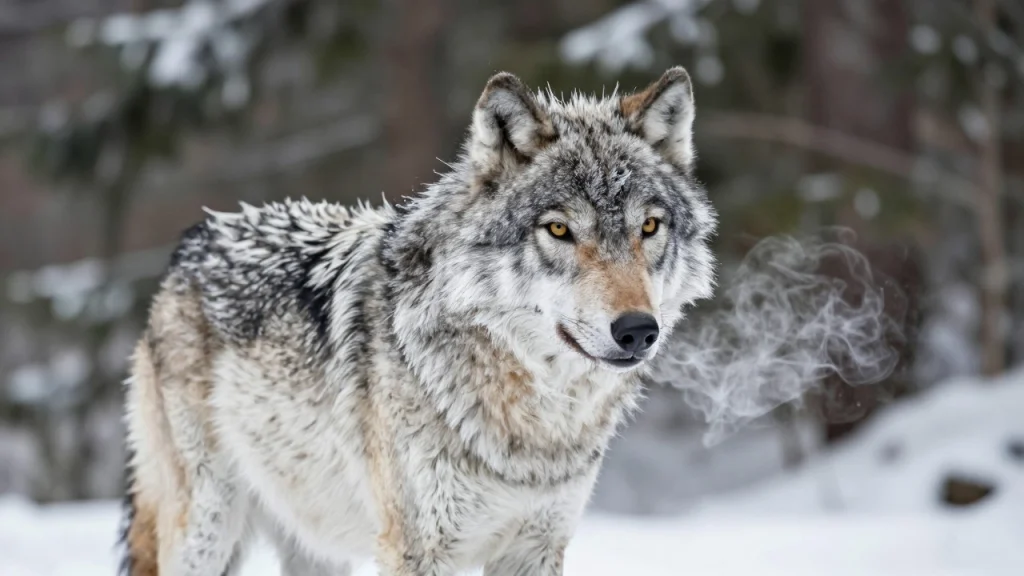
A wolf’s bite pressure is about 1,200 pounds per square inch (PSI). This immense jaw strength allows gray wolves to crush the thick bones of large ungulates like elk and moose to access nutritious bone marrow.
Compared to a measured mean of about 256 newtons (roughly 58 pounds of force) in a sample of pet dogs, a wolf’s modeled bite force is significantly higher. Their biting mechanism is finely tuned by specialized anatomical adaptations, strong jaw muscles, and heavy canine teeth built for capturing and consuming large wild prey.
Understanding the Bite Force of a Wolf
When measuring jaw power in wild carnivores, researchers look at the pressure exerted during a full-force bite. A wolf’s bite strength varies depending on how the force is applied and which part of the mouth is engaging the object.
- Modeled canine bite force: about 593 newtons (roughly 130 pounds of force)
- Comparison to domestic dogs: A theoretical gray-wolf canine bite force is about 2.3 times the measured mean for a sample of pet dogs.
This powerful bite is essential for survival in cold, harsh environments where scavenged carcasses freeze solid and every part of a kill must be consumed.
Anatomical Factors Behind a Wolf’s Jaw Strength
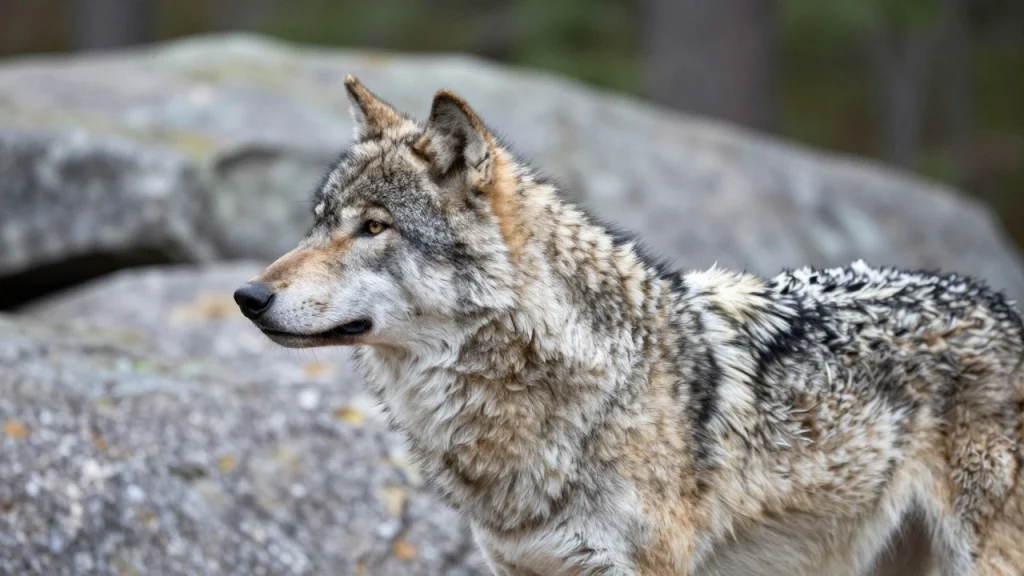
A wolf’s impressive biting force is not just about muscle size; it is a combination of skeletal structure and dental design. Wolves have massive skulls with strong sagittal crests, the ridge of bone on top of the skull, which provide broad anchor points for powerful temporalis muscles.
In dogs, the premolar and molar teeth have a scissor action; the carnassial teeth are the first mandibular molar and maxillary fourth premolar. The back molars are built to withstand heavy, repeated force without fracturing.
How Wolf Bite Force Compares to Other Wild Predators
While a wolf boasts exceptional jaw strength among North American canids, placing its force alongside other prominent wild predators highlights how different species adapt to their specific hunting styles.
- Gray Wolf: about 593 newtons (roughly 130 pounds of force)
- African Lion: about 1,770 newtons (roughly 400 pounds of force) of modeled canine bite force
- Grizzly Bear (a brown bear subspecies): about 1,680 newtons (roughly 380 pounds of force) of modeled canine bite force
Unlike big cats that rely primarily on rapid suffocation bites to the throat, wolves use repeated, high-impact bites to wear down large prey during group hunts. Their ability to deliver sustained pressure ensures they can grip prey even through thick hides and dense winter coats.
The Role of Jaw Strength in Wolf Survival and Diet
For a gray wolf, jaw power is directly tied to pack nutrition and survival. Wolves frequently hunt large herbivores like bison, deer, moose, and caribou. Breaking through tough skin, dense tendons, and thick skeletal structures requires continuous force.
Cracking open large leg bones allows wolves to reach the high-fat bone marrow inside, a critical energy source during winter months when prey is scarce. Without such powerful jaws, wolves would be unable to fully utilize the carcasses they hunt, leaving vital nutrients behind.