
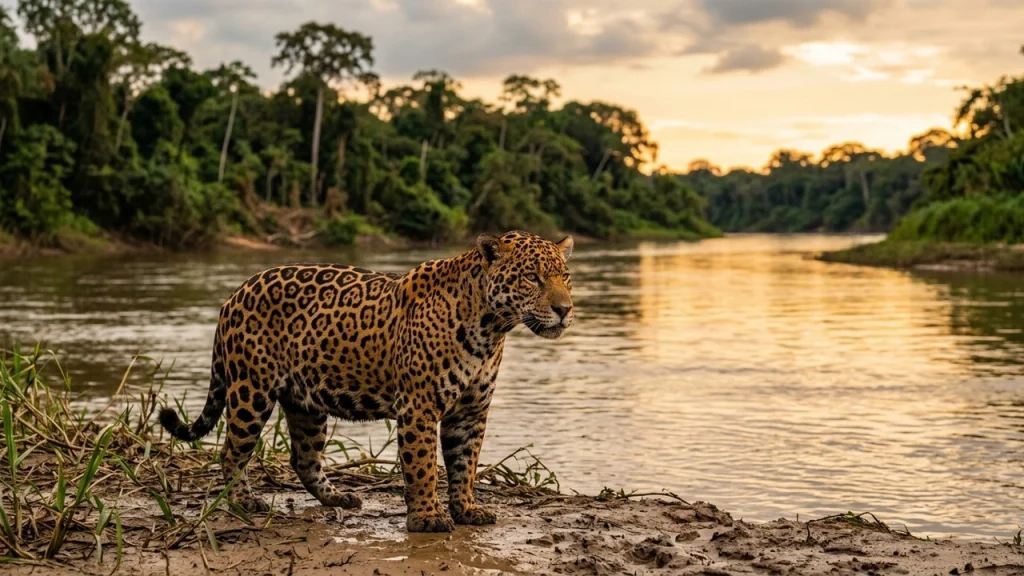
Wild jaguars occur only in the Americas, from extreme southern Arizona and New Mexico through Mexico and Central America into South America as far as northern Argentina and northeastern Brazil.
The biggest unbroken block of occupied ground lies in the Amazon Basin and reaches into the Cerrado, Pantanal and Chaco toward the south. Another edge runs toward the northeast, reaching Venezuela’s Caribbean shoreline plus the Guianas. That pattern gives the short answer to where jaguars live: mainly low, wet and well covered country in Latin America, anchored by the Amazon and Pantanal.
Present range from the borderlands to Argentina
The documented span starts near southern Arizona, crosses Mexico and Central America, passes through much of South America including the Amazon Basin, and ends in northern Argentina at the Rio Negro.
In shorthand, the range covers Mexico through Central America and South America, with a few individuals in the southwestern United States. The United States now holds only dispersing and vagrant animals, not a self sustaining population.
The species once used wider ground to the north, but today the footprint is far smaller than it once was. The cats have nearly disappeared from Mexico plus Argentina’s pampas scrub grasslands, and no wild populations persist in Uruguay or El Salvador.
Forests, wetlands and dry country they can use
Dense lowland forest is the core address. Jaguars favor thick, humid lowland woods that give plenty of concealment, although they also turn up in scrub, reed beds, coastal woods, swamps and thickets.
Cover types stretch well past rainforest alone:
- coastal mangrove wetlands, open pampas plains, seasonally flooded savanna including the Pantanal, evergreen stands, marshy grass country and humid tropical woodland
- needleleaf stands, mixed broadleaf stands, forest that loses leaves in the dry season and spiny scrub in the Chaco
- caverns, ravines, rocky hollows, dense tangles and even disused old structures that offer denning cover
Such breadth helps explain persistence in both humid and dry landscapes. The cats can persist in habitats other than rainforest, from grasslands toward drier country, although they are not typically found in arid areas. In practice they settle where shade, prey and drinking places overlap, rather than in open or heavily disturbed land.
Water shapes daily life
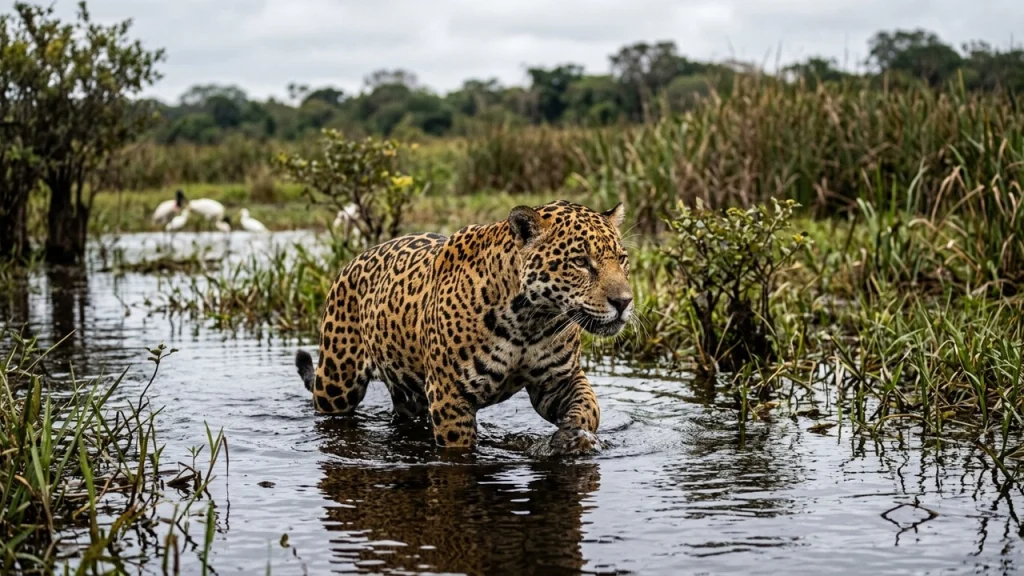
Jaguars stay near water. They are strong swimmers and generally occupy places near lagoons, watercourses, rivers and slow moving streams plus swamps. Rivers supply fish, caimans and capybaras.
Body and behavior fit that waterside habit. Muscular limbs and large paws help them climb trees, pad across soft forest floor and swim in rivers and streams. They commonly live beside water and readily take aquatic animals.
Skilled swimming widens the menu. A jaguar can traverse broad waterways to seize fish, capybaras and caimans without leaving the water.
How high they climb and where they hide
Most animals live low. The species is generally found below 1,000 m, although it has been recorded as high as 3,800 m.
They keep close to water and shun open or heavily altered ground. For shelter they use rocky caves or dense thickets as den sites.
Amazon, Pantanal and other strongholds
The Amazon holds the largest share. The largest jaguar subpopulation lives in Amazonia, estimated at 57’000 to 64’000 animals and 89% of the total population.
The Pantanal wetland is the second famous stronghold, and the wetland sustains very large and healthy jaguar groups.
The wetland itself is huge, covering 179,000 square kilometers.
Not every stronghold is secure. Inside the Atlantic Forest, only 200 plus or minus 80 adults are thought to remain.
Why the map shrank
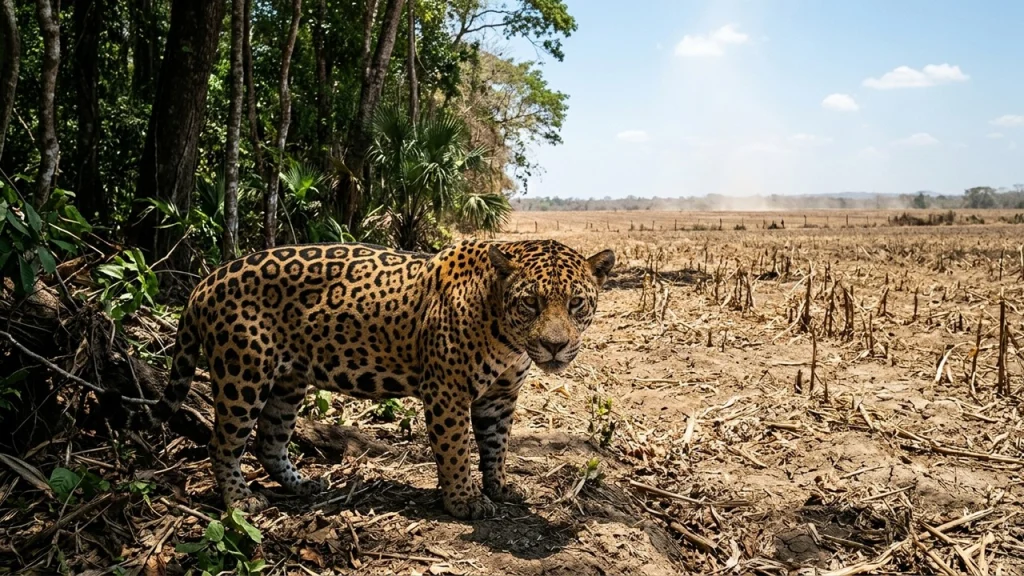
Today’s range covers only 51% of its historic range. The missing ground lies mainly at the edges, especially in the United States and southern Argentina, plus northern Mexico and northern Brazil.
Fragmentation now matters as much as total loss. Logging, farming and mining break habitat into pieces with scarcer prey and fewer partners.
Globally, the IUCN Red List classes the jaguar as Near Threatened. The label signals a species close to qualifying for a threatened category, not a safe one.
Solitary life on a large territory
Each jaguar needs space. By habit the species hunts alone, defends a territory and favors the night.
Female ranges cover approximately 25 to 38 square km, and males use up to twice that area.
They are the hemisphere’s biggest felids and sit third worldwide by size. Adults weigh 70 to 249 pounds, with males larger than females. Wild animals survive 12 to 15 years, while zoo animals may attain 20 years.
Sources
- San Diego Zoo Wildlife Alliance: Jaguar | San Diego Zoo Animals & Plants
- Animal Diversity Web: Panthera onca (jaguar) | INFORMATION
- IUCN SSC Cat Specialist Group: Living Species – Jaguar | IUCN CatSG
- San Diego Zoo Wildlife Alliance Library: Summary – Jaguar (Panthera onca) Fact Sheet
- Smithsonian’s National Zoo: Conserving the World’s Largest Working Wetland