
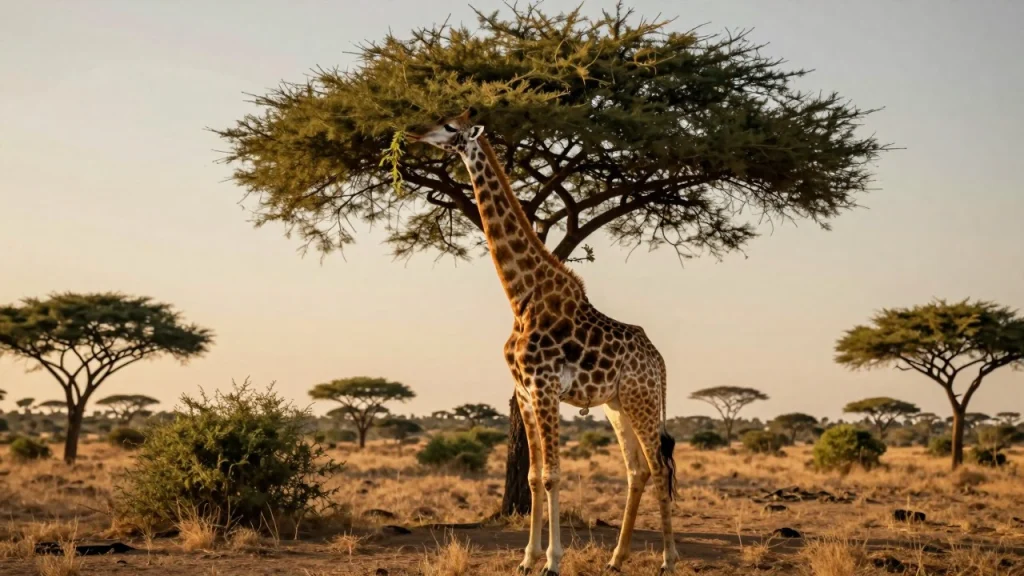
The iconic long neck of the giraffe is one of the most remarkable adaptations in the animal kingdom. Standing up to nearly 19 feet tall, giraffes rely on their long necks primarily to feed on high foliage that other herbivores cannot reach and to participate in social dominance behaviors known as necking.
While reaching tree canopies gives giraffes a distinct evolutionary edge, their height comes with complex anatomical and physiological requirements. From special blood pressure controls to unique muscular structures, every aspect of a giraffe’s body is finely tuned to support its extraordinary vertical reach.
Evolutionary Advantages of a Long Neck
Scientists have long debated the exact evolutionary drivers behind the giraffe’s neck length. The two leading explanations center around foraging competition and social interaction.
Reaching High-Altitude Food Sources
The most widely accepted explanation, famously linked to early evolutionary theories, is high-level browsing. In the African savanna, ground-level vegetation is heavily browsed by zebras, antelopes, and gazelles. By growing exceptionally tall, giraffes gained exclusive access to leaves at the tops of trees, particularly acacia species.
This vertical separation minimizes competition for food, allowing giraffes to thrive even during dry seasons when ground-level plants become scarce. Their flexible, prehensile tongues and long necks work together to pluck nutrient-rich foliage safely tucked above the reach of other plant-eaters.
The “Necking” Hypothesis for Mating Success
In addition to foraging benefits, researchers emphasize the role of sexual selection through a behavior called necking. Male giraffes use their powerful, heavy necks as weapons during combat to establish dominance and win mating rights with females.
During these battles, males swing their heads like sledgehammers, striking opponents with considerable force. Males with longer, thicker, and heavier necks tend to win these encounters, passing their genetic traits down to future generations. This suggests that sexual competition played a significant role alongside feeding advantages in shaping the species over millions of years.
How a Giraffe’s Long Neck Works Anatomically
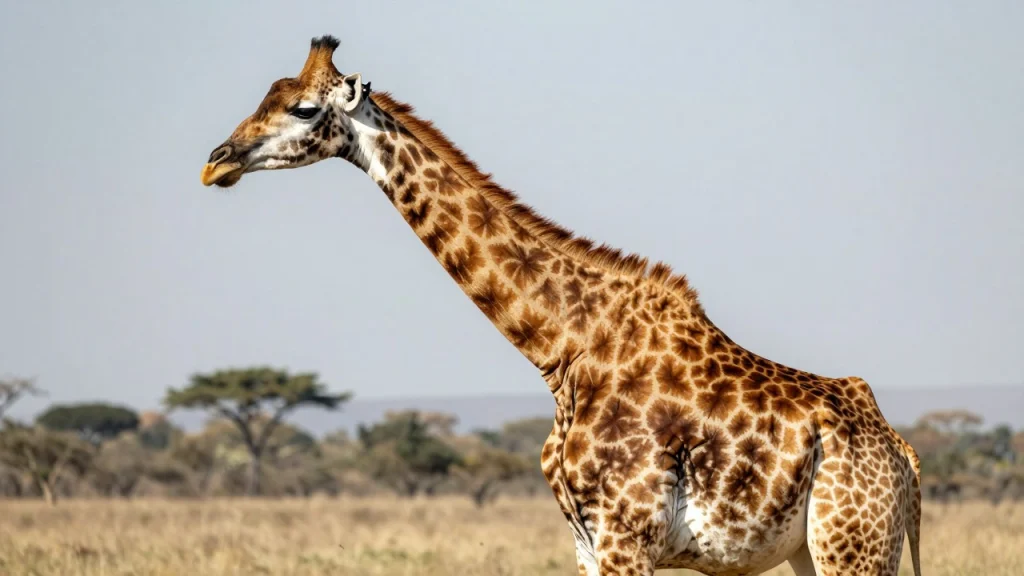
Despite its incredible length, a giraffe’s neck shares a surprising anatomical trait with most other mammals, including humans: it contains only seven cervical vertebrae. Rather than adding extra bones, evolution lengthened each individual vertebra, with a single neck bone reaching up to 10 inches in length.
Supporting such a heavy structure requires impressive muscular and structural adaptations:
- Nuchal Ligament: A thick, elastic ligament running from the base of the skull down to the shoulders acts as a powerful rubber band, supporting the neck’s weight without exhausting the animal’s muscles.
- Enlarged Muscle Attachments: High shoulders and strong muscular anchors provide the leverage needed to maneuver the neck smoothly during feeding, drinking, and walking.
- Modified Joints: Highly flexible ball-and-socket-like joints between the vertebrae allow a wide range of movement, enabling giraffes to reach high branches or bend down to drink water.
Circulatory and Physiological Adaptations
Living high above the ground presents significant cardiovascular challenges. A giraffe’s heart sits roughly 6 to 7 feet below its brain, requiring immense pressure to pump blood upward against gravity.
To maintain steady blood flow, a giraffe possesses an extraordinarily powerful heart that weighs around 25 pounds and generates blood pressure roughly double that of humans. However, this high pressure creates a secondary problem when the animal lowers its head to drink.
To prevent brain damage from sudden blood surges when bending down, giraffes rely on a specialized vascular network at the base of the brain called the rete mirabile. This dynamic network of elastic blood vessels absorbs sudden increases in blood flow, while specialized valves in the jugular veins control blood return when the giraffe raises its head back up.
Life at the Top: Benefits and Challenges
Having a long neck provides clear survival benefits, but it also creates distinct physical vulnerabilities in the wild.
- Vigilance against predators: Excellent visibility allows giraffes to spot predators like lions from great distances across open savannas.
- Efficient stride length: The elevated center of gravity and long limbs allow giraffes to cover large distances efficiently while foraging.
- Drinking vulnerability: Lowering the neck to reach ground water requires spreading the front legs wide, putting the giraffe in a awkward, vulnerable posture that leaves it exposed to apex predators.
Understanding why giraffes developed such long necks reveals how evolutionary pressures shape every detail of a wild mammal’s anatomy. Through a combination of feeding efficiency and social competition, the giraffe evolved into one of the most uniquely adapted species on Earth.
Sources
- Cleveland Zoological Society: Truth or Tail: Giraffe have more neck bones than a human.
- Stanford Blood Center (Stanford University): For Giraffes, Blood Circulation Is a Tall Order
- Animal Diversity Web (University of Michigan): Giraffa camelopardalis
- San Diego Zoo Wildlife Alliance Library: Giraffes (Giraffa spp.) Fact Sheet: Physical Characteristics
- Journal of Experimental Biology: How long limbs reduce the energetic burden on the heart of the giraffe