
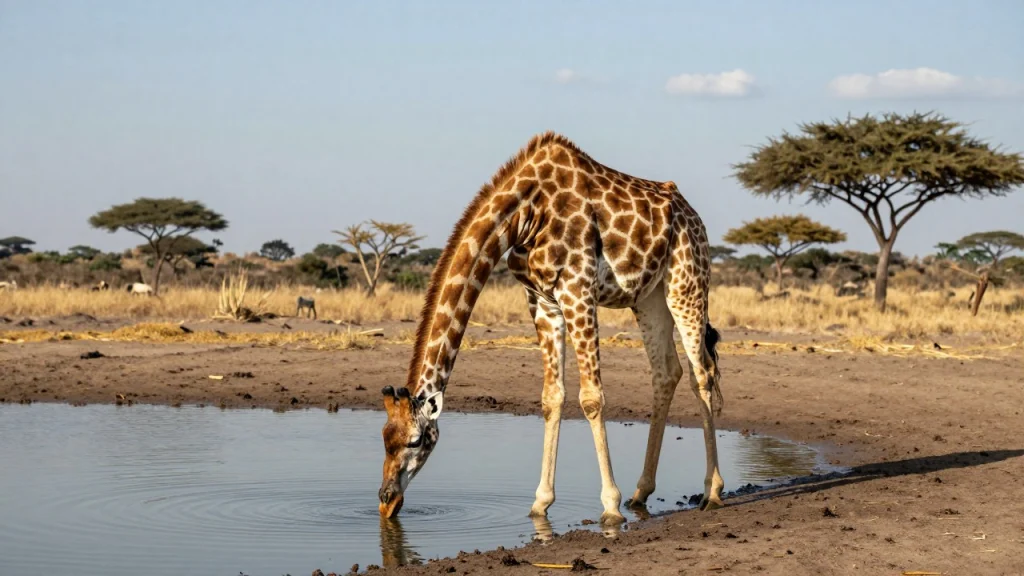
Giraffes are the tallest land mammals on Earth, standing up to 19 feet tall. While their extreme height allows them to reach high acacia leaves, it also presents a massive physiological challenge when they need to lower their heads to drink. Bending down can drop their brain about 5 to 10 feet (1.5 to 3 meters) below their heart, which should theoretically trigger a fatal spike in blood pressure or lead to severe fainting when standing back up.
Despite this intense pressure shift, giraffes drink safely thanks to a complex biological plumbing system. Their bodies use a combination of high-baseline blood pressure, specialized vascular safety valves, a spongy network of blood vessels called the rete mirabile, and extremely elastic artery walls. Together, these physiological adaptations regulate blood flow in real time to protect the brain from dangerous surges and sudden drops in pressure.
The Physical Challenge of a roughly 10-Foot Drop
To understand how a giraffe prevents fainting, it helps to consider the sheer physics of its circulatory system. A giraffe’s heart weighs about 25 pounds, and blood pressure at heart level is about twice that of other mammals. This tremendous pressure is necessary to force blood straight up a long neck to reach the brain while standing upright.
When a giraffe lowers its head to drink, gravity suddenly shifts from opposing blood flow to pulling blood rapidly downward toward the brain. Without adaptive mechanisms, this shift would cause excessive blood to flood the cranial cavity, damaging delicate cerebral blood vessels. Conversely, when the animal raises its head quickly to check for predators, gravity instantly pulls blood away from the head, which would cause sudden lightheadedness or loss of consciousness.
The Rete Mirabile: Nature’s Pressure Absorber
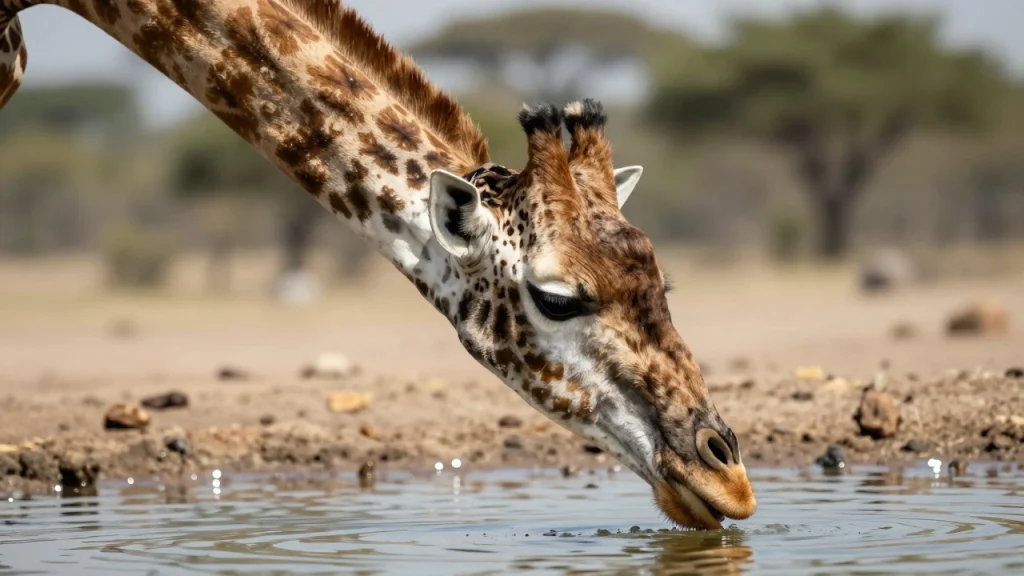
The primary defense against brain hemorrhage when bending down is a specialized vascular structure known as the rete mirabile (Latin for “wonderful net”). Located at the base of the giraffe’s brain, this intricate network of fine blood vessels acts as a physical buffer and reservoir for arterial blood flow.
When the giraffe lowers its head, the rete mirabile absorbs the incoming rush of blood under high hydrostatic pressure. By distributing the volume across countless tiny, flexible capillaries, it equalizes the pressure before blood reaches the sensitive brain tissue. When the giraffe lifts its head back up, this same network releases stored blood back into circulation, preventing a sudden blackout.
Specialized Valves and Elastic Blood Vessels
Beyond the rete mirabile, a giraffe’s circulatory tract relies on several mechanical controls to manage gravity’s pull:
- One-Way Jugular Valves: The large jugular veins in a giraffe’s neck contain a series of one-way valves. When the head is lowered, these valves stop blood from flowing backward down the veins toward the head, controlling venous return and maintaining proper circulation.
- Thick-Walled Arteries: The carotid arteries leading to the brain have thick, muscular walls rich in elastic fibers. When pressure increases during bending, these vessel walls restrict their diameter, controlling the rate of blood flow to the brain.
- Tightly Stretched Skin and Fascia: The skin on a giraffe’s lower legs and neck is exceptionally tight and inelastic. This acts like natural compression stockings, preventing blood from pooling in the lower extremities when standing and keeping systemic pressure balanced.
Spreading the Stance to Reduce the Angle
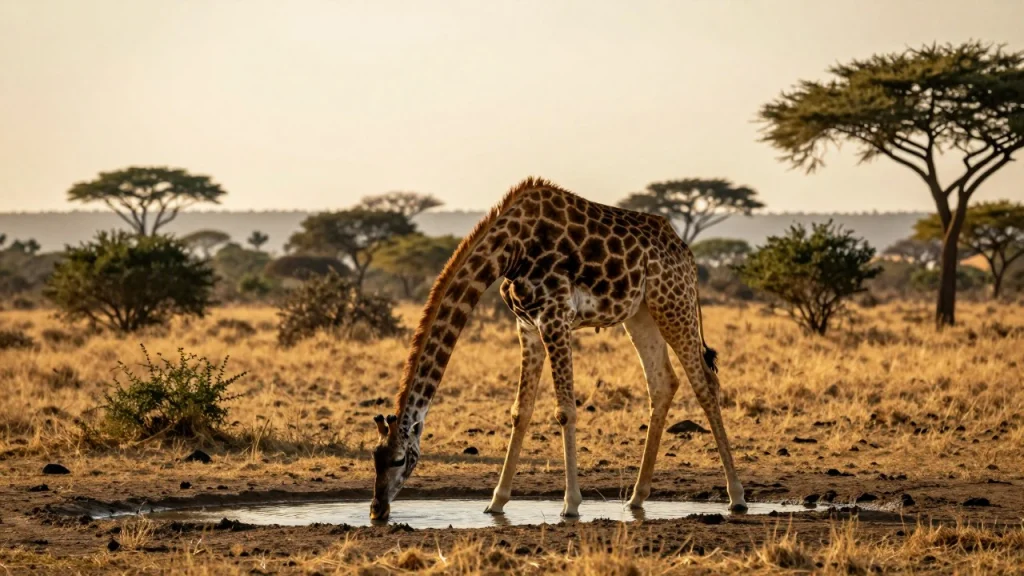
In addition to internal physiological controls, giraffes use distinct behavioral postures to make drinking safer. Because a giraffe’s neck is slightly shorter than its long legs, it cannot reach ground water simply by lowering its neck.
To reach the water’s surface, a giraffe must splay its front legs wide apart or bend deeply at the knees. This physical adjustment lowers the height of the shoulders and shortens the distance the head must travel. By reducing the steepness of the angle, the giraffe moderates the gravitational pull on its blood supply and lowers the exertion needed to stand up quickly if threatened by wild predators like lions or crocodiles.
A Perfect System of Evolutionary Engineering
The giraffe’s ability to drink water without fainting demonstrates how multiple anatomical systems evolve together to solve extreme physiological hurdles. High blood pressure, fine-tuned vascular networks, muscular vessel walls, and behavioral postures work seamlessly to manage drastic hydrostatic changes.
Without this integrated biological system, the tallest mammal in the world would be unable to perform one of its most essential daily survival needs. Thanks to these adaptations, giraffes can dip their heads, drink their fill, and return to an upright posture within seconds.