

In native habitats, wild bears consume between 13.1 kg and 14.6 kg of bamboo leaves alongside stems daily, but during spring, intake surges up to 43.7 kg of shoots a day. This colossal consumption provides enough calories to sustain a large bear on a plant that offers minimal nutritional return.
Within conservation enclosures, bears at the Panda Base consumed around 15 kg to 20 kg of harvested bamboo per day. Meanwhile, institutional care guidelines show that To balance their inefficient digestion, an individual needs between 70 and 100 pounds of fresh bamboo daily to obtain vital nutrients. To process such vast bulk, Securing such vast quantities forces a panda to dedicate between 10 and 16 hours a day to foraging and eating. In addition, Field records document that pandas dedicate at least 12 hours each day entirely to consuming bamboo.
Daily consumption across wild mountain ranges
Feeding rates in the wild remain remarkably stable across mountainous regions where mature bamboo stands dominate the landscape. Free-ranging populations living in the Xiangling Mountains consume between 13.1 kg and 14.5 kg of bamboo a day.
These figures illustrate the high baseline requirements of wild bears. Because mature leaves and woody stalks contain dense structural fibers, bears chew methodically through large piles of branches every single day to fuel basic physiological maintenance.
Foraging hours and the daily energy budget
Gathering and chewing tens of kilograms of tough plant matter dominates a panda’s daily schedule. After long meals, the remainder of their time involves mostly sleeping and resting to curtail unnecessary energy loss.
Across native forests, wild bears typically nap between meals for intervals of two to four hours at a stretch, resting on their back, stomach, or side in sprawled or curled positions. These periodic naps allow their simple gastrointestinal tracts to process ingested greenery while keeping metabolic costs low.
These behavior cycles prove that giant pandas maintain an extremely strict energy budget, moving minimal distances across slopes and foraging almost whenever they travel.
The carnivore gut processing a fibrous grass
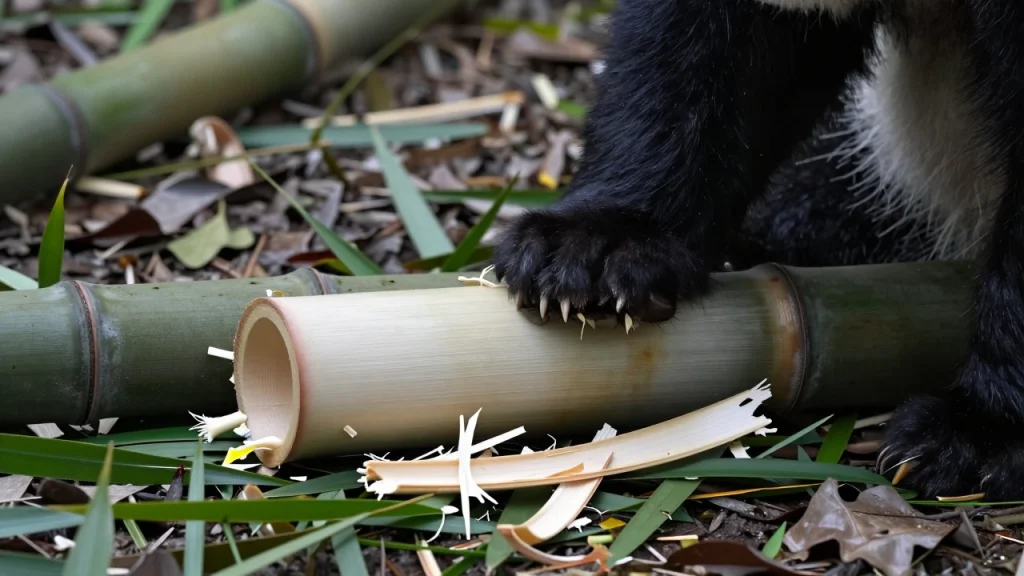
The fundamental reason pandas must ingest such staggering quantities of plant matter lies in their digestive anatomy. Anatomically, the digestive tract of a giant panda resembles a meat-eater rather than an herbivore, meaning that large portions of ingested vegetation pass through as unabsorbed waste.
Unlike cattle or sheep, giant pandas possess neither a multi-chambered stomach nor an enlarged cecum for prolonged microbial fermentation. Because their gut is short and simple, only about 17% of the nutrients present within stalks and foliage are successfully extracted.
Despite subsisting on a low-yield diet, active giant pandas sustain standard mammalian energetic demands. Metabolic investigations confirm that their mean daily energy expenditure of 21,592 KJ per day aligns with estimated daily digestible energy intake values between 17,222 KJ and 28,329 KJ in free-ranging animals. Eating massive quantities remains the only way to balance this energetic ledger.
Passing kilograms of hard, splintered bamboo through a short digestive canal presents serious risks of internal injury. To survive abrasive woody fragments, their gastric walls are extremely muscular to crush fibrous pulp, while the intestinal lining produces heavy mucus coats to shield delicate membranes against sharp splinters.
Heavy waste production and tracking wild populations
Because transit through the gut is rapid and digestion is incomplete, giant pandas produce immense volumes of waste. Processing this massive volume creates heavy waste, with adult bears relieving their bowels between 40 and 50 times a day.
The number of droppings left behind directly reflects how long an individual occupied a particular spot:
- During shorter resting stops lasting under two hours, biologists typically count five to ten droppings at the site.
- Extended resting periods lasting beyond two hours produce heavier deposits, where 11 to 25 droppings accumulate around the resting animal.
Biologists use these frequent droppings to track wild pandas, map their home ranges, and assess the nutritional health of resident populations without intrusive handling.
Anatomical adaptations for harvesting bamboo
Harvesting and handling rigid bamboo culms requires specialized physical traits that set giant pandas apart from all other bears. While feeding, an animal usually sits upright, assuming an erect pose resembling a person sitting flat on the ground.
This seated posture is advantageous because keeping the body vertical leaves their forelegs free to grip and steer tough culms. The forepaws feature specialized anatomical structures for grasping:
- Pandas grasp thick stalks using their five digits combined with an enlarged wrist bone termed a pseudo-thumb.
- Rather than being a genuine digit, this structure consists of skin tissue covering an enlarged radial sesamoid wrist bone.
- This unique wrist modification acts like an opposable clamp, helping the animal significantly when tearing stubborn plant sheaths.
This dexterity allows the bear to strip, bend, and position stalks rapidly, maximizing intake rate during long feeding sessions.
Dental mechanics and crushing jaws
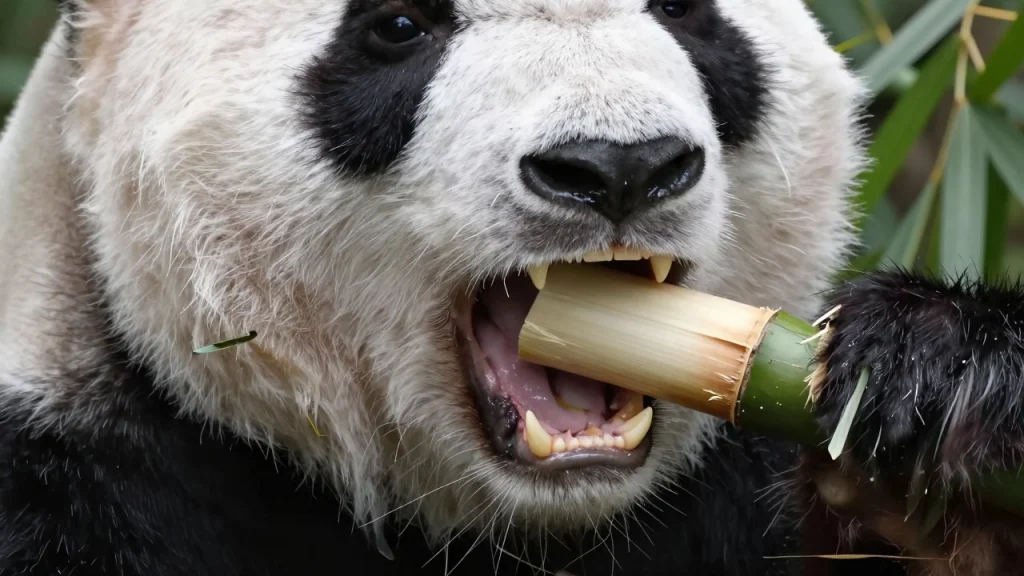
Masticating fibrous stalks for over half of every day requires extraordinary biting forces. Bears use sharp front teeth to strip away coarse outer rind, exposing the softer core tissue nestled inside each culm.
Green foliage is equally prized, as pandas strip leaves from branches, compress them into dense wads, and swallow them. Processing these tough bundles requires specialized oral anatomy:
- Their skulls display an expansive sagittal crest that has broadened and deepened over time, providing solid anchors for massive jaw muscles.
- Their crushing cheek teeth have evolved accordingly, as their molars and premolars are broader and flatter than those of other bears, bearing complex ridges and cusps to pulverize tough plant fibers.
- Due to the continuous mechanical strain of chewing tough stalks, pandas exhibit the most jaw strength of any living bear species.
These powerful jaws and specialized molars reduce fibrous stalks to small fragments, facilitating rapid gastric passage.
Dietary variety and ecological vulnerabilities
Although giant pandas are famed for their specialized vegetarian habits, their diet contains minor variations. Field analyses confirm that an individual’s diet is 99% vegetarian, focusing almost entirely on bamboo culms, foliage, shoots, and roots.
Because their underlying biology remains that of a carnivore, the remaining 1% of their diet may encompass carrion, bird eggs, and small animals. When roaming near agricultural borders, wild individuals sometimes enter cropland to forage for crops including wheat, plots of kidney beans, ripe pumpkin, and domestic pig food.
Within native bamboo forests, botanical diversity is vital for long-term health. Across their entire range, pandas can feed on 25 different types of bamboo, although individuals generally consume only the 4 or 5 kinds growing within their local territory.
Relying on multiple bamboo varieties protects bears from a dangerous biological phenomenon:
- A peculiar ecological risk is that every bamboo plant belonging to a particular species across a district will flower, drop seeds, and die simultaneously.
- Following a mass die-off, seedlings take several years to grow large enough to sustain feeding bears.
- To survive periodic die-offs, local populations require at least 2 different bamboo species inside their home range to avoid starvation.
Forests with multiple co-occurring bamboo species ensure that bears can switch food sources whenever one variety dies off.
Forest elevation and reserve sustainability
Giant pandas depend on cool, misty mountain woodlands to support their enormous food requirements. In the mountains of southwestern China, giant pandas dwell in mixed broadleaf and coniferous forests featuring thick undergrowth, situated at elevations ranging from 5,000 to 10,000 feet.
Ecological research in protected reserves shows that these mountain habitats provide abundant resources. Conservation research concludes that standing bamboo biomass is not the limiting factor preventing natural population expansion or impeding reintroduction efforts inside wildlife reserves. Maintaining intact forest corridors and mitigating habitat fragmentation remain the primary conservation priorities for this iconic bear.
Sources
- Smithsonian’s National Zoo and Conservation Biology Institute: Giant Panda
- San Diego Zoo Wildlife Alliance: Giant Panda
- Animal Diversity Web: Ailuropoda melanoleuca (giant panda)
- Scientific Reports: Metabolic rates of giant pandas inform conservation strategies
- World Wildlife Fund UK: Top 10 facts about pandas