
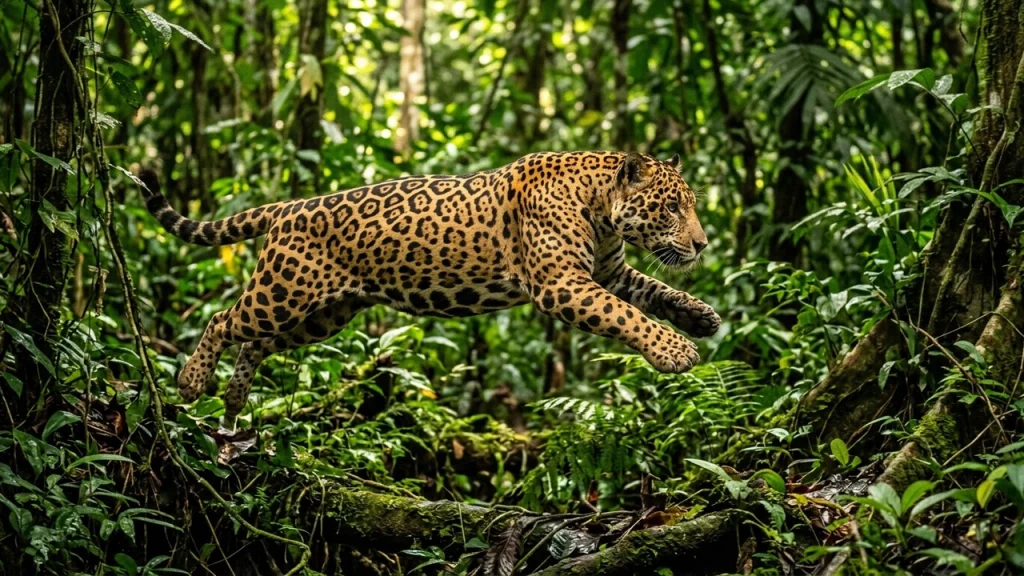
The jaguar is an ambush hunter built for power rather than speed, relying on short, explosive bursts rather than long pursuits. Indigenous South American languages reflect this predatory style through the term yaguara, which designates an animal that slays in a single bound. The cat stalks within close quarters of its target, relying on explosive leg propulsion to bridge the final gap.
Accurate depth perception plays a vital role in executing these swift, decisive lunges. These large felines possess the finest three-dimensional vision among all carnivores, allowing them to measure jumping distances accurately before striking. Instead of engaging in extended pursuits, they secure meals by pouncing directly onto unsuspecting targets.
Anatomical design built for power over speed
Their overall physical structure favors sheer power over rapid speed, even though they can sprint over short intervals. Under cover of darkness, jaguars stalk and ambush terrestrial targets rather than chasing down game like lions or cheetahs.
While they have the ability to run at a respectable pace, sustained running does not serve as an essential hunting skill. The jaguar has compact, muscular limbs and a lean body framework. In addition, the jaguar maintains a stocky, muscular physique supported by relatively short limbs.
Skeletal adaptations for explosive lunges
Cranial strength and the single-bite takedown
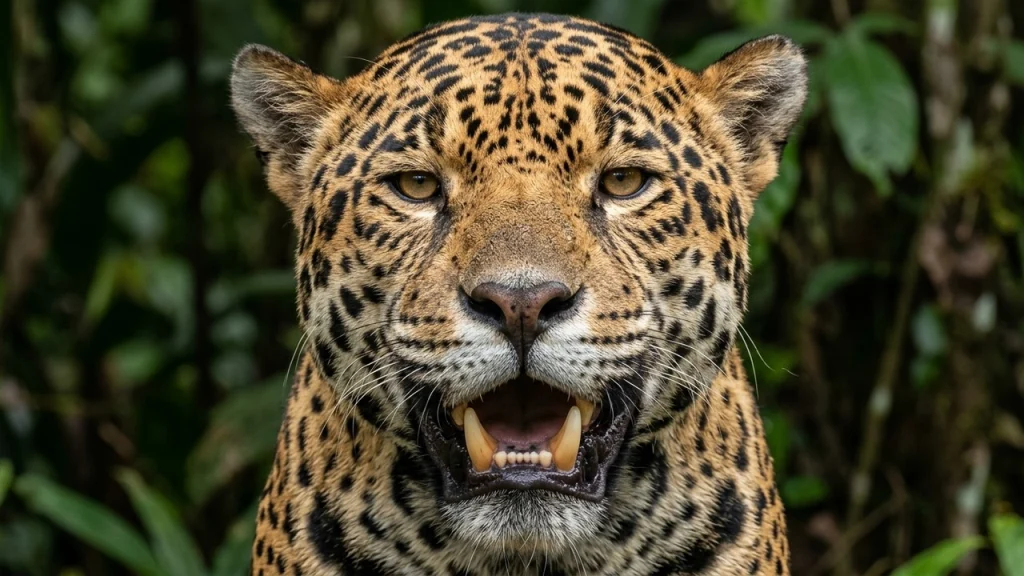
The force of the initial jump represents only the beginning of the jaguar’s hunting sequence. Jaguars are powerfully built, with prominent cheeks and large, square jaws. In relation to general body size, the jaguar possesses an exceptionally large and robust skull adapted for crushing bone and armored prey. Exceptionally developed temporalis and masseter muscles work in tandem with large, robust, flattened canine teeth that appear cylindrical in cross section.
Ranking as the third strongest among felids, these specialized canines withstand mechanical bite pressure measuring 591 kg (1,399 lbs.). Operating as apex predators, they deploy an unmistakable dispatched method by biting directly through the skull or cervical vertebrae to incapacitate the victim’s nervous system. During the final phase of a strike, the predator penetrates temporal bones and crushes the braincase of its quarry. Because of this devastating cranial impact, a single bite upon landing a pounce often concludes the hunt.
Aquatic predation and heavyweight strength
This jaw strength surpasses that of other big cats and ranks among the most potent in the mammalian class, easily piercing a caiman’s skull or the hardened shell of a turtle. Such biting capability allows the cat to consume hard-shelled reptiles including tortoises, turtles, and spectacled caimans.
Demonstrating extraordinary dragging power after an ambush, an individual was recorded hauling a sea turtle weighing 34 kg over a distance of 91.5 meters into protective forest cover. Field researchers document that jaguars prey upon more than 85 species, regularly hunting deer, peccaries, tapirs, capybaras, and domestic cattle.
Versatile hunting tactics across diverse prey
To manage such varied targets, the predator adapts its strike based on prey size and armor:
- Armored reptiles: Piercing bites can penetrate heavy bone or thick shells.
- Large ungulates: Powerful lunges can target the neck or skull of heavy mammals like tapirs and cattle.
- Aquatic quarry: Jaguars sometimes sit quietly at the water’s edge and tap the surface with their tail to attract fish.
Habitat tactics and stealth maneuvering
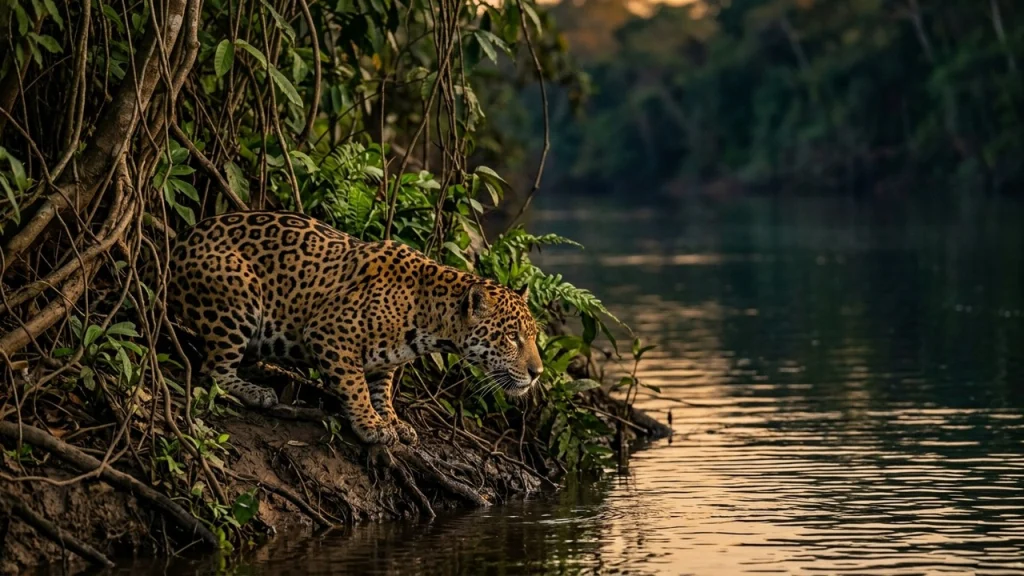
To get close enough for a single lethal bound, the predator uses its environment with great cunning. When stalking quarry on foot, they rely on dense plant growth to remain hidden before leaping. Thick vegetation masks both sound and movement during the slow approach. Beyond ground stalking, the powerful cats can also ascend into trees to seek safety or locate potential game from above.
Unlike most felines, they feel entirely comfortable in aquatic environments and rarely wander far from a lake or river. Rather than avoiding wet habitats like typical domestic or wild felines, jaguars embrace waterways. In quiet shallows, naturalists have watched them sit motionlessly along riverbanks, occasionally flicking their tail tip against the water to lure curious fish within striking range.
Physical dimensions and spotting patterns
The scale of this apex hunter reflects its dominant ecological standing across Central and South America. Within the Western Hemisphere, the jaguar stands as the largest native cat and ranks as the third largest worldwide. Across the entire globe, only tigers and lions surpass it in physical dimensions. In overall body length, an adult ranges between 3.8 and 6 feet, corresponding to between 1.1 and 1.8 meters. Height at the shoulder generally reaches 27 to 30 inches.
Across varied habitats, body mass ranges from 70 up to 249 pounds, equivalent to 31 to 121 kilograms, with males exceeding females in size and Pantanal individuals attaining noticeably heavier weights. Across regional populations, mature females typically measure 10 to 20 percent below male size. Although they share visual similarities with African and Asian leopards, their rosettes display more intricate patterns that frequently encircle a central dark dot.
Maturation and territorial range
Mastering the precise balance of stalking patience and explosive leaping demands extended practice. Maturing cubs master their stalking, leaping, and biting techniques by remaining alongside their mother for two years or more. In natural ecosystems, their lifespan spans 12–15 years, while managed zoo care can extend longevity up to 25 years.
Despite their remarkable physical prowess, these powerful predators face expanding human pressures across their geographic range. Historical changes have severely restricted their distribution, eliminating more than half of their native territory since the 1880s. The vast Amazon Basin serves as their primary modern stronghold, accompanied by smaller populations dispersed across Central America.
Sources
- San Diego Zoo Wildlife Alliance: Jaguar | San Diego Zoo Animals & Plants
- Animal Diversity Web: Panthera onca (jaguar)
- National Geographic: Jaguar, facts and photos
- Los Angeles Zoo: Jaguar | Los Angeles Zoo and Botanical Gardens
- Frontiers in Veterinary Science: A multimodal investigation of a pink-discoloured canine tooth in a jaguar (Panthera onca): a clinical, computed tomographic, microstructural, ultrastructural, and computer-aided design/ computer-aided manufacturing prosthodontic reconstruction study