
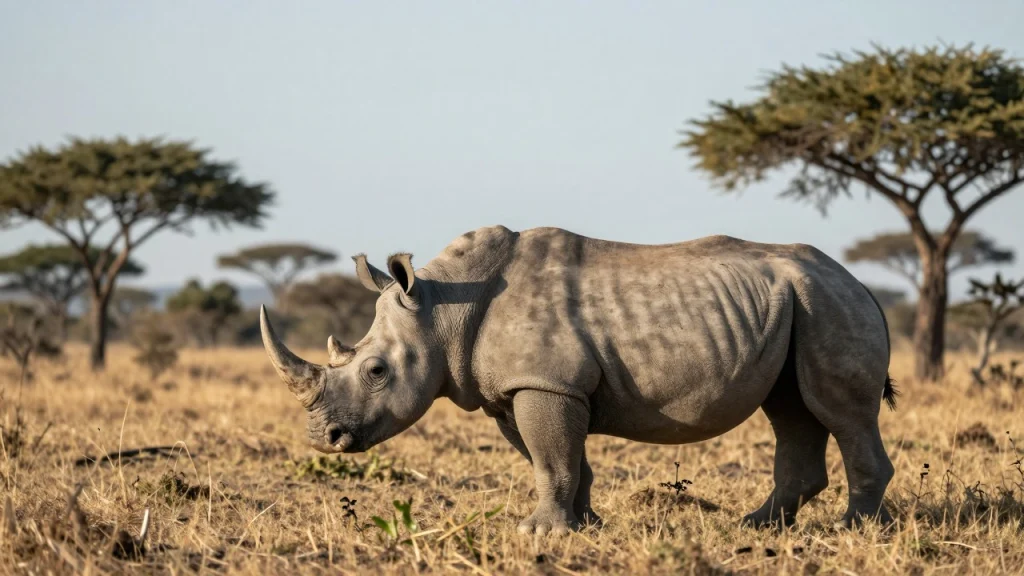
Rhinoceroses have evolved their iconic horns over millions of years primarily as essential tools for survival, defense, and social interaction. Far from being purely ornamental, these massive structures serve critical functional purposes in the daily lives of rhinos across African savannas and Asian dense forests.
Understanding why rhinos possess horns involves looking at how these solitary megaherbivores navigate their environments, protect their young, and establish dominance within their territories.
Primary Functions of Rhinoceros Horns
The evolutionary success of the rhinoceros is closely linked to the versatility of its horn. Depending on the species and environment, rhinos rely on their horns for several vital tasks.
Defense Against Predators
In the wild, fully grown rhinos have very few natural predators due to their sheer size and thick skin. However, calves and young rhinos are vulnerable to large carnivores such as lions, hyenas, and tigers.
Mother rhinos use their front horns as formidable defensive weapons to ward off predators attempting to target their offspring.
Territory and Mating Battles
Rhinos are mostly solitary animals with defined home ranges. When bulls encounter rivals, disputes over territory or access to breeding females frequently arise.
During these encounters, male rhinos use their horns to clash, push, and strike one another. Horn size often signals strength and age, allowing mature males to establish dominance without always needing to engage in dangerous combat.
Environmental Manipulation and Foraging
Rhinoceroses use their horns much like agricultural tools. Depending on whether a species is a browser or a grazer, the horn assists in gathering food:
- Uprooting vegetation: Rhinos use their horns to dig into the soil for roots, bulbs, and minerals.
- Breaking branches: Browsing species, like the black rhino, use their horn to snap heavy branches and access foliage high out of reach.
- Clearing pathways: In dense brush, rhinos clear paths through thorny scrubland using their heads and horns.
What Are Rhinoceros Horns Made Of?
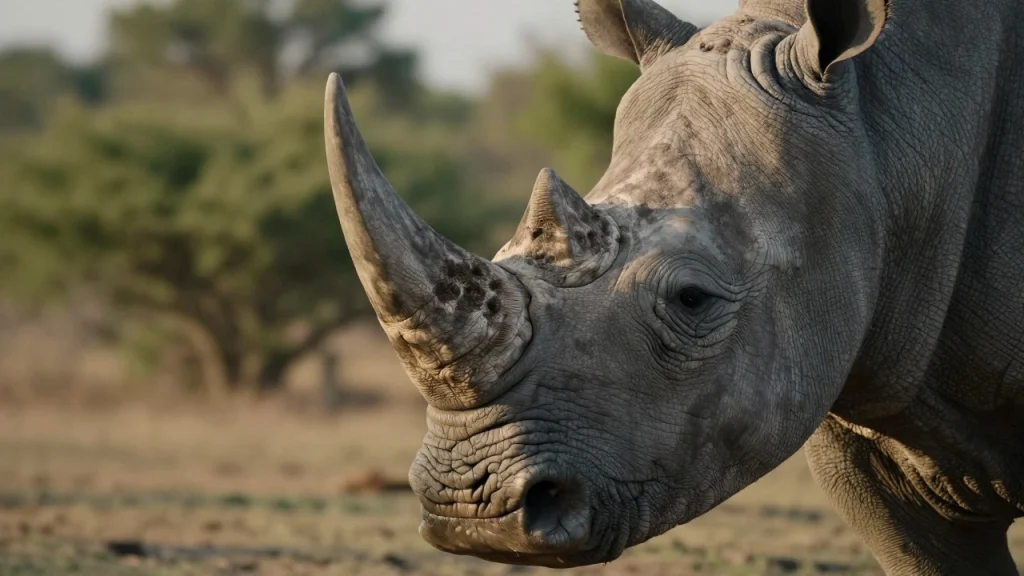
Unlike the horns of cattle or goats, which feature a bony core covered by a keratin sheath, a rhinoceros horn contains no bone at all.
Rhino horns are composed entirely of keratin, the same structural protein found in human hair and fingernails. The keratin fibers are densely packed and bound together with specialized glands, creating a solid, highly durable structure anchored directly to the thick skin of the snout.
Because they are made of keratin, rhino horns grow continuously throughout the animal’s life. If a horn breaks or chips during a fight or while digging, it slowly regenerates over time.
Variations Among Rhino Species
Not all of the five living rhinoceros species possess identical horn structures. Their physical adaptations reflect their distinct ecological niches across Africa and Asia.
Two-Horned Species
The white rhinoceros and black rhinoceros, as well as the Sumatran rhinoceros, have two horns. In black and white rhinos, the front horn is larger and the rear horn smaller.
Single-Horned Species
The Indian (greater one-horned) rhinoceros and the Javan rhinoceros feature only a single horn. In these species, the horn serves similar defense and foraging roles, though male Indian rhinos also rely heavily on their sharp lower incisors when fighting rivals.
Evolutionary Advantage and Conservation Context
The rhinoceros lineage is ancient, with ancestors walking the Earth 55 million years ago, and horned rhinoceros skulls are known from the Miocene; horns are used for feeding, defense, and fighting. The horn equips them with the tools needed to modify their environment, protect their lineage, and maintain social order.
Today, however, the very feature that ensured their survival in the wild has made them targets for illegal poaching. Protecting rhinos and preserving their natural habitats remains critical to ensuring these magnificent creatures and their unique adaptations survive for generations to come.
Sources
- San Diego Zoo Wildlife Alliance: Rhinoceros
- Animal Diversity Web, University of Michigan: Diceros bicornis (black rhinoceros)
- Animal Diversity Web, University of Michigan: Ceratotherium simum (white rhinoceros)
- ZooKeys / IUCN SSC Asian Rhino Specialist Group: A taxonomic review of the genus Rhinoceros with emphasis on the distinction of Eurhinoceros (Perissodactyla, Rhinocerotidae)
- Biology (Basel) / PubMed Central: The Development of Horns in Bovidae and the Genetic Mechanisms Underpinning This Process