
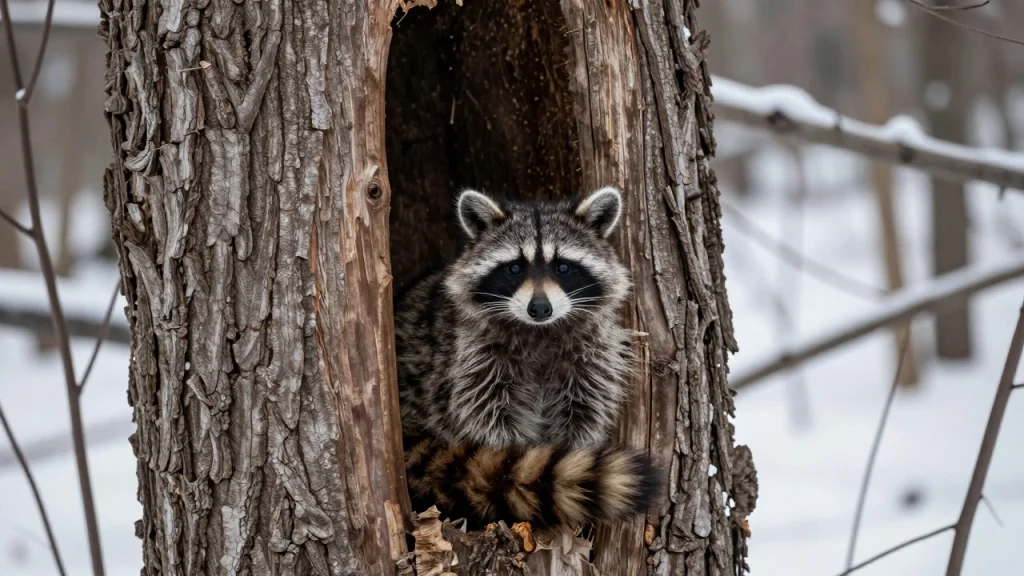
A raccoon does not hibernate. What it does instead is drop into torpor, a winter sleep taken in a den, during which the heart rate drops, the breathing slows and the metabolism falls while the animal stays in control and can get up to feed. Where winters are severe, that state can hold a raccoon for days or for weeks at a stretch.
The reason the distinction matters is what the animal can do afterwards. A true hibernator runs a bout of deep sleep that stretches from day to week, eats nothing while it lasts, and depends entirely on stored energy. Physiologists define daily torpor as bouts of less than 24 hours accompanied by continued foraging. Raccoon winter sleep fits the first pattern far more closely, and in extremely cold, snowy periods they have been seen sleeping for long stretches without ever crossing into hibernation. It is interrupted, it is flexible, and it ends as soon as conditions improve.
Torpor is a pause button, not a shutdown
Raccoons keep to the dark hours, so a winter bout means sleeping out of sight in a den, and the National Park Service describes that state as very like hibernation. That state’s slowing lasts for a shorter stretch than in a true hibernator.
The real dividing line is not temperature but the clockwork behind it. Entry into and arousal from torpor are governed by the circadian clock in daily heterotherms, and a hibernator apparently runs without that control, which is why a raccoon can surface on schedule for a meal and drop back down afterwards instead of committing to a season-long shutdown.
Fat pays for those pauses. Raccoons live off stored fat through the winter, and an animal that has weathered a hard season may drop as much as 50 percent of its body weight while doing so.
What turns winter sleep on, and what switches it off
The most useful trigger biologists describe is snow rather than frost. In the far north, where cold and permanent snow cover hold all winter, a raccoon typically sleeps for several months. What initiates that dormancy is the snow cover rather than the low temperature, and a mild winter that leaves bare ground keeps raccoons moving.
Reversibility is the other half of the story. A run of 1 to 3 days with temperatures above freezing, later in the winter, can send them out to feed no matter how deep the snow. In the southern states, by contrast, they stay active all winter long, so one species lives two very different winters depending on latitude.
Autumn is a storage season
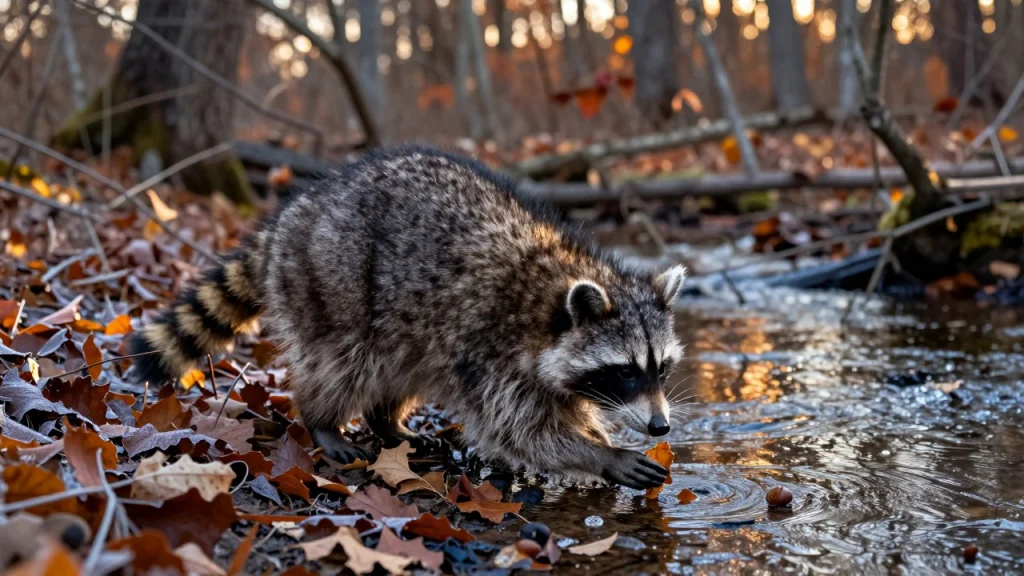
The fat gets built before the cold arrives. As autumn gives way to winter the coat grows heavier, and the animal feeds as hard as it can while food is still there. In the northern part of the range the feasting begins earlier still: raccoons gorge through spring and summer to lay down body fat, then sleep through much of the winter in a den.
That reserve is the whole energy budget for a long winter, which is why raccoons seem to vanish for weeks at a time and re-emerge visibly leaner in spring. It is also why a thin raccoon seen in late winter is not automatically a sick one; it has simply spent what it stored.
Where raccoons actually spend the winter
Hollow trees are the classic winter address, and they suit the job well. In one study the measured cavities came out at 11 by 14 inches, usually 10 to 39 feet above the ground and high enough to stay clear of most predators and of flooding. Insulation matters most in the north, where a well-built den site can decide whether an animal sees spring.
Where hollow trees are scarce the address list widens considerably:
- Hollow trees, the winter dens most often chosen, with cavities averaging 11 by 14 inches and usually 10 to 39 feet up
- Burrows dug by other animals, such as those made by woodchucks
- Caves and mines
- Deserted buildings, barns and garages
- Rain sewers and houses, where chimneys, attics and the crawl spaces beneath homes are all used
- Rock crevices, ground dens and brush piles
Dens also tend to sit near water, generally 220 to 460 feet away, because that is where the food is. Cold enough weather changes the social rules as well: apart from a mother with her young, raccoons keep to themselves, though several of them will share a single den when the cold is severe.
The winter night shift
Mild weather does not end the season for a hungry raccoon. Feeding peaks before midnight, and they usually get under way within 1 hour of sunset, then return to the resting site well after sunrise. A raccoon in genuine need of food will step out in daylight anyway.
The menu follows the habitat. Crayfish rank as the most important animal food, and insects such as grasshoppers, beetles and caterpillars are heavily used; all told, more of a raccoon’s diet is invertebrate than vertebrate. In farming country corn can be the single most important item on the menu, and urban raccoons have long since added rubbish to the list.
None of this would be possible without the hands, and the forepaws are the reason. Raccoons lean on touch above almost everything else: the forepaws are sensitive enough to handle prey and open it up, and food is lifted with the front paws rather than the mouth. Food is also dipped or handled in water, a habit confusing enough that the Latin name lotor translates as the washer.
Cubs face their first winter alongside their mother
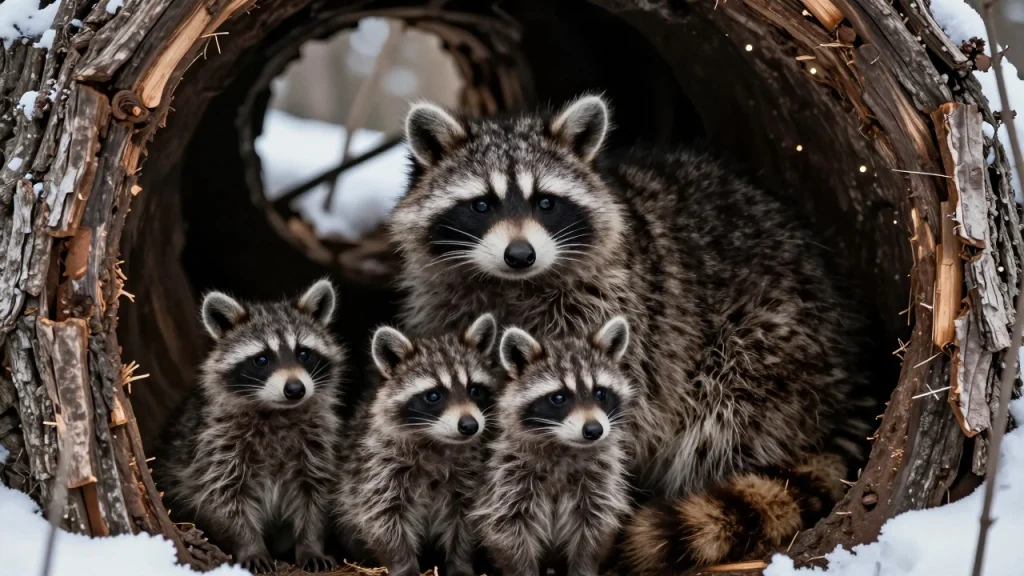
Raccoon breeding is timed to the same calendar. Gestation runs about 63 days and most litters arrive between April and May, so a female is feeding small cubs through the autumn. Litters run from one to seven kits, with four the average. Kits arrive blind and helpless inside a tree den, open their eyes somewhere between 18 and 24 days, and are weaned at 70 days.
Cubs stay with the female all through their first winter, splitting from her only in early spring, so a juvenile learning to forage is doing it in the very season when the adults are sleeping hardest and food is hardest to find.
Range, other species and conservation status
The species people usually meet is the northern raccoon, Procyon lotor, and it is not in trouble. The global conservation listing for the species is Least Concern, and its population trend is increasing. It is native to southern Canada, most of the United States and down into northern South America, and Asia and Europe now hold widely spread populations, with extensive ones in Germany, Russia and Japan.
Six further species of raccoon exist besides the familiar North American one, and most of them live on tropical islands. A typical adult tips the scales at 12 to 35 pounds, and females run smaller. Wild raccoons typically live 2 to 3 years, though individuals in managed care have reached 20.
The friction with people is housing rather than hunger: cubs tucked into a chimney or attic generate most complaints, and raccoons are primary carriers of rabies, though rabies passing from raccoon to human is exceedingly rare.
What a raccoon in winter actually looks like
Expect a den rather than a coma. A severe spell can keep a raccoon in its den for weeks, and the sleep ends as soon as there is food to be had or a few degrees of warmth to be gained. That is the practical difference between a raccoon and a true hibernator: it never commits to the season, so a mild spell in the depths of winter is enough to put it back on its feet and back to work.
Sources
- U.S. National Park Service: Raccoon – Big Thicket National Preserve (U.S. National Park Service)
- Animal Diversity Web, University of Michigan: Procyon lotor (Guadeloupe raccoon) | INFORMATION | Animal Diversity Web
- San Diego Zoo Wildlife Alliance: Raccoon | San Diego Zoo Animals & Plants
- U.S. Forest Service (Fire Effects Information System): Procyon lotor, northern raccoon | US Forest Service Research and Development
- Physiological and Biochemical Zoology via PubMed Central: Daily torpor and hibernation in birds and mammals (Ruf and Geiser, 2015)
- National Geographic: Raccoon | National Geographic