
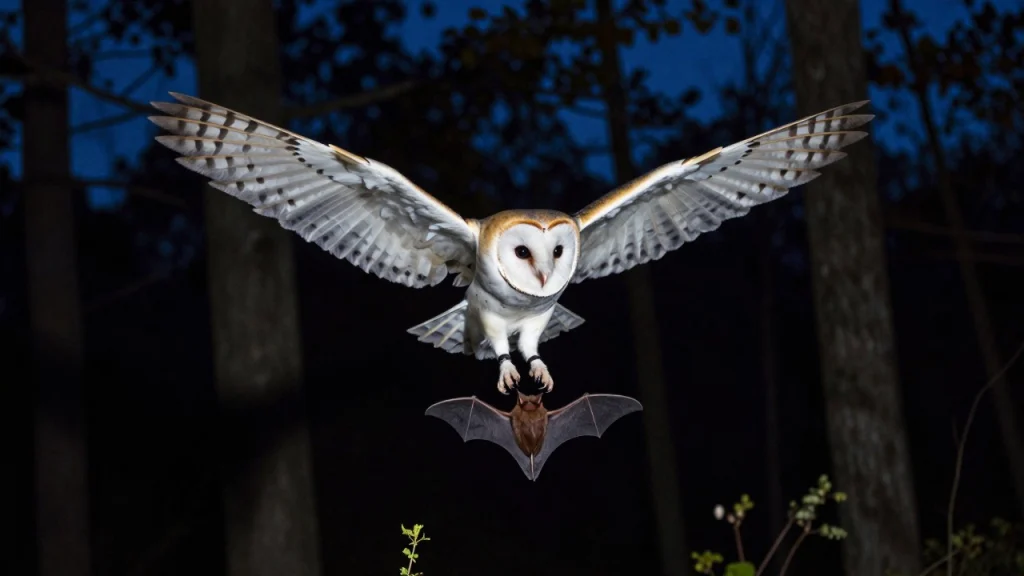
Bats fly through the night, and the dark hours are when most of their enemies are working too. Owl predation dominates the scientific record of bat predators, with hawks and snakes close behind, and a wider supporting cast of mammals, spiders and even other bats moves in whenever an opportunity appears. The animals that hunt bats after dark fall into two very different groups: those that intercept bats in open air, and those that wait for them where they sleep.
Neither style is especially easy, which is why bats are not a staple meal for anything. Specialising on bats is rare, and the predators that do hunt them treat a bat as an opportunistic catch rather than a staple. U.S. National Park Service guidance on Yellowstone bats runs from raptors such as owls, falcons and hawks to snakes and raccoons, and a Sierra Nevada summary adds weasels, ringtail cats and raccoons among the hunters that work the roosts. That opportunism is the whole story: a bat colony is a concentrated, predictable and often immobile larder, so whatever patrols a cave mouth, a cave wall or an attic gets the easy meal.
The birds that share the night shift
Owl predation is the best documented part of the picture. For the European serotine bat, Animal Diversity Web names barn owls, tawny owls and common kestrels as birds that include the species in their regular diet. The same account lists the horseshoe whip snake and people among the known hunters of that bat, the people mostly by accident, because serotines are run down by cars on the road while they forage at night.
Falcons and hawks are daylight hunters that only cross paths with bats at the edges of the night, and that schedule matters. The serotine is mainly a creature of the night, though it will also fly at dawn and dusk, because the insects it feeds on are most active in those windows. The exposed period is therefore the two ends of the night, when colonies leave and return, and that is when the daylight raptors get their chances.
Snakes waiting at the roost door
Snakes are the other consistent night-time group, and their method is patience rather than speed. The horseshoe whip snake will take serotines hanging inside buildings, which points at where the real danger sits: the ambush is set at the roost, not in the air. A bat hanging motionless in a dark attic or tree cavity is a far easier catch than one weaving through open sky, and a snake is built to hold on once it has reached a bat. Snakes also turn up in the general surveys of bat enemies, so this is a worldwide pattern rather than a local oddity.
The ground shift: raccoons, weasels and cats
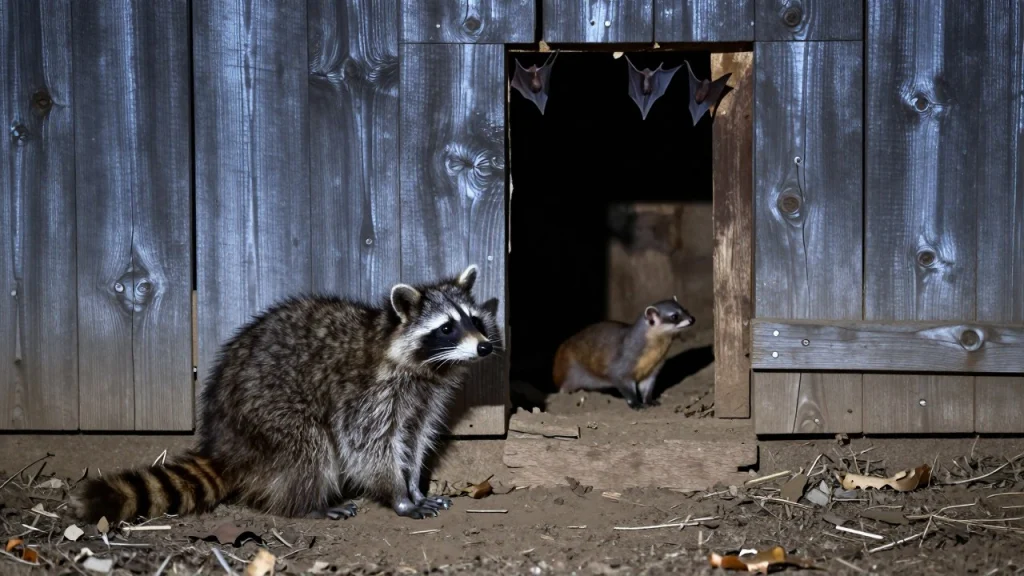
Mammals do much of the remaining work, and they do it around the roost rather than the flight path. For the big brown bat, Animal Diversity Web spells out the pattern: pups dropped from maternity roosts are taken by snakes, raccoons and cats, while bats in flight are picked off by owls and falcons on the way out of the roost. A summer maternity roost is consequently the most dangerous place a bat can be, since the young cannot yet fly and every scavenger in the area learns where it is. The account stresses that it is hunted by only a handful of hunters, among them owls, snakes and even house cats.
Bats that hunt other bats
Bats are not purely the prey in this story. Carnivory is real among phyllostomid bats, and the woolly false vampire bat, Chrotopterus auritus, eats small mammals, birds, frogs, reptiles, insects and, occasionally, fruit. Its hunting style suits a night of ambush rather than a chase: it is an ambusher rather than a sprinter, and it carries wings that are stubbier and wider than those of a long-distance flier, buying agility in tight quarters at the cost of efficient sustained flight.
Records of it eating bats are rare, which is what you would expect from a species that mostly hunts things far smaller and far easier to catch. One documented case involved an adult male netted while carrying a partly eaten broad-eared free-tailed bat, Nyctinomops laticaudatus.
Spiders and centipedes on the night shift
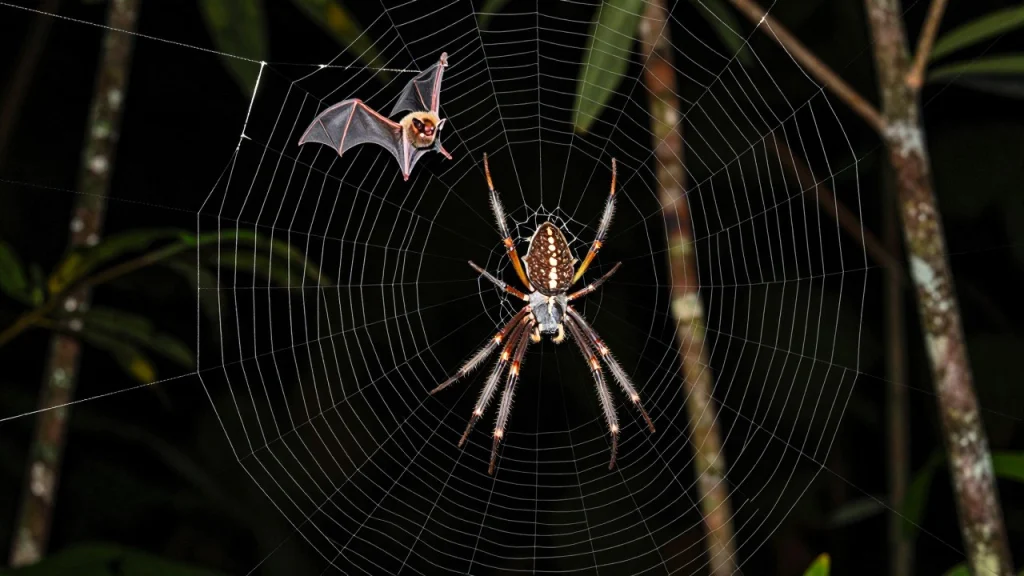
The most unexpected bat predators have no bones at all. A review in PLOS ONE gathered 52 reports of bat-catching spiders from around the world. In that review eighty-eight percent of all bat catches by spiders happened in webs, with 12 percent falling to hunting spiders that chase their prey down.
The culprits are giant tropical orb-weavers. The orb-weavers Nephila and Eriophora have been seen snagging bats in webs as wide as 1.5 m, strung at heights where bat flight paths run, and an Asian and Australian member of the Nephila genus has many times been recorded biting, killing and consuming small bats. The genus Eriophora is more strictly nocturnal still, hiding in a leaf retreat through the daytime and only begins weaving once the sun is down, then holding position at the hub of the web all night. For one well-studied Nephila, feeding peaked in the hours after dusk and before midnight, which is exactly the window when bats are out.
Geography drives how often this happens. In the same review, seventy-seven percent of the recorded incidents happened in the tropics, from 23° N to 23° S, where the giant webs are dense. Even so, encounters stay rare, because bats navigate by very high-frequency calls and have evolved a way of steering clear of silk threads. When a small bat does get caught, the payoff is large: a single bat of about 2 g is worth that spider about 10 times its normal daily catch.
Not every spineless ambusher works from a web. In one Venezuelan cave, centipedes of enormous size have been watched taking down mormoopid and phyllostomid bats, reaching prey that hangs at the very top of the cave where a web would never be spun.
How bats stay off the menu
Facing this many hunters, bats spend much of their energy on not being found. The big brown bat settles on hidden, out-of-the-way roosts to stay ahead of its enemies, and serotines respond to pressure by changing their own routine, huddling in larger groups and shifting the hour at which they set out to feed. Where barn owls are present, serotine females bunch into nursery roosts more often, trading a little crowding for the safety of numbers.
Design helps too. Hanging head down keeps a resting bat harder for a predator to reach and gives it a clean drop into flight, while a roost shields bats from bad weather and from hunters alike. Quiet is another layer: very high-frequency pulses are less likely to give a predator’s ears any clue while remaining effective for finding insect prey. Bats also keep returning to the very roost where they reared young successfully before, so a site that has kept them alive gets reused, which concentrates the risk but also concentrates the knowledge of where they are hard to reach.
Some species add chemistry to the mix. The pallid bat of the open country advertises itself with a strong, skunk-like smell that predators may find unappealing.
Why the pressure rarely decides a bat’s fate
Bats are built to persist. Roughly 40 to 80 percent of the bats that survive their first year are still flying 7 to 8 years on, many individuals reaching 10 to 30 years of age, and a big brown bat can reach 19 years of age outdoors, with males tending to outlive females. The nightly losses add up, but they are spread thin across owls, snakes, spiders and carnivorous bats rather than concentrated in one efficient enemy, so a colony’s size is rarely set by predation. The balance is easy to state: some animals need thousands of insects a night to survive, and other creatures in the same ecosystem count on bats for their calories, so the hunt goes on every night of the year.
Sources
- U.S. National Park Service: Bats – Yellowstone National Park
- U.S. National Park Service: Bats – Sequoia & Kings Canyon National Parks
- Animal Diversity Web: Eptesicus serotinus (serotine) | INFORMATION | Animal Diversity Web
- Animal Diversity Web: Eptesicus fuscus (big brown bat) | INFORMATION | Animal Diversity Web
- PLOS ONE: Bat Predation by Spiders
- Biodiversity Data Journal (via PubMed Central): First record of predation of Nyctinomops laticaudatus by Chrotopterus auritus