
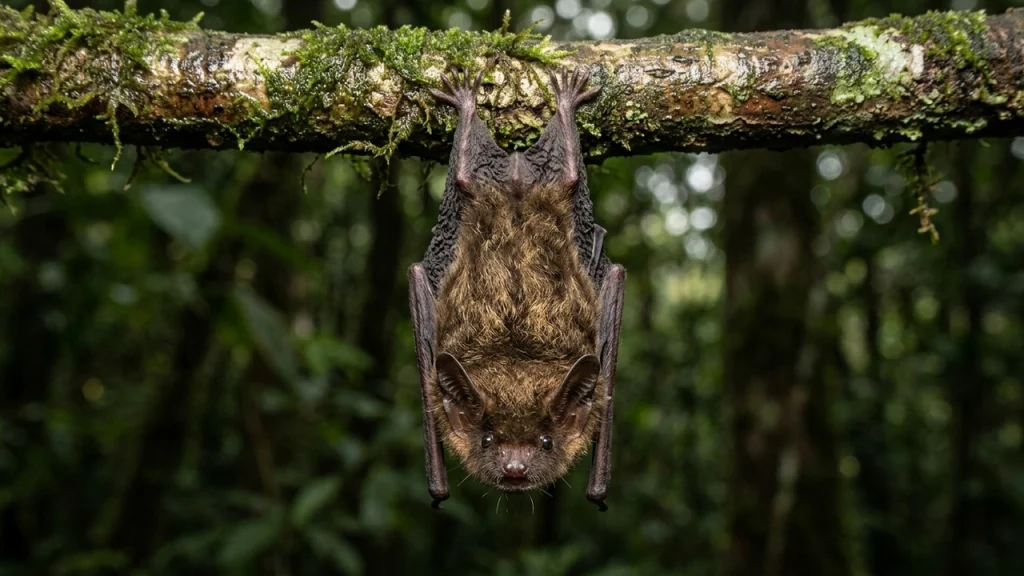
The San Diego Zoo Wildlife Alliance says bats hang head-down because their hind legs are so light that they could not hold a body upright. An iScience study reports that specialized landings help bats reach that upside-down roosting posture.
Feet made for hanging
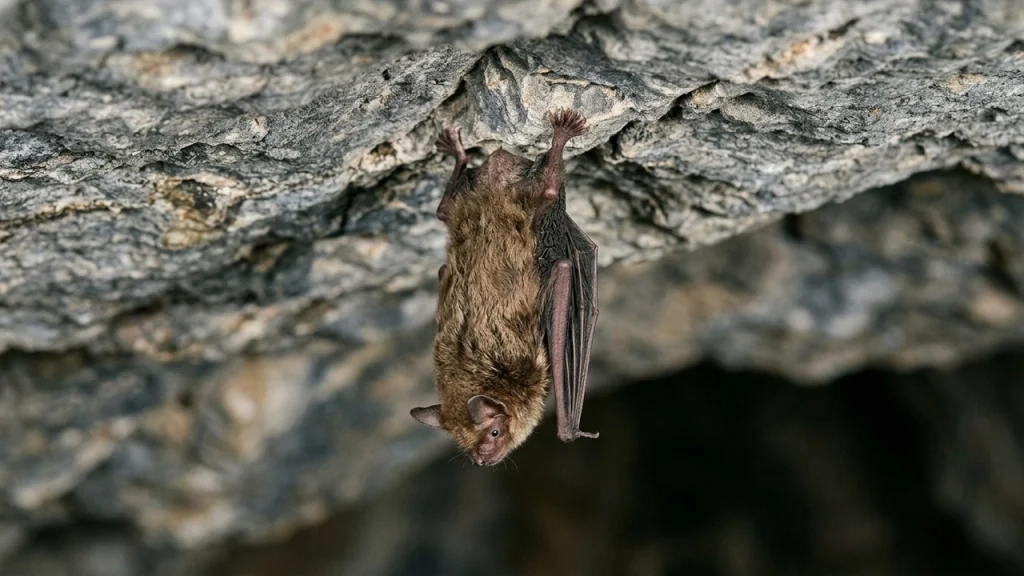
Animal Diversity Web describes hindlimbs that are generally short and small, ending in sharp, curved claws. Those claws are what bats cling with when they settle onto a surface in their roost.
Taking off reverses the arrangement. Most bats leave a hanging position by dropping away from it, and many of them cannot take off from the ground at all, the San Diego Zoo Wildlife Alliance says.
A grip that needs little effort
The Scientific Reports paper describes tendon-locking mechanisms as ratchet-like setups between the flexor tendons and the sheaths around them, and those setups can hold a degree of digital flexion with no continuous muscular effort.
Turning over in the air
According to PLOS Biology, a bat’s wings carry a lot of bone and muscle, and this is something the species exploits. The same journal adds that a bat can turn over quickly by shifting its wing mass relative to its body.
To invert itself as it lands, the animal pulls one wing closer while stretching the opposite wing outward. During that aerial turn it also stretches its feet upward toward the surface overhead. PLOS Biology reports that the combined flip and reach took half a second.
Touchdown happens in more than one way. A clawed thumb grips the substrate as the animal lands, and the iScience study catalogued two-point landings on both hind limbs, three-point landings that add one thumb claw, and four-point landings on both thumb claws and both hind limbs.
That two-point style let the bats in the study keep compressive forces low on their elongated hindlimb long bones. The same study also links acrobatic, low-impact landings to coevolution with shifts to stiff, horizontal roosts.
A simpler account comes from the San Diego Zoo Wildlife Alliance, which describes bats landing by slowing down until they stall and then seizing a branch or other surface. Some bats, they add, flip first and then grab hold.
Blood flow in an inverted roost
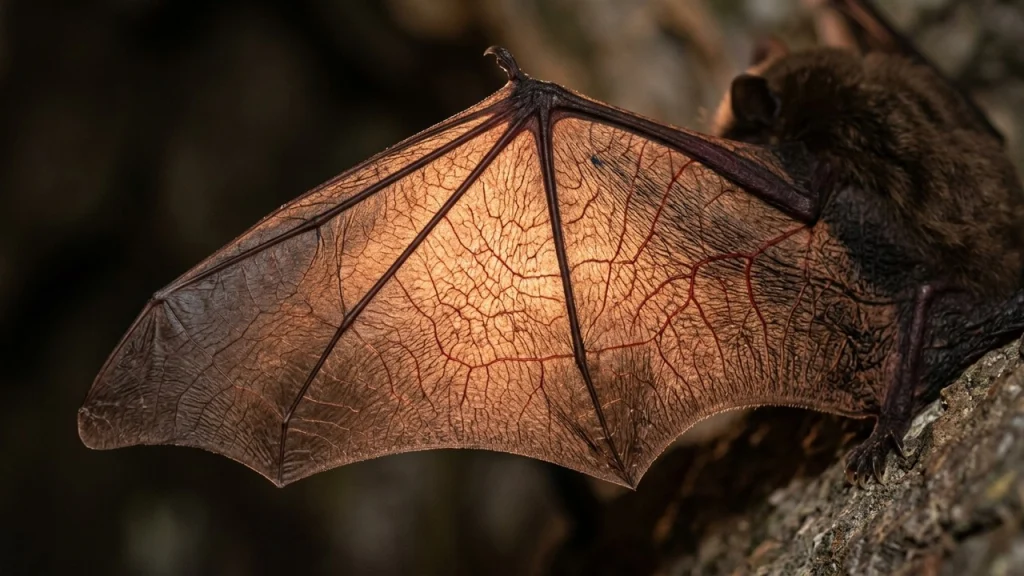
The wing vasculature plays a part in blood flow while a bat roosts inverted. According to a paper in BMC Biology, blood vessels running through the wings pulse in a wave-like rhythm that pushes blood toward the heart, both in flight and while the animal rests inverted.
What the posture means day to day
Wrapped like a cloak, the wings fold over a resting bat, the San Diego Zoo Wildlife Alliance says. Bats are status grabbers: dominant individuals take the prime, higher-up spots, and lower-ranking and juvenile animals make do on the fringe.
Small bodies and intense metabolic rates make conserving body warmth crucial for survival. Clustering together while roosting can further reduce heat loss, according to Animal Diversity Web.
The ground is the risk that hanging avoids. Bats generally dodge predators by staying in protected roosts during the day and flying agilely at night, and young bats still learning to fly face the same risk after a fall. A mother gives birth hanging from her feet, then catches her baby with her wings as it drops.
Sources
- San Diego Zoo Wildlife Alliance: Bat | San Diego Zoo Animals & Plants
- Animal Diversity Web: Chiroptera (bats) | INFORMATION | Animal Diversity Web
- PLOS Biology: How Bats Land Upside Down
- Scientific Reports: Vertical support use and primate origins
- BMC Biology: Wing pathology of white-nose syndrome in bats suggests life-threatening disruption of physiology
- iScience: Roosting ecology drives the evolution of diverse bat landing maneuvers