
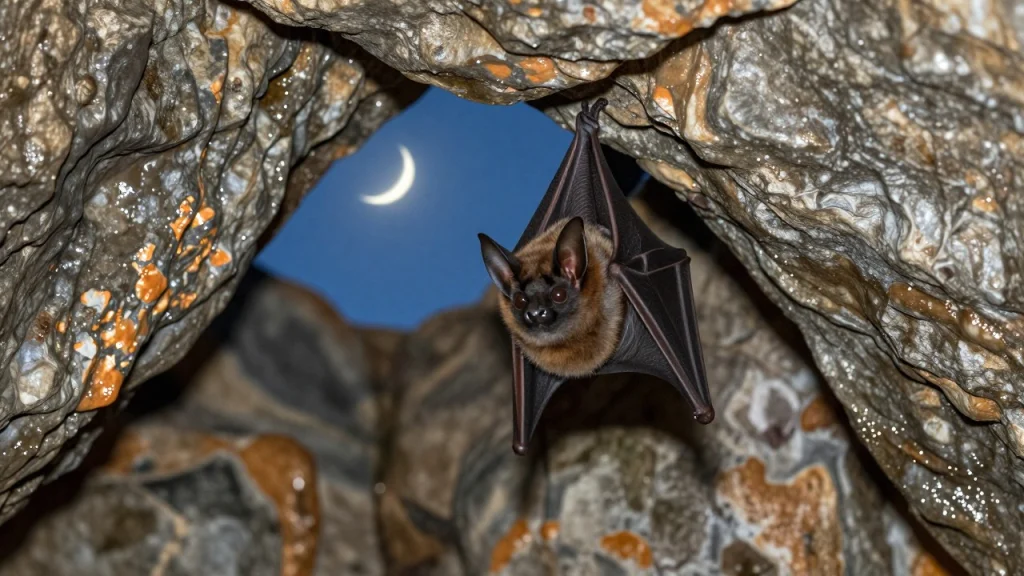
No, bats are not blind: every bat can see, and most see better at night than during the day. How sharp their sight is depends on the species, and at night many also use echolocation to find their way.
The phrase “blind as a bat” remains one of the most common idioms in the English language, but scientific research proves that no bat species on Earth is actually blind. Every known bat species possesses working eyes that perceive light, silhouette patterns, and motion. These nocturnal mammals do not wander aimlessly through dark skies, nor do they navigate without visual feedback.
Instead of lacking visual function, most bat species actually see far better in nocturnal darkness than during the day. Their ocular structures are specially tuned to low-light conditions, allowing them to detect environmental outlines under starlight, moonlight, and early evening twilight. Understanding how bats navigate nocturnal landscapes requires exploring how their visual systems interact with biological sonar.
Two evolutionary paths: megabats and microbats
All living bats belong to the taxonomic order Chiroptera, a name derived from classical roots that translates directly to “hand wing.” In mammalian history, these flying mammals represent the sole mammalian order capable of powered flight, and just the third vertebrate lineage in evolutionary history to do so.
Zoologists divide the order into two major biological groups, each characterized by distinct sensory specializations:
- Megachiroptera (megabats): Medium- to large-size bats that travel by sight and feed on floral resources.
- Microchiroptera (microbats): Smaller species that consume mostly insects and broadcast biological sonar pulses to navigate.
These two groups display marked structural contrasts in their cranial anatomy. Megachiropteran species orient themselves in nocturnal darkness through eyesight, giving them large, prominent eyes that gather ambient light. In contrast, microchiropterans generally have small eyes, relying far more on biological sonar than on ocular perception. Instead of oversized eyes, most microchiropterans possess large, complex pinnae (external ears), which frequently feature an enlarged tragus or antitragus to intercept returning audio signals.
Dietary ecology reinforces these morphological divisions. Because stationary tree fruits do not fly through the air, fruit-eating bats lack complex echolocation systems. Instead of tracking airborne targets through acoustic chirps, fruit bats depend on excellent eyesight and a keen sense of smell to find ripe food. Within the fruit bat suborder, only bats belonging to the genus Rousettus possess a simple form of acoustic orientation, which evolved entirely independently from the echolocation seen in microbats.
Retinal cones and unexpected color vision
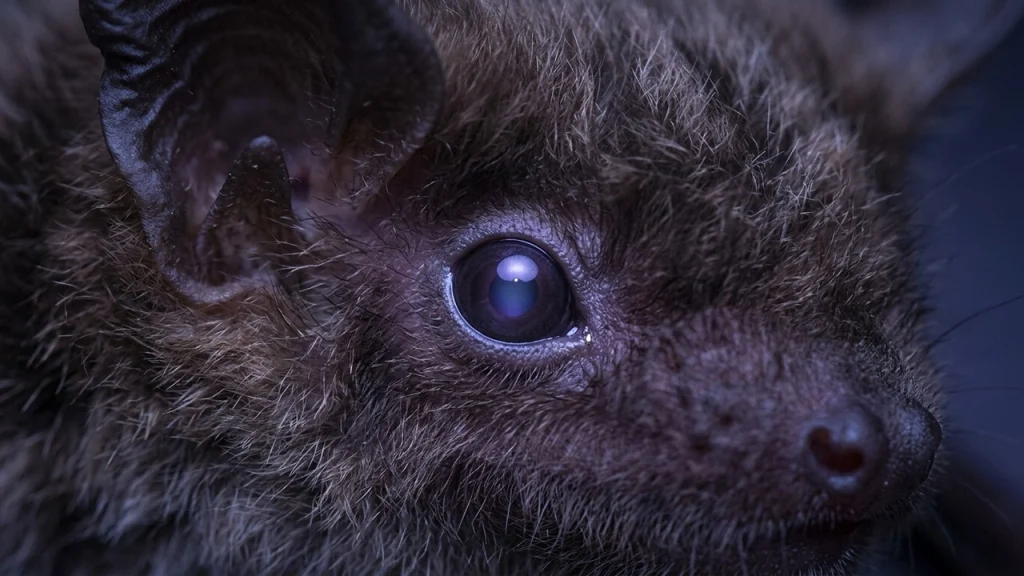
Across mammals, ocular retinas employ rod photoreceptors for nocturnal activity, whereas cone photoreceptors provide daylight sight and colour discrimination. Because microbats hunt flying prey through pitch-black caves and nighttime forests using echolocation, researchers historically believed that these animals possessed pure rod retinas devoid of cone photoreceptors.
Modern cellular analyses overturned that long-standing scientific belief. Laboratory investigations of two phyllostomid microbat species, Glossophaga soricina and Carollia perspicillata, revealed that these bats possess a significant population of retinal cones. These cones express two distinct opsin proteins:
- A shortwave-sensitive (S) opsin tuned to shorter wavelengths of light.
- A longwave-sensitive (L) opsin tuned to longer wavelengths of light.
Rather than perceiving an entirely monotone grayscale world, many bats possess functional color discrimination. All bat species native to the United States have dichromatic vision, meaning they are red-green colorblind and perceive their surroundings in shades of blue and yellow. Biologists suggest that this dichromatic visual system helps bats distinguish subtle color contrasts and outlines under dim twilight conditions.
Ultraviolet detection and twilight orientation
Genetic investigation of bat visual pigments shows that bats have retained the ancestral ultraviolet tuning of their S cone visual pigment. Genetic analysis indicates sensitivity to ultraviolet wavelengths below 400 nm, and corneal electroretinogram measurements confirm heightened sensitivity to ultraviolet light mediated by this cone pigment.
This specialized ultraviolet sensitivity provides crucial ecological advantages during crepuscular and nighttime hours:
- Locating food: Nectar-feeding bats use ultraviolet perception to detect ultraviolet-reflecting flowers opening during the night.
- Predator avoidance: Heightened visual sensitivity at twilight helps bats spot aerial predators against fading skies.
- Landscape navigation: Some bat species visually orient themselves by detecting polarized light patterns along the evening horizon.
Retaining functional cone photoreceptors proves that microbats have maintained the biological foundation for daylight vision, two-color vision, and ultraviolet perception alongside their nocturnal habits.
Passive vision versus active echolocation
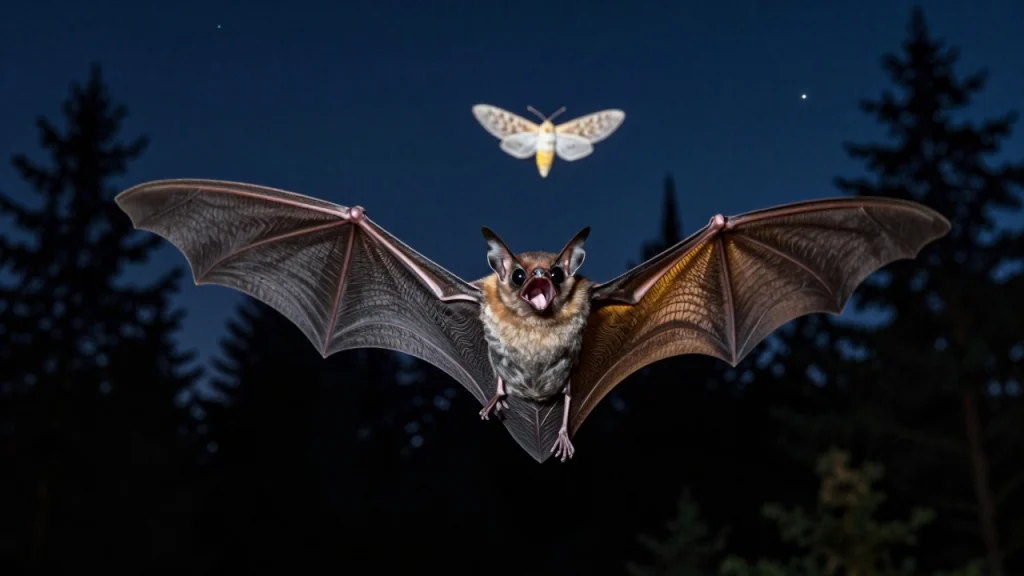
To understand why bats rely on both sensory systems, scientists examine the fundamental physical differences between sight and sound:
- Vision operates as a passive mode of perception: Optical systems rely on external sources of light energy, such as the moon, stars, or sunset glimmers, to stimulate retinal cells without expending bodily energy.
- Echolocation operates as an active mode of perception: Acoustic orientation requires animals to produce sound energy themselves, expending metabolic effort to broadcast calls into the surrounding air and analyze returning echoes.
Microbats utilize active biosonar to hunt flying insects, reading reflected sound waves to evaluate prey size, shape, speed, and trajectory in fractions of a second. Depending on the species, some bats produce high-frequency vocalizations reaching as high as 100 kHz, far above the threshold of human hearing.
Although biosonar provides exceptional resolution for small targets at close distances, it works over a limited range. Echolocation helps bats inspect immediate cave walls and chase evasive bugs, but they continue to rely on their eyes to see landmarks and open spaces beyond that acoustic range. Vision provides continuous, long-distance spatial context that sound pulses cannot deliver.
Multimodal hunting: combining eyes and sound in flight
Because active acoustic calls and ocular maintenance both demand energetic resources, bats integrate their senses to maximize foraging efficiency. Scientists hypothesized that bats maintain functional vision to provide sensory redundancy when commuting across landscapes and tracking small insects.
In an empirical field study, researchers fitted 21 wild noctule bats (Nyctalus noctula) with miniature recording tags, monitoring their spatial maneuvers and vocal pulses through dark and illuminated skies. The experimental findings revealed dramatic behavioral shifts between dark and illuminated conditions:
- In darkness, noctules closed in on insect prey at flight speeds averaging 5.2 m/s.
- In lit environments, noctules accelerated their prey approach speeds to 7.9 m/s.
- When tracking prey under illumination, noctules cut their echolocation call emission rate by half while increasing call intensity by 7 dB.
These measurements indicate that hunting bats combine acoustic and visual data in illuminated settings, producing faster and more efficient approaches to their prey. By using their eyes to spot insects against illuminated backgrounds, bats conserve acoustic effort while intercepting prey with greater velocity.
Gentle nocturnal mammals and maternal care
The remarkable visual and acoustic capabilities of bats support a rich variety of wild ecological roles. Popular culture often misrepresents bats as frightening bloodsuckers, yet among nearly 1,000 documented bat species, merely 3 feed on blood, which typically comes from cattle in Latin America. The vast majority of bat species serve natural ecosystems by consuming pest insects, dispersing seeds, and pollinating flowers.
Bats also display intricate maternal behaviors that rely on sensory coordination. All newborn bats depend entirely on their mothers for protection and nourishment. Mother bats nurse and care for their offspring in communal roosts.
Far from being blind, bats possess sophisticated, interconnected sensory systems. By pairing light-sensitive eyes with high-precision biosonar, these flying mammals perceive their environment through multiple complementary channels, thriving as agile nocturnal hunters and essential components of global biodiversity.
Can bats see in the dark?
West Texas A&M University says their vision is tuned to the light around dawn and dusk. The National Park Service says they echolocate at night and especially in caves, while their eyes take in what lies beyond the range of that sound.
Grand Canyon bats match people in eyesight. They add sound-based searching for nighttime meals.
Can bats see in daylight?
Yes, bats can see in daylight. A study in PLoS ONE found a significant population of retinal cones in two phyllostomid microbat species, Glossophaga soricina and Carollia perspicillata. Bats locate food by eye in daylight and by ear after dark.
The San Diego Zoo Wildlife Alliance describes bats as seeing in shades of black, white and gray. The National Park Service says every bat species in the United States is red-green colorblind and sees in shades of blue and yellow. The PLoS ONE study adds that bats retained the ancestral ultraviolet tuning of their S cone pigment. Its gene analysis suggests sensitivity to wavelengths below 400 nm, and corneal electroretinogram recordings revealed an elevated response to ultraviolet light mediated by that pigment.
Why do people say blind as a bat?
The saying may have started because rapid, irregular bat flight resembles a sightless person stumbling. What looks unsteady in bat flight is in fact fully planned motion. The National Park Service notes that bats are nocturnal and very rarely seen during the day.
Read literally, the phrase would credit excellent vision in dim light. In everyday usage, however, the idiom suggests poor eyesight.
Sources
- San Diego Zoo Wildlife Alliance: Bat | San Diego Zoo Animals & Plants
- Animal Diversity Web: Chiroptera (bats) | INFORMATION | Animal Diversity Web
- National Park Service: Bats – El Malpais National Monument (U.S. National Park Service)
- PLoS ONE: Bat Eyes Have Ultraviolet-Sensitive Cone Photoreceptors – PMC
- Proceedings of the National Academy of Sciences: Wild bats hunt insects faster under lit conditions by integrating acoustic and visual information – PMC
- Rutgers University: FS1207: The Facts About Bats in New Jersey (Rutgers NJAES)
- U.S. National Park Service: Bats – Grand Canyon National Park (U.S. National Park Service)
- West Texas A&M University: Why are bats blind? | Science Questions with Surprising Answers