
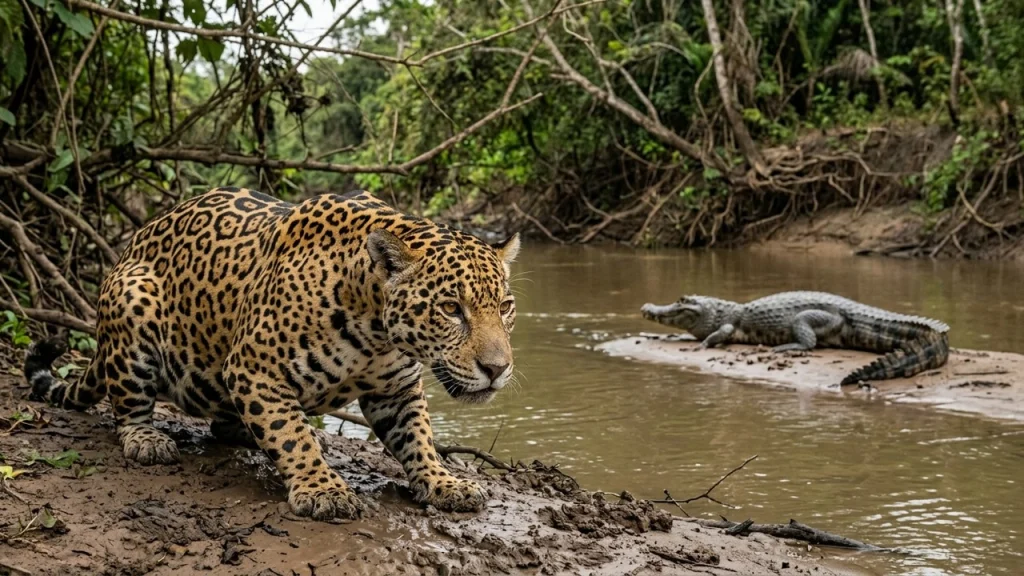
Yes, and it happens often, but size sets the limit. The jaguar is a pure meat eater, and researchers have counted upwards of 85 prey species on its menu, crocodilians among them. Most of the reptiles it takes are caimans, which are crocodilians in their own right and by far the more numerous and more approachable of the group. Work done on jaguars living in the Brazilian Pantanal places caiman alongside cattle and peccaries as one of the three foods these cats depend on.
The qualifier matters, though. This is not an even contest with a fully grown animal of the swamp. A study of jaguar prey weights puts what a cat can realistically take in a narrow band, and the largest crocodilian species on record fall well outside it. The fair summary is that jaguars hunt crocodilians, mostly caimans, and they succeed because of a bite that no other large cat in the Americas can match.
Which crocodilians share habitat with jaguars
Swimming ability is a big part of why the question comes up at all. The cat is comfortable in water and its range follows the banks of rivers, lagoons, wetlands and forest streams. A leopard in African savanna never crosses paths with a crocodilian, while a jaguar working the flooded forests and grasslands of South America regularly shares the same water.
Field descriptions of the species list three conditions a population needs: drinking water, dense vegetation, and enough prey to live on. The first brings caimans into the hunting range, the second lets the cat creep up on them, and the third decides whether those caimans are a routine meal or an occasional one.
Crocodylia holds three families and 23 species, and sizes diverge sharply across them. The smallest reaches roughly 1.5 m, while the Indopacific crocodile runs to about 7 m. In the part of the world jaguars occupy, the everyday encounters involve the yacare caiman of the Pantanal, the spectacled caiman, and a handful of dwarf species. Nothing on that list is a match for a full size crocodile such as the one at the top of the size range.
How a jaguar kills an armored animal
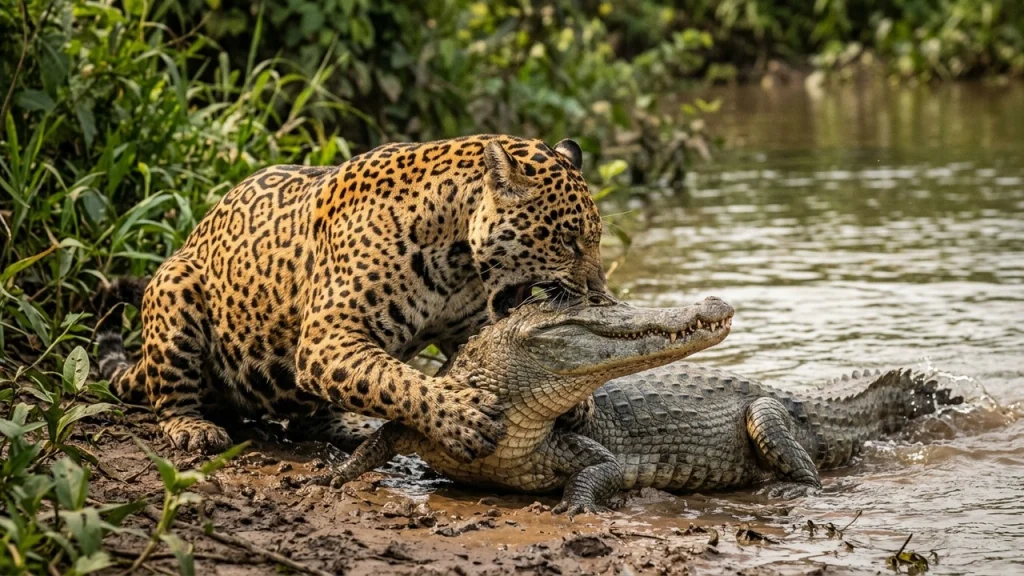
Reptile hide and bony shells are difficult materials to work through, so the mechanics settle the outcome. Among the big cats it is the only one known to have a real taste for reptiles. The cat’s oversized chewing muscles and needle teeth let it dispatch prey by driving those teeth into the skull, and that same technique is the reason turtles, tortoises and caimans are all on the table at all.
The neck is the target. A crushing bite there finishes a caiman quickly, and the usual sequence is a leap from concealment followed by either a suffocating hold on the neck or an instant kill through the back of the head. What makes this remarkable is that its jaws can shear through scaled skin and crack a shell cleanly, something a leaner predatory cat could not manage.
Securing the food is the last step. Researchers have recorded a jaguar hauling a sea turtle of 34 kg a distance of 91.5 meters into forest cover, which shows how much effort the animal will spend rather than abandoning a kill.
What the Pantanal field studies found
The firmest numbers come out of the Brazilian Pantanal, where a team tracked wild jaguars with satellite collars. Ten of the cats were collared and followed, five adult males, one younger male and four adult females. The work logged a total of 431 kill clusters, plus 153 prey items recovered from 125 separate scat samples, and both numbers came from the same tracked animals.
Walking the kill sites and analyzing droppings gave the same short list of staple prey: cattle, caiman and peccaries. Those three, combined, made up more than 70% of the recorded jaguar diet in both the wet and the dry season, which places a crocodilian in the core of the menu rather than at the fringe of it.
Timing explains why. Flooding in the wet season pushes caiman out of their hiding places and spreads them thinly across open ground, where far more cats can reach them. Consequently the caiman share of both kills and scats climbed during the wet season, because the flooding strips these reptiles of the cover they normally depend on.
A wider review points the same way. It pooled data from 25 studies covering 3214 recorded jaguar kills spread across the species’ entire range, and its prey list includes crocodilians and their eggs, and even dolphins.
Where the advantage reverses
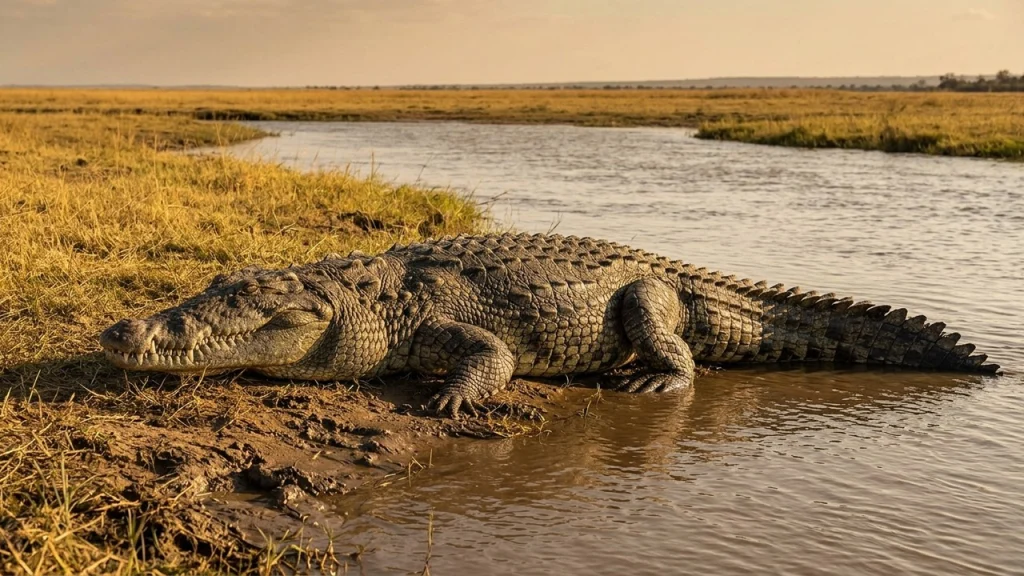
Crocodilians are not helpless, and the same build that makes them hard to kill makes them dangerous. Their armor plating and heavy muscular tail are the issue, and the tail does the damage. They can hit very high speed in a short burst to grab prey, though they cannot hold that pace and run an animal down when the first attack fails. A jaguar trying to haul a crocodile through deep water is fighting something that can swing sideways at the exact moment it has committed.
Weight is the real reason the biggest species stay off the menu. The prey a jaguar can access runs from 6 to 60 kg, and the band it prefers runs from 45 to 85 kg, so a grown crocodile of the larger species is simply too heavy to fall inside either range. Those animals have no pressure to fight a jaguar either, since a big crocodilian may go years without a single meal, up to two of them. A predator that eats only occasionally is not going to take a risk it does not have to.
What this means for a threatened cat
The IUCN classes the species as near threatened, the U.S. federal wildlife agency lists it as endangered, and CITES Appendix I covers it, with a rough estimate of about 10,000 animals still in the American wilderness and a population that is falling.
So the crocodile question is not only a curiosity about an unusual menu item. In some of the places where jaguars still survive, caimans are one of the few large, dependable wild sources of protein left, and the animal that depends on them is among the most threatened big cats in the world.
The short version: jaguars eat crocodilians, caimans above all, and they kill them with a neck bite backed by a skull piercing bite that no other cat can match. What they do not do is take on the largest adult crocodiles, which are too heavy to be worth the risk.
Sources
- Animal Diversity Web: Panthera onca (jaguar)
- San Diego Zoo Wildlife Alliance: Jaguar
- San Diego Zoo Wildlife Alliance Library: Jaguar (Panthera onca) Fact Sheet: Diet & Feeding
- PLOS ONE: Can Scat Analysis Describe the Feeding Habits of Big Cats? A Case Study with Jaguars (Panthera onca) in Southern Pantanal, Brazil
- Frontiers in Ecology and Evolution: Prey Preferences of the Jaguar Panthera onca Reflect the Post-Pleistocene Demise of Large Prey
- Animal Diversity Web: Crocodylia