
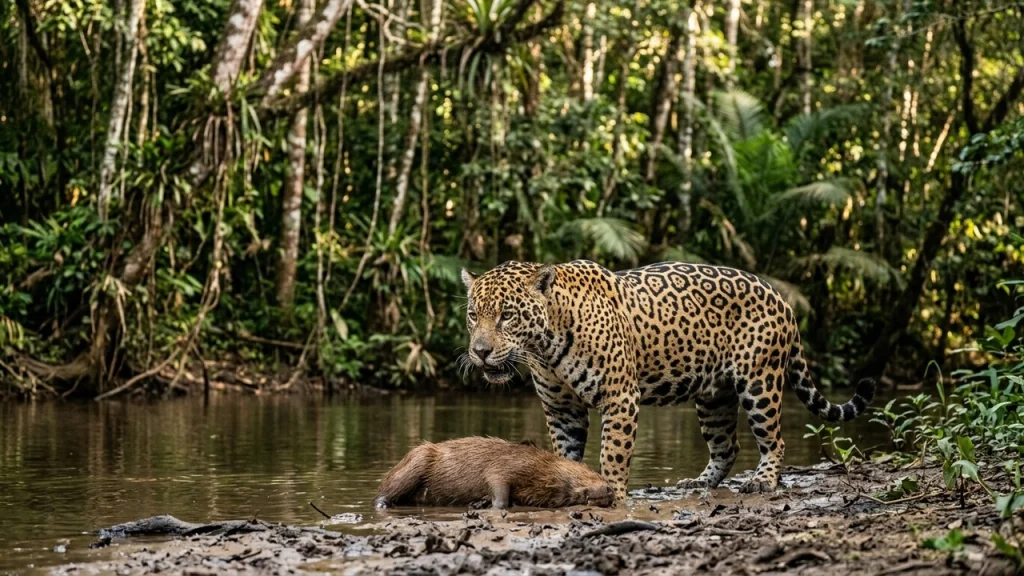
As the largest feline in the Americas, the jaguar (Panthera onca) occupies a crucial predatory role across tropical forests and wetlands. From a nutritional perspective, jaguars feed exclusively on meat. Field surveys demonstrate an extraordinarily broad predatory menu, as researchers have identified over 85 species across the cat’s nutritional intake. This vast dietary spectrum reflects an opportunistic foraging style across Central and South America.
When assessing what wild jaguars consume, their food choices include large ungulates, armored xenarthrans, and semi-aquatic wildlife. Among terrestrial mammals, preferred quarry consists of large animals, specifically peccaries, deer, and tapirs. However, these powerful predators do not restrict themselves to traditional hoofed game. Their opportunism extends to capturing caimans, turtles, snakes, porcupines, and capybaras. Rather than chasing swift prey across open plains, the cat relies on stealth and an extraordinary skull-cracking bite.
Continental dietary breadth and recorded prey
To understand the full scope of jaguar foraging, wildlife ecologists have synthesized extensive field data. A comprehensive continental review synthesized 25 studies documenting 3214 wild jaguar kills across Central and South America. This broad meta-analysis recorded 111 wild species taken by the cats, spanning small 1 kg rabbits up to massive 130 kg lowland tapirs. Such dietary flexibility demonstrates how readily the big cat adapts to local prey availability.
Across diverse biomes, a core set of prey species recurs consistently. The most recurring food items across studies, representing 16–21% of dietary records, included capybaras, caimans, collared peccaries, armadillos, and giant anteaters. These dominant prey groups fall into three natural categories:
- Heavy rodents such as capybaras
- Armored reptiles like caimans
- Thick-skinned mammals like peccaries and armadillos
Statistical models that account for local prey density reveal clear predatory preferences and avoidances. Statistical analysis revealed that the big cats strongly favored capybaras (Hydrochaeris hydrochaeris) and giant anteaters (Myrmecophaga tridactyla), while consistently avoiding tapirs, primates, carnivorans, agoutis, and black-eared opossums (Didelphis marsupialis). The avoidance of tapirs is especially striking. Tapirs represented the sole wild prey exceeding 100 kg in the analyzed dataset, and hunting records indicated that jaguars actively avoided both species.
Body mass ranges and predatory energy returns
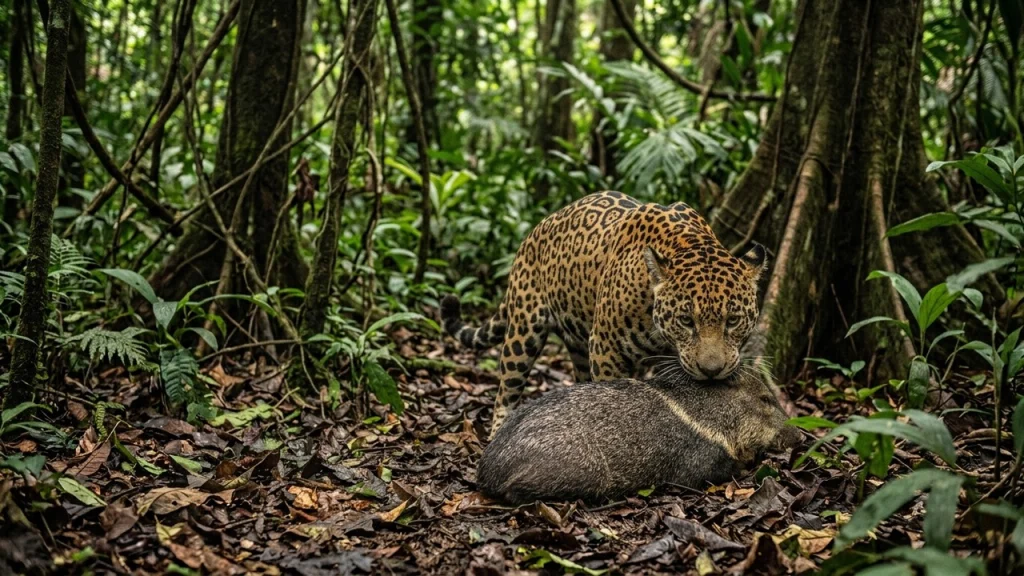
Predators balance the energetic payoff of a kill against the danger and exertion of the hunt. Segmented statistical modeling established that their accessible prey weight range spans from 6 to 60 kg.
When evaluating predatory efficiency, the preferred weight range for jaguar prey spans 45 to 85 kg. The average body mass calculated for their ideal, significantly preferred prey items comes out to 32 ± 14 kg. This mass aligns closely with adult capybaras and anteaters.
Based on an adult female body weight of 60 kg, the predator-to-ideal-prey ratio stands at 1: 0.53, shifting to 1:0.84 for smaller 38 kg individuals. This proportionally smaller prey selection reflects the extinction of Pleistocene megafauna, leaving modern jaguars adapted to harvesting medium-sized mammals and riverine reptiles.
Riparian foraging and aquatic hunting
Unlike many felids that avoid entering water, the jaguar possesses specialized adaptations for riverine hunting. Jaguars show a natural affinity for water and demonstrate remarkable prowess as accomplished swimmers. Because they routinely inhabit riparian corridors, these felines exhibit an appetite for water-dwelling animals.
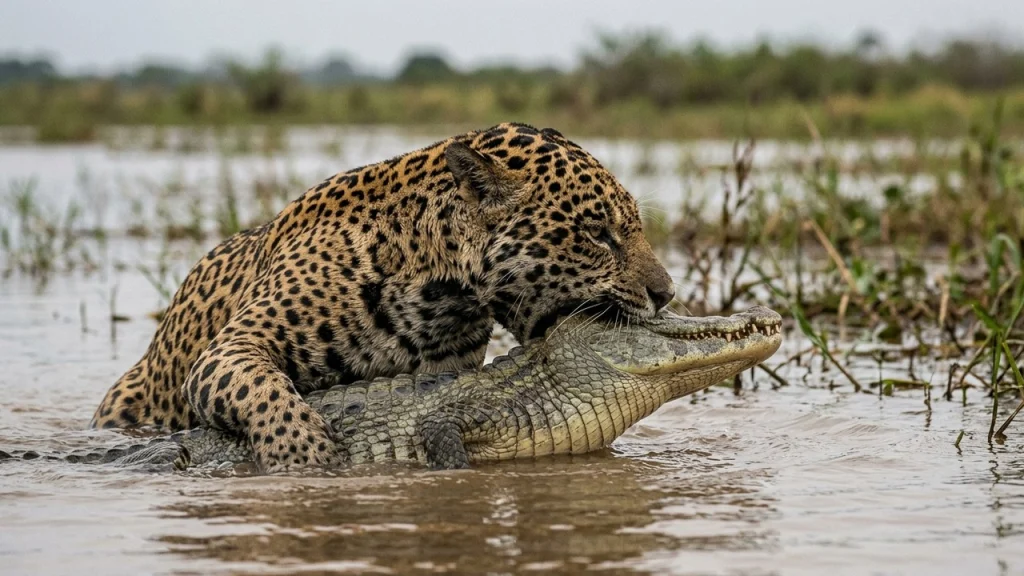
Their specialized cranial power allows them to consume armored reptiles, including spectacled caimans, freshwater turtles, and land tortoises.
In addition to overpowering crocodilians and turtles, jaguars display refined techniques for harvesting aquatic game. Naturalists have watched these cats wait motionless along riverbanks, gently flicking their tail tips against the water to lure curious fish.
Lethal mechanics and skull-crushing bites
Rather than sprinting across open terrain like lions or cheetahs, jaguars stealthily track and ambush terrestrial targets under cover of darkness.
Once contact is made, the cat executes a distinctive killing stroke. When subduing a catch, they can clamp the throat to induce asphyxiation or crush the posterior cranium using their canine teeth to inflict immediate death.
This cranial killing technique corresponds directly to the cat’s powerful skull morphology. This biomechanical adaptation enables the feline’s stout jaws and pointed teeth to crack armored turtle carapaces and penetrate tough reptilian hides. Once a target is subdued, the big cat hauls the carcass away into dense cover to feed in privacy.
Case study of dietary consistency in Belize
Field research in Central America illustrates how jaguar populations adapt their feeding habits to local ecosystems. Within Belize, the protected Cockscomb Basin Wildlife Sanctuary spans 425 km 2 of tropical forest that sustains dense populations of jaguars alongside pumas. The sanctuary’s surrounding landscape harbors at least 23 species of wild native land mammals exceeding 2 kg, alongside domestic cattle, pigs, sheep, and dogs on adjoining rural properties.
In a dietary study conducted in the sanctuary, researchers used molecular fecal genotyping to analyze individual foraging patterns. In the Belize scat analysis, male specimens accounted for a substantial 94% of collected fecal samples. The investigation revealed remarkable dietary consistency across resident males rather than individual specialization.
Most individuals adhered closely to a standard 2:1:1 dietary pattern composed of nine-banded armadillos (Dasypus noveminctus), other small vertebrates weighing 10 kg or less, and ungulates like collared and white-lipped peccaries (Pecari tajacu and Tayassu pecari). Longitudinal monitoring confirms that resident jaguars in this basin have maintained an armadillo-heavy foraging regimen for at least 20 years.
However, this foraging consistency does not prevent cats from taking domestic animals near farm boundaries. Field researchers observed clear behavioral prey switching between native wild ungulates and domestic stock among jaguars whose territories traversed both reserve boundaries and working farms.
Maternal care, captive diets, and ecological balance
Feeding behaviors develop early in a young jaguar’s life under maternal guidance. Mothers provide fresh kills to their offspring while continuing to nurse them until five to six months of age. Subadults begin capturing prey independently at 15 to 18 months old, yet remain close to their maternal home range until roughly two years of age before dispersing.
In professional zoological settings such as the San Diego Zoo, jaguars consume a prepared ground carnivore meat mixture accompanied by sturdy bones and periodic thawed rabbits.
In native ecosystems across the Americas, the feeding ecology of jaguars carries profound conservation ramifications. As dominant apex predators, these felines function as a keystone species by regulating prey numbers and shaping overall community structure.
Unfortunately, the cat’s predatory habits can spark conflict with human enterprise. When domestic herds graze near forest edges, jaguars occasionally kill cattle and other domestic livestock, sparking hostile retaliation from agricultural landholders. The species maintains a conservation ranking of near threatened under the IUCN.
Sources
- Animal Diversity Web: Panthera onca (jaguar)
- San Diego Zoo Wildlife Alliance: Jaguar | San Diego Zoo Animals & Plants
- PLOS ONE: Dietary similarity among jaguars (Panthera onca) in a high-density population
- Frontiers in Ecology and Evolution: Prey Preferences of the Jaguar Panthera onca Reflect the Post-Pleistocene Demise of Large Prey