
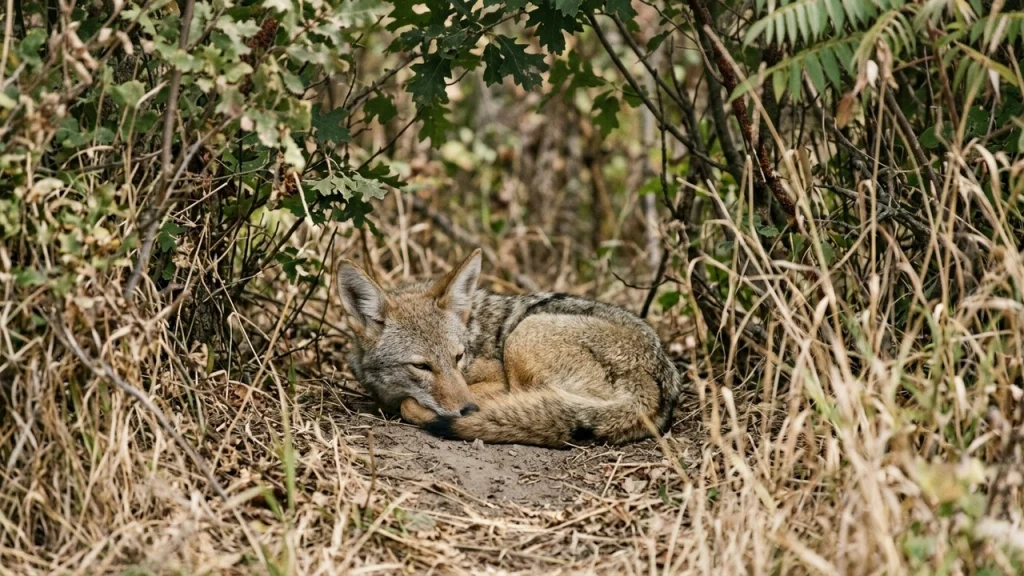
During daylight hours, coyotes primarily seek secluded bedding locations, commonly called loafing sites, to rest and remain hidden. While coyotes operate primarily under cover of darkness, people occasionally observe them roaming during broad daylight. In rural areas, open nature, and suburban green spaces, these wild canids curl up in dense thickets, overgrown brush, riparian corridors, or woodland margins rather than staying underground.
Subterranean dens do not serve as permanent year-round residences for adult coyotes. Instead, coyotes rely on underground burrows almost exclusively during the springtime pup-rearing season to protect newborn litters. Outside of the reproductive window, adult pack members sleep directly on the ground, in tall agricultural crops, or under bushy shrubbery within their territories. Although frequently categorized as nocturnal creatures, coyotes are actually crepuscular animals that reach their greatest activity levels around dawn and dusk. Close to human settlements in particular, their movements concentrate heavily during the early morning hours and late in the evening.
Bedding sites and vegetative cover across the landscape
In rural and forested regions, they bed down in areas such as:
- Overgrown brush, small woodlots, and vegetated fence rows provide essential concealment alongside hunting opportunities.
- When traveling and foraging across their home range, coyotes favor open woodlands, grassy meadows, woodland margins, and riparian corridors.
Scientific telemetry studies demonstrate that coyotes select specific buffer zones for their daily rest. In agricultural environments, coyotes typically loaf in forested patches within 50–300 m of borders next to farm fields and roadways.
Daytime bedding choices also shift dynamically with crop growth. Once winter wheat grew to heights of approximately 0.5 m between spring and summer, coyotes left woods behind to bed inside wheat fields, later shifting into tall corn after the wheat harvest.
The seasonal role of underground dens
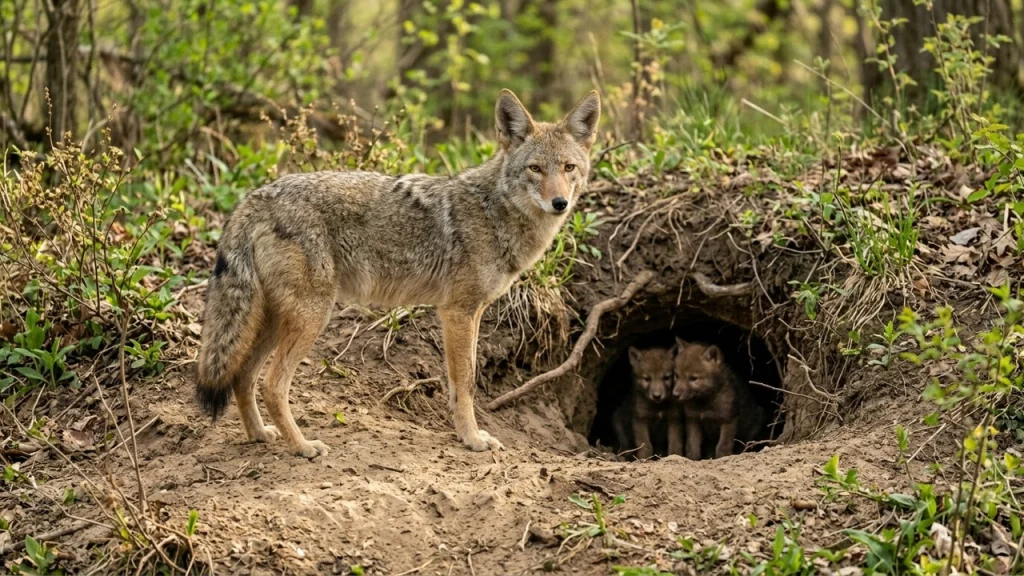
Contrary to common assumptions, adult coyotes do not spend every afternoon sleeping inside burrows. Underground dens function primarily as reproductive nurseries during spring and early summer.
Even though coyotes possess the ability to dig their own subterranean shelters, they frequently take over and widen abandoned tunnels created by badgers or woodchucks. Prior to whelping, adult coyotes excavate one or several dirt dens, occasionally modifying existing burrows or settling inside rock piles, hollow tree trunks, or drainage culverts.
These reproductive homes represent significant territorial investments for resident pairs:
- Coyote pairs often return to the exact same den sites year after year.
- An established coyote den usually contains multiple entry holes leading underground.
- Adults and developing youngsters routinely exit their underground burrows to urinate and defecate outdoors.
Protecting litters from natural predators
Vigilance remains exceptionally high while pups remain small and dependent. Parents confine young litters closely inside or beside the den to shield them against hostile competitors like wolves and mountain lions.
Human presence also strongly shapes where coyotes establish their nurseries. When selecting den locations inside suburban areas, coyotes consistently favor secluded pockets where human foot traffic remains minimal.
However, coyote parents maintain rapid emergency responses if their nursery is discovered. Whenever unexpected disturbances threaten the nursery area, coyote parents promptly relocate their entire litter to a backup den. Young pups first emerge above ground from their birth den at approximately 3 weeks of age, depending on their parents to hunt provisions during their early months.
Daylight foraging and family energy demands
While daylight usually signifies quiet rest for coyotes, seasonal demands occasionally alter this baseline pattern. Adults must adjust their schedules when they have hungry litters to support back at the nursery.
Throughout spring and early summer, parents display substantial daytime activity as they forage constantly to nourish fast-growing pups.
Coyote social structures support this intensive parental effort:
- Coyotes defend coordinated family territories composed of a mated pair, current pups, and grown offspring from previous litters.
- Adult body weight spans 25 – 45 pounds for males and 18 – 35 pounds for females.
Territorial patrol boundaries and daytime movements
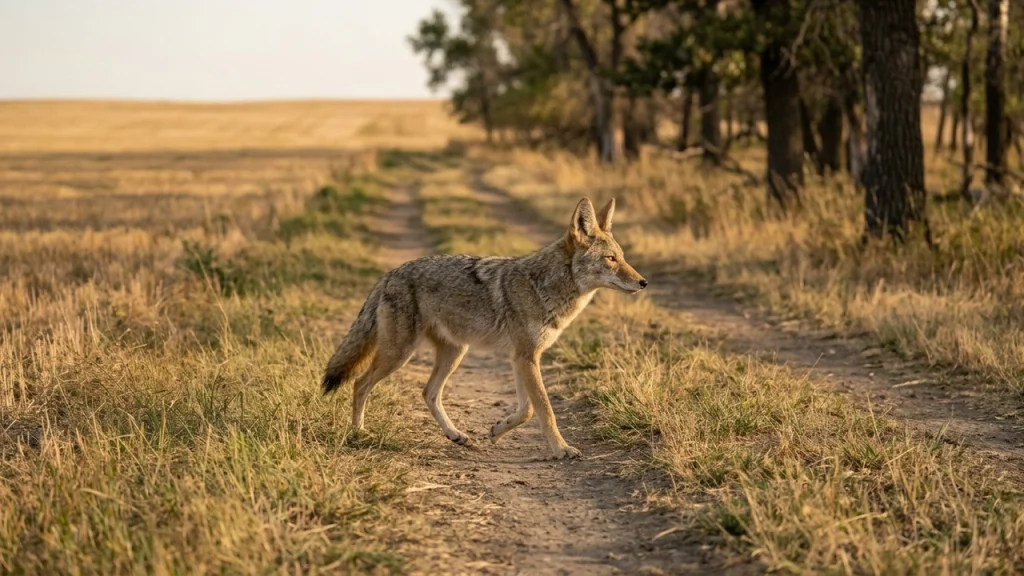
A resident coyote pack organizes its daily resting and hunting schedules within well-defined geographical boundaries. Coyote family home ranges encompass 2 – 30 square miles, shifting based on local prey abundance.
During the active pup-rearing season, defended family territories can measure up to 19 km across, centered on the den while pack members travel along established trails. During an ordinary night of foraging, a hunting coyote traverses an average distance of 4 km.
Telemetry research reveals clear physical boundaries in territorial maintenance. Radio-tracking investigations demonstrated resident territories measuring between 13 and 47 km 2 without exceeding 47 km 2, suggesting a natural ceiling for defensive patrol capacity.
Solitary transients and wide-ranging roamers
Not every coyote belongs to a stable family group holding permanent ground. Some coyotes are unattached, nomadic individuals known as transients.
These solitary animals adopt completely different daily movement strategies:
- Non-territorial transient coyotes roam over expansive landscapes, documenting wandering zones between 64.5 km² and 633.4 km² across varied regions.
- While traversing vast landscapes, transients often pause for several weeks in localized biding areas averaging about 21 km 2 that resemble resident home ranges.
Urban coyotes and daytime concealment
The remarkable expansion of coyotes into metropolitan cities demonstrates their outstanding behavioral adaptability. Because coyotes are opportunistic predators, individual animals often display noticeably different behavior patterns.
As a result of this ecological flexibility, certain coyotes flourish in urban sectors characterized by intense human presence and minimal natural vegetation.
Urban animals survive primarily by remaining invisible:
- Even within densely built environments, coyotes make concerted efforts to avoid people, meaning residents rarely see them and only occasionally hear their calls.
- Because of their secretive demeanor, numerous coyotes dwell right beside human neighborhoods without community members ever realizing they are there.
Property owners can discourage coyotes from bedding near residences by clearing thick weeds and brush to strip both predators and their rodent prey of sheltered cover. Landscaping maintenance should include trimming lower branches on bushes and small trees up to a height of 2 feet, removing concealed spaces where coyotes readily hide.
Understanding daytime coyote sightings
Seeing a coyote during daylight hours frequently prompts concern among homeowners. People should always exercise caution if they encounter a coyote during daylight hours, as daytime individuals may have lost their natural fear of humans.
Illness can also alter natural daily rhythms. When mange causes extensive fur loss, affected coyotes struggle to maintain normal body temperature, forcing them to search for warmth, nourishment, and shelter near buildings during daylight hours in freezing weather.
In summary, coyotes spend the majority of their daylight hours resting peacefully in dense brush, wooded forest edges, and tall agricultural fields. Underground dens remain specialized nurseries reserved for raising pups in spring. By understanding their preference for quiet daytime shelter and their crepuscular habits, human communities can peacefully coexist alongside these resilient wild canines across rural and urban landscapes alike.
Sources
- Animal Diversity Web: Canis latrans (coyote)
- National Park Service: Coyotes at Fredericksburg & Spotsylvania NMP
- University of California Agriculture and Natural Resources: Coyote: Pest Notes for Home and Landscape
- PLOS ONE: Space Use and Habitat Selection by Resident and Transient Coyotes (Canis latrans)
- Ohio State University Extension: Urban Coyotes: Conflict and Management