
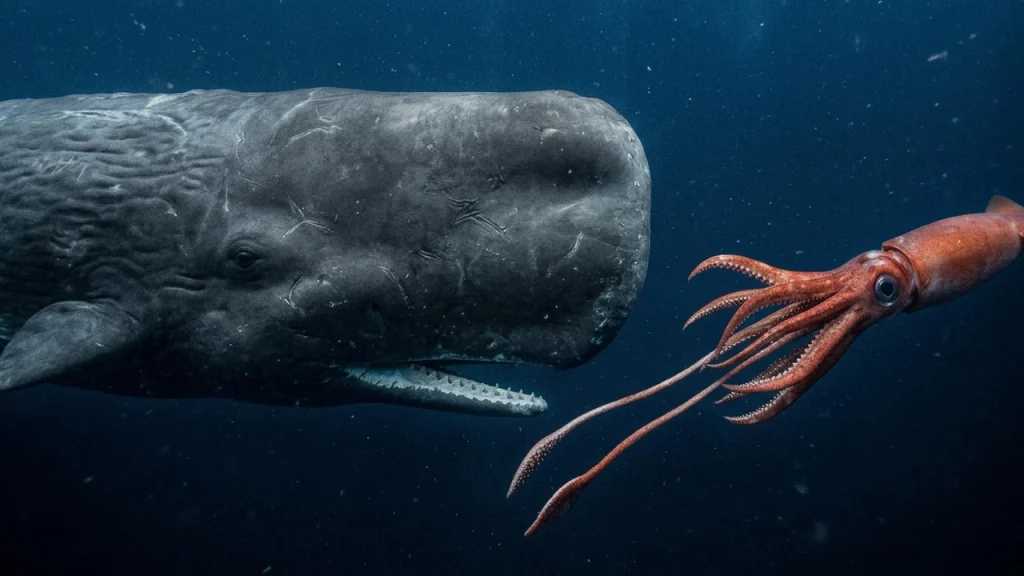
According to Animal Diversity Web, the sperm whale wins most of the time when it meets a giant squid. Its account of giant squid says that, huge as the animal is, it is not big enough to escape from a sperm whale or to fight one, and it points to the number of giant squid found in sperm whale stomachs as the evidence.
For the colossal squid, Animal Diversity Web says it may prey on or fight with the sperm whale, and it calls the sperm whale a known predator of the colossal squid. National Geographic says sperm whales eat giant squid and also the colossal squid, an even larger cousin. The Aquarium of the Pacific gives the sperm whale’s main food as large and medium-sized squid, and occasionally giant squid.
Beaks in stomachs and scars on skin
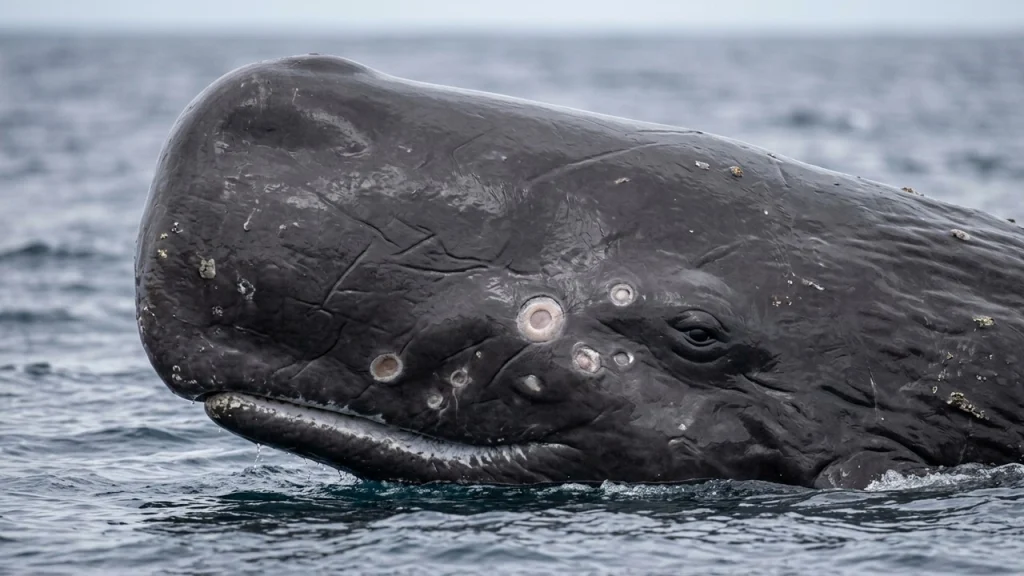
Sharp beaks from both giant squid and colossal squid have been found in sperm whale stomachs, according to National Geographic. It also reports that sperm whales often bear ring-shaped scars on their skin, made by the serrated ‘teeth’ on the squids’ suckers, and it describes them as marks of their battles.
How a sperm whale hunts
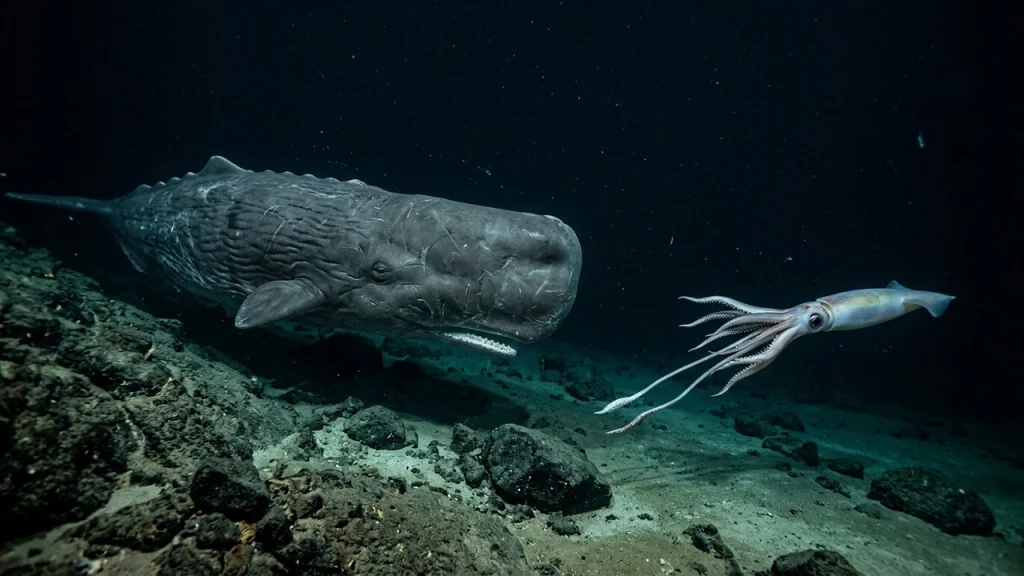
The Aquarium of the Pacific says sperm whales are believed to forage mainly on or near the ocean bottom, finding food in the dark depths with highly developed echolocation. NOAA Fisheries says sperm whales hunt on deep dives that routinely reach 2,000 feet and can last 45 minutes, and the Aquarium of the Pacific lists the sperm whale as the deepest diver among marine mammals, able to reach 2,987 meters (9,800 feet).
National Geographic puts the range of a sperm whale’s sonar at a few hundred meters and says it should always detect a giant squid before the squid sees the whale coming. According to the Aquarium of the Pacific, some of the clicks and creaks these whales make appear powerful enough to stun prey.
Giant squid: size, arms and eyes
National Geographic’s fact box lists giant squid (Architeuthis dux) at a size of 33 feet and a weight of 440 pounds.
Animal Diversity Web says most giant squid specimens found so far fall in the 35 to 45 foot range. The same account puts the heaviest animals at about a ton and says that most of the time they weigh a thousand pounds or less. National Geographic says the largest giant squid ever found was 59 feet long and weighed close to a ton.
Animal Diversity Web says giant squid have two tentacles averaging about 10 to 12 meters in length, plus eight arms with suckers in two longitudinal rows. National Geographic says giant squid and colossal squid both have record-setting eyes, some 10 inches in diameter. It also describes squid as generally good at fast bursts and says the few observations of live giant squid show them to be powerful animals.
Colossal squid: size, eyes and hooks
Animal Diversity Web says the colossal squid, Mesonychoteuthis hamiltoni, may reach a length of up to 14 m, with a mantle length of 2 to 4 m. The eyes can be up to 30 cm across, and the same account calls them possibly the largest in the animal kingdom. Its beaks are the largest of any squid, and it has 25 rotating hooks arranged in two rows at the ends of its tentacles.
Sperm whale size
NOAA Fisheries gives sperm whale length as running from 40 feet for females to 52 feet for males, and weight from 15 tons for females to 45 tons for males. It says the head is extremely large, about one-third of the total body length. The Aquarium of the Pacific says the sperm whale is the largest toothed whale as well as the largest toothed animal in the world.
Sources
- NOAA Fisheries: Sperm Whale
- Aquarium of the Pacific: Sperm Whale | Online Learning Center
- Animal Diversity Web: Architeuthis dux | INFORMATION
- Animal Diversity Web: Mesonychoteuthis hamiltoni | INFORMATION
- National Geographic: Giant Squid
- National Geographic: Giant squids’ huge eyes see the light of charging whales