
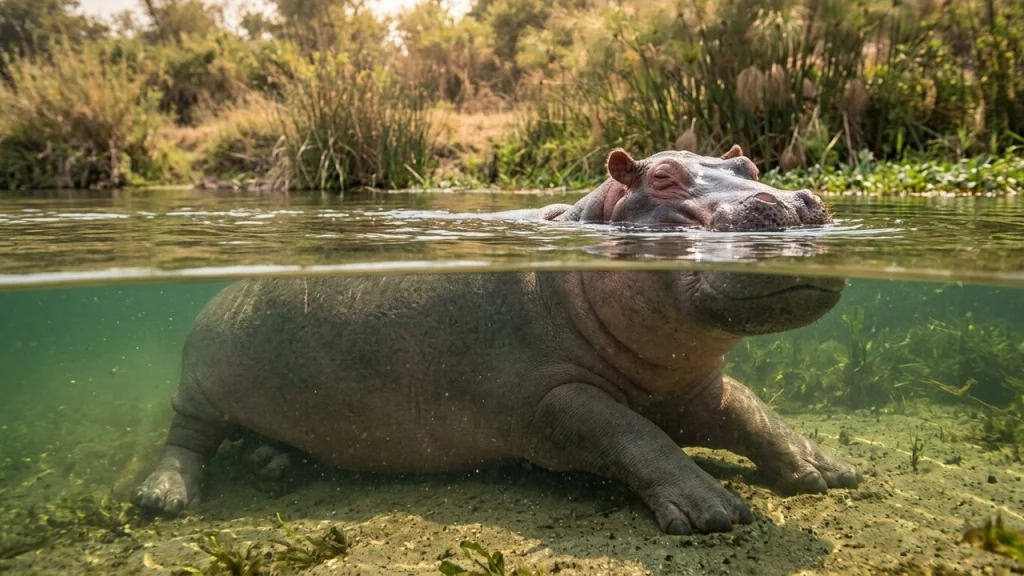
Hippos can even sleep underwater, the San Diego Zoo Wildlife Alliance says, using a reflex that lets them rise for a breath and sink back down without waking up. By day, herds prefer to sleep in shallow water, Animal Diversity Web says, though occasionally they sleep on a mud bank; they sleep grouped closely together.
A PubMed Central paper on the river hippopotamus is more cautious. It says hippos appear to sleep both on land and partially immersed in water, though behavioral studies in captivity point to the possibility that they can sleep fully submerged.
What the sleep research says
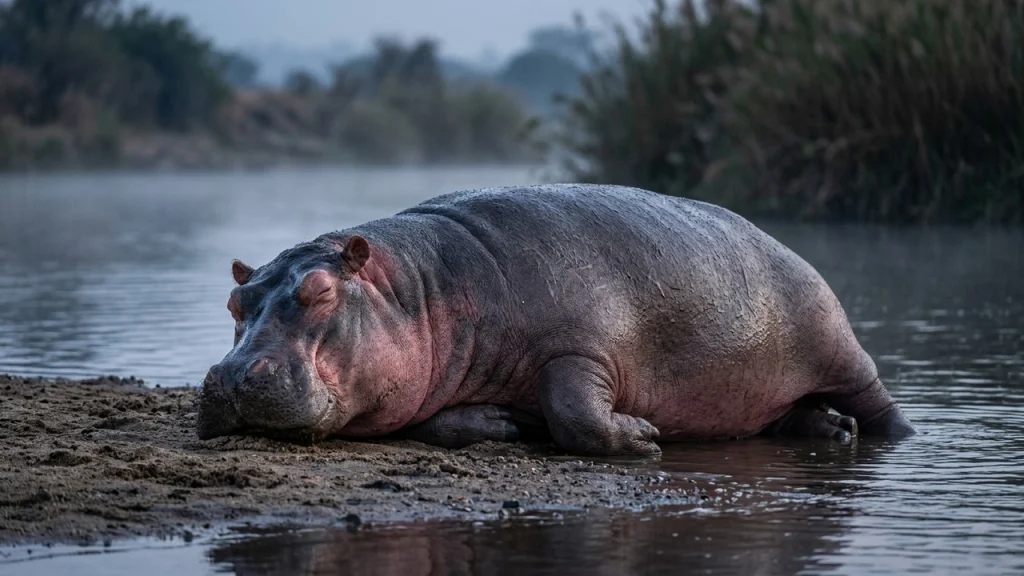
A figure in the paper pictures a pod of wild river hippos asleep in a river in South Africa’s Kruger National Park, according to its caption. Numerous phylogenetic studies place the river hippopotamus, Hippopotamus amphibius, within the sister taxon to the cetaceans, the paper says. It contrasts cetaceans, which it calls completely aquatic carnivores, with the river hippopotamus, a semiaquatic herbivore.
On sleep itself, the paper says potential REM suppression like that seen in cetaceans is unlikely to occur in the hippopotamus during sleep, which supports behavioral observations by Lyamin and colleagues. It also says it would be harder for a hippo’s cerebral hemispheres to work as independent units, as seen during sleep in cetaceans.
The paper concludes cautiously: it would appear safe to say that the hippopotamus does not have a specific sleep physiology in common with the cetaceans. Given its long independent evolutionary trajectory, it adds, the hippopotamus is best considered its own very unusual Cetartiodactyl, not a step toward becoming a cetacean.
Resting together in pools
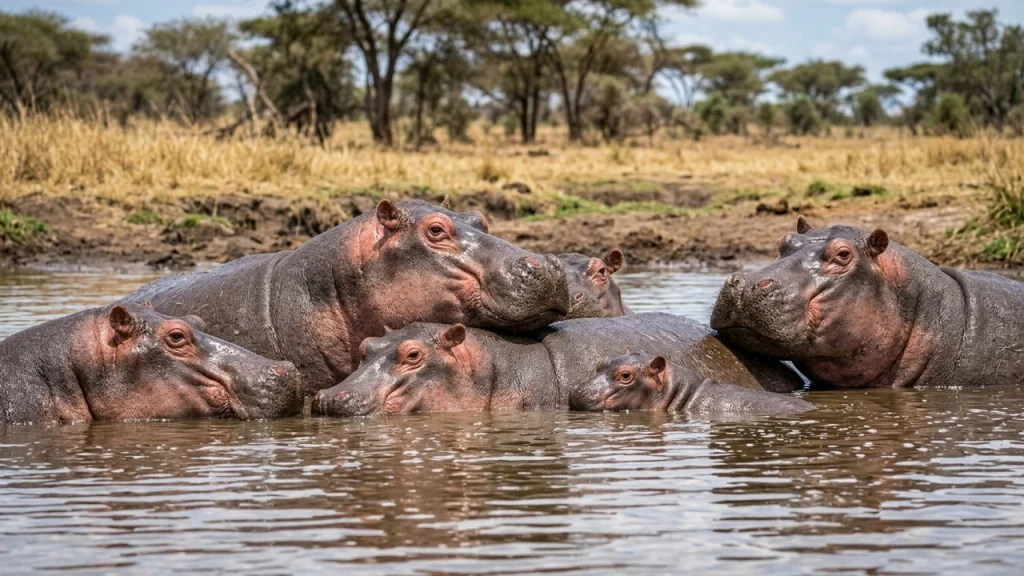
Hippos spend almost all of their daylight hours wallowing in shallow water, the San Diego Zoo Wildlife Alliance says. Animal Diversity Web adds that hippos often rest close together, with their heads on each other’s backs.
Female hippos lead the herd and control the centers of the resting pools, according to Animal Diversity Web, while males rest along the pools’ outer banks and protect the females and calves.
Water depth and breathing
On depth, Animal Diversity Web notes that the water must be deep enough for a hippo to submerge its whole body, and that water about 2 meters deep is usually preferred. When shallow water is not available, hippos stay in deeper water with only their nostrils above the surface to breathe, it says.
The Denver Zoo Conservation Alliance says a hippo can remain completely underwater for five to six minutes. Hippos can hold their breath for at least five minutes when submerged, the San Diego Zoo Wildlife Alliance says.
When a hippo submerges completely, its nostrils close and its ears fold to keep water out, Animal Diversity Web says. The same source says that placing the eyes, ears and nostrils high on the head allows hippos to stay mostly submerged while they can still breathe and stay aware of their surroundings. The San Diego Zoo Wildlife Alliance says hippos can’t swim and can’t even float, despite their adaptations to life in the water.
Daytime rest and night grazing
Hippos lead very sedentary lives, according to Animal Diversity Web: they rest most of the day, then leave their resting pools at dusk to feed. The same source adds that most of a hippo’s activity is nocturnal.
After the hot sun sets in the evening, hippos leave the water for a night of grazing that goes on for about six hours, the San Diego Zoo Wildlife Alliance says. The IUCN SSC Hippo Specialist Group says animals are usually present in the water all night even though hippos can graze every night, as some return after a few hours while others leave later.
Hippos cannot sweat, the Denver Zoo Conservation Alliance says, so submerging in water, or covering themselves in mud, helps their bodies stay cool during the heat of the day. Staying in the water by day also protects hippos from the sun, the same organization adds. It is likely that thermoregulation has determined hippos’ nocturnal feeding habits, according to the IUCN SSC Hippo Specialist Group.
Food intake is small relative to a hippo’s size, the IUCN SSC Hippo Specialist Group says, but resting by day reduces its energetic demands, and food may stay in the gut longer than in most large herbivores.
Sources
- San Diego Zoo Wildlife Alliance: Hippo | San Diego Zoo Animals & Plants
- Animal Diversity Web: Hippopotamus amphibius (hippopotamus)
- PubMed Central: Organization of the Sleep-Related Neural Systems in the Brain of the River Hippopotamus (Hippopotamus amphibius): A Most Unusual Cetartiodactyl Species
- IUCN SSC Hippo Specialist Group: Common Hippopotamus | Hippo Specialist Group
- Denver Zoo Conservation Alliance: River Hippopotamus | Denver Zoo Conservation Alliance