
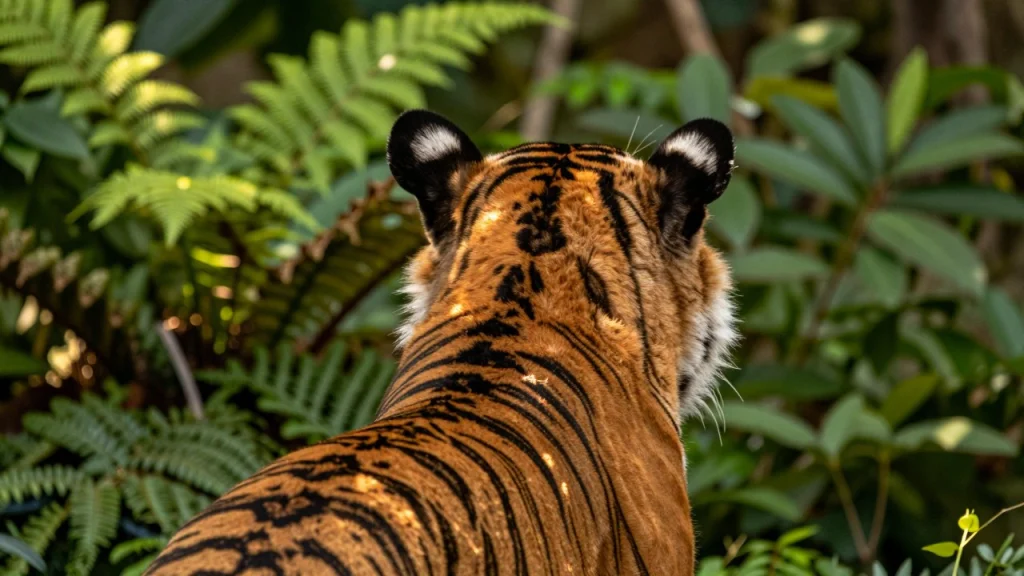
Tigers are known worldwide for their bold orange and black stripes. They also have white spots on the backs of their ears. These distinct patches, scientifically referred to as ocelli or “false eyes,” serve critical evolutionary purposes that aid in survival, communication, and visual camouflage in the wild.
These white markings are surrounded by jet-black fur, creating a high-contrast pattern that stands out even from a distance. While their exact purpose isn’t fully confirmed, these spots are thought to serve two functions: visual communication among tigers and defensive camouflage against potential threats.
Visual Communication and Cub Following
One proposed function of the white ear spots is visual signaling, particularly between a mother tiger and her cubs. In the dense vegetation of tropical forests, tall grasslands, and thick bush habitats where tigers live, maintaining visual contact with offspring can be challenging.
When a tigress walks through dense brush, she typically carries her ears slightly back or upright. The high-contrast white spots act as bright visual beacons or “follow-me” signals for her cubs.
- High visibility: The stark contrast between the white patch and the dark ear edging makes the mother easy to spot even in low-light conditions.
- Navigation aid: Young cubs can follow their mother through thick undergrowth without breaking camouflage or making unnecessary noise.
- Group coordination: The markings help maintain family cohesion while moving through complex, obstructed environments.
Threat Display and Expressing Aggression

In addition to guiding cubs, ear position plays a vital role in tiger communication and social interactions. Tigers use body language, particularly facial expressions and ear orientations, to signal their mood to rivals, predators, or other animals.
When a tiger feels threatened or intends to display aggression, it flattens its ears backwards against its head. This movement rotates the white spots forward, presenting two large, bright white marks directly toward the opponent.
- Intimidation display: Facing the white patches forward creates a sudden, startling visual contrast that signals hostility or defensive readiness.
- Mood indicator: The sudden visibility of the white spots serves as a clear warning sign to other animals to back off, potentially preventing physical conflict.
- Facial emphasis: The white spots draw attention to the tiger’s facial expression, highlighting bared teeth and aggressive postures.
Defensive Camouflage and “False Eyes”
Another key evolutionary purpose of these ear spots is defensive deception. The circular white patches surrounded by dark fur resemble large, unblinking eyes when viewed from behind.
In the wild, many predators and rivals avoid attacking an animal that appears to be looking directly at them. For a resting or drinking tiger, these “false eyes” can deter surprise ambushes from other predators or competing tigers.
- Deceiving rivals: An approaching animal might mistake the white spots for open, attentive eyes, leading it to believe the tiger is awake and watching.
- Preventing surprise attacks: Ambush tactics rely on stealth; if a potential aggressor thinks it has been spotted, it is less likely to strike.
- Disrupting outline: In dappled sunlight filtering through trees, the contrasting spots break up the tiger’s physical silhouette, blending its ears into background highlights.
Do Other Wild Felines Have White Ear Spots?
Leopards also have white spots on the backs of their ears. Like tigers, leopards inhabit dense cover or tall grass where visual signaling between mothers and offspring or aggressive ear-position displays are beneficial for survival.
Ultimately, the white spots on the back of a tiger’s ears are a remarkable adaptation. Whether guiding young cubs through shadowed forests, signaling aggression to rivals, or acting as false eyes to deter surprise attacks, these small patches of fur play a big role in the everyday survival of these majestic predators.
Sources
- Animal Diversity Web: Panthera tigris (tiger) | INFORMATION | Animal Diversity Web
- San Diego Zoo Wildlife Alliance: Leopard | San Diego Zoo Animals & Plants
- Animal Diversity Web: Acinonyx jubatus (cheetah) | INFORMATION | Animal Diversity Web
- Animal Diversity Web: Leptailurus serval (serval) | INFORMATION | Animal Diversity Web