
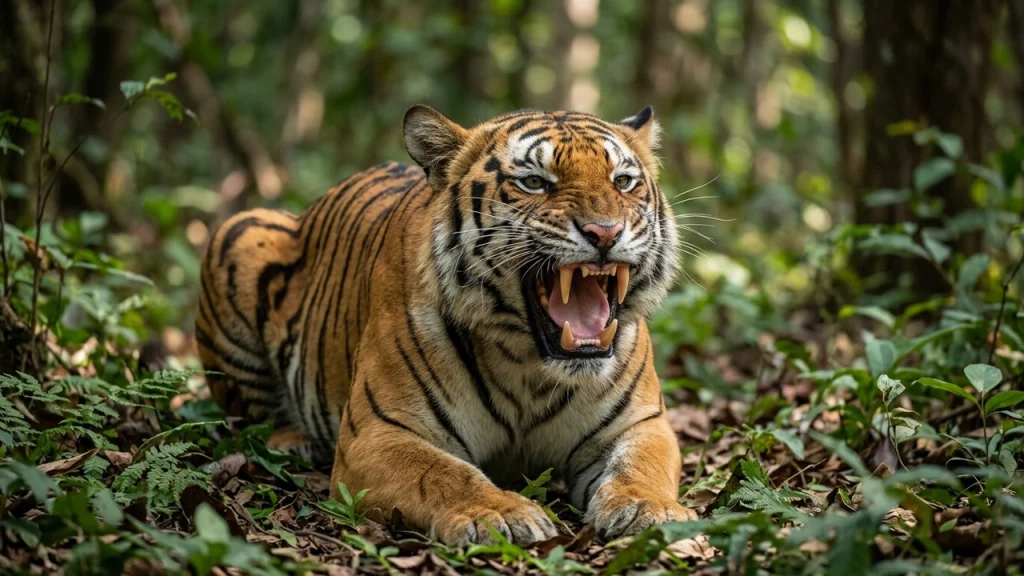
Two different figures are quoted for a tiger’s bite, and they come from different kinds of source. The San Diego Zoo Wildlife Alliance states that the average tiger’s bite exerts 1,050 pounds per square inch (PSI), while a lion’s exerts only 600 PSI.
A craniometric study of carnivore skulls calculated bite force instead, using a mathematical lever model. For tigers it gives 3375.27 N (newtons) at the canines and 4172.26 N at the carnassials. The zoo’s PSI figure is a stated figure, while the study’s newton values are modeled from skulls, so the two are not conversions of each other.
How the figures were produced
The study worked from complete, dry crania and mandibles taken from individuals kept in captivity. Its researchers took 33 measurements on each skull, mandible, temporomandibular joint and teeth, then calculated bite force with the lever model. In all the individuals it studied, the bite force at the carnassial was on average greater than at the canine.
A veterinary review of bite forces in dogs and cats found values that were highly variable depending on the animal’s willingness, the situation or the measurement technique. The review adds that some measurement methods do not accurately mimic conscious bite force measurements, and forces measured that way can be lower than “live” measurements.
How the tiger compares with lions, bears and domestic cats
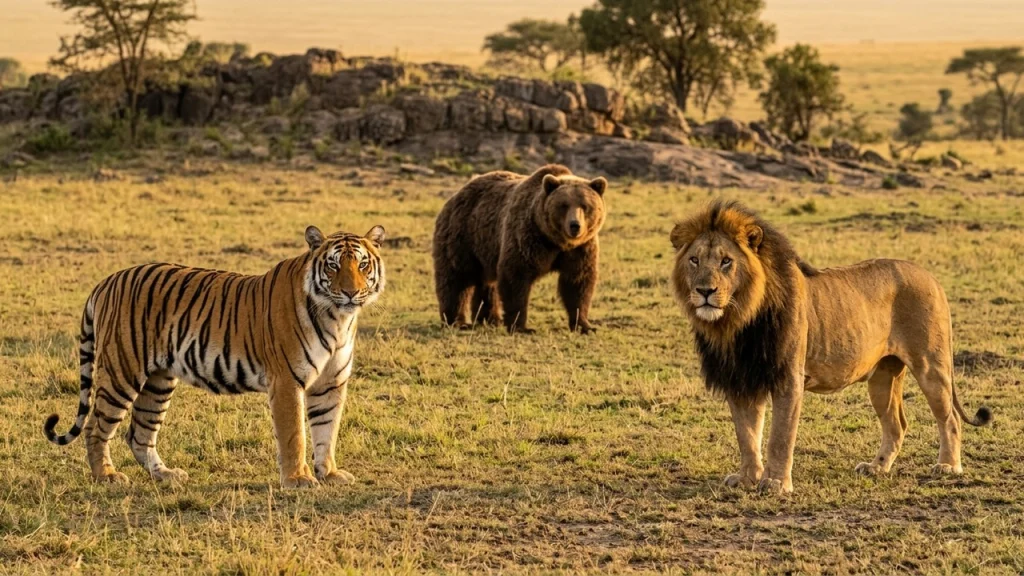
In the skull study, the tiger’s canine figure of 3375.27 N is above the African lion’s 2608.77 N, while at the carnassials the lion’s 4566.87 N is above the tiger’s 4172.26 N. The study calculated values for two more species:
- Brown bear: 1627.01 N at the canine teeth, a value ranked between the largest felines and canids.
- Domestic cat: 184.06 N at the canine teeth and 332.79 N at the carnassials.
The study also lists a separate score with no unit, in which the Bengal tiger comes out highest among the felines studied at 193.46, ahead of the African lion at 119.46 and domestic cats at 79.19.
What gives a tiger its bite
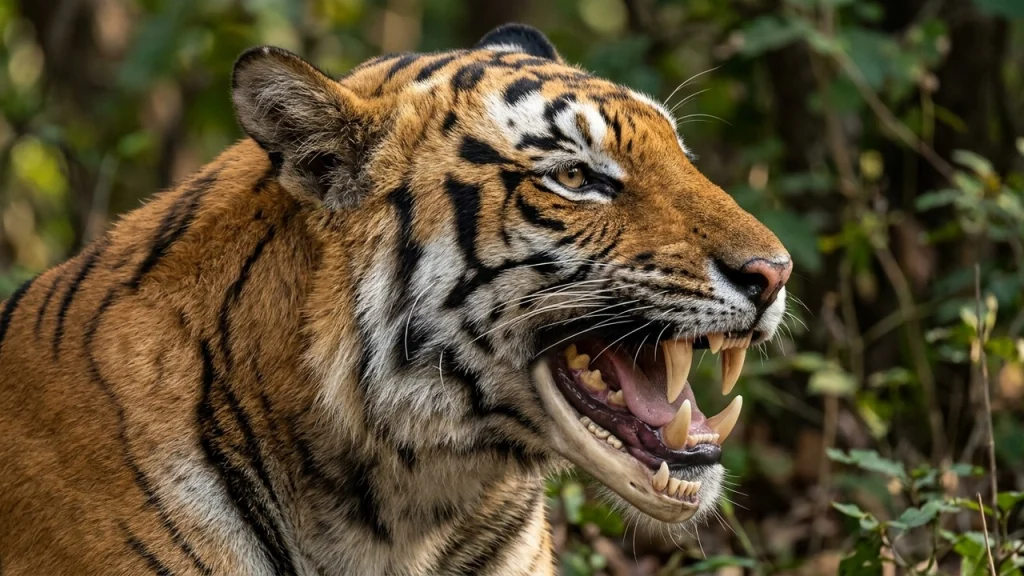
According to the veterinary review, bite force comes from the chewing (masticatory) muscles, the jawbones (mandibles and maxillae), the temporomandibular joints and the teeth working together. Animal Diversity Web notes a well-developed sagittal crest and coronoid processes in tigers, which provide attachment for muscles behind their strong bite.
Animal Diversity Web says the canines of Bengal tigers measure 7.5 to 10 cm, the longest of any living large cat, and the San Diego Zoo Wildlife Alliance credits tigers with the largest canine teeth of any living cat. A tiger starts feeding at the buttocks and uses its carnassials to rip open the carcass.
The skull study found a strong correlation between cranial size and bite force. The veterinary review lists body weight and the skull’s morphology and size as the main factors affecting bite forces in dogs and cats. Animal Diversity Web gives a tiger body mass range of 91 to 423 kg and says male Siberian tigers can reach 3.7 meters and weigh over 423 kg.
A tiger’s tongue is covered with hard papillae, which scrape flesh off the bones of prey. The Smithsonian’s National Zoo feeds its tigers rabbits once a week and knucklebones or cow femurs twice a week, with the aim of exercising their jaws and keeping their teeth healthy.
How a tiger uses its bite on prey
Animal Diversity Web says a tiger kills small animals, those weighing less than half its own body weight, with a bite to the back of the neck. The canines slip between the neck vertebrae and force them apart, breaking the spinal cord. For larger animals, a bite to the throat crushes the trachea and suffocates the animal. Animal Diversity Web calls this the safer tactic because it reduces the physical assault the tiger may receive while killing its prey.
The San Diego Zoo Wildlife Alliance describes tigers using their large canine teeth and powerful jaws to grab prey by the neck and suffocate it. According to Animal Diversity Web, a tiger’s attack ends in a successful hunt only 1 time in 10 to 20. Kills come once or twice a week, the zoo alliance says, and a tiger eats as much as it can. Animal Diversity Web gives 18 to 40 kg of meat as what a tiger eats after a successful large kill, and says tigers do not typically eat every day.
Tigers in the wild today
The Smithsonian’s National Zoo says tigers are considered an endangered species globally. On the IUCN Red List the Sumatran subspecies is listed as critically endangered and the Amur as endangered, and all tigers are protected under CITES Appendix I.
Of the nine tiger subspecies that once existed, six remain. The South China tiger is believed to be nearly or entirely gone from the wild. The zoo calls 3,900 a generous estimate of the tigers left in the wild, of which roughly 200 to 400 are Sumatran and 360 are Amur.
Sources
- Animal Diversity Web: Panthera tigris (Tiger) – Animal Diversity Web
- Animals (MDPI), PubMed Central: Craniometric Characteristics of Selected Carnivora Species Kept in Captivity in Relation to Bite Force and Bending Strength of the Upper Canines
- Veterinary Sciences (MDPI), PubMed Central: Bite Forces and Their Measurement in Dogs and Cats
- San Diego Zoo Wildlife Alliance: Countdown to Global Tiger Day.2 Days To Go!
- San Diego Zoo Wildlife Alliance: Tiger – Animals & Plants
- Smithsonian’s National Zoo: Tiger – Smithsonian’s National Zoo and Conservation Biology Institute