
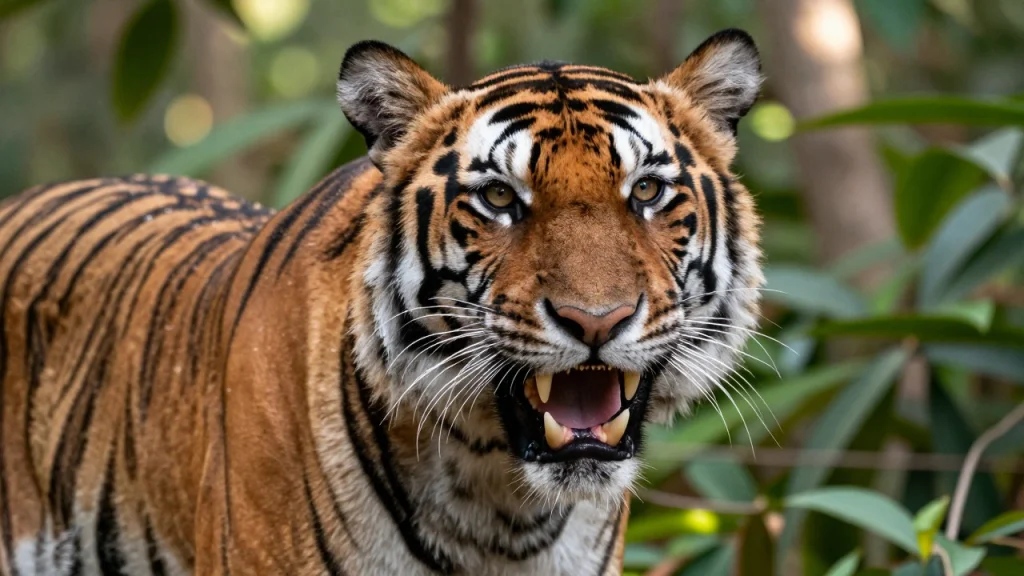
An adult tiger has 30 teeth, a specialized dental set fine-tuned for a hypercarnivorous diet. As top predators in their ecosystems, tigers rely on these sharp, powerful teeth to catch prey, tear through tough muscle, and crush bone.
While humans have 32 teeth adapted for an omnivorous diet, big cats like tigers have fewer teeth. Their dental arrangement prioritizes cutting and gripping over chewing, an adaptation for hunting large mammals.
The Dental Structure of an Adult Tiger
A tiger’s mouth contains four distinct types of teeth, each serving a specific function during hunting and feeding. Like most mammals, tigers are diphyodonts, meaning they grow two sets of teeth during their lifetime: temporary milk teeth (deciduous teeth) as cubs, and permanent adult teeth.
Tiger Dental Formula (Half Jaw):
Upper: 3 Incisors | 1 Canine | 3 Premolars | 1 Molar
Lower: 3 Incisors | 1 Canine | 2 Premolars | 1 Molar
Total: (3+1+3+1) + (3+1+2+1) = 15 per side x 2 = 30 Teeth
Incisors: Precision and Grooming
Located at the very front of the upper and lower jaws, the 12 incisors (six on top and six on the bottom) are relatively small and narrow.
- Plucking and Scraping: Tigers use their incisors to strip feathers or fur from prey and scrape meat directly off bones.
- Grooming: These front teeth help clean dirt, debris, and parasites from their coat.
Canines: The Lethal Weapons
Flanking the incisors are the 4 massive canine teeth (two upper and two lower). Bengal tigers have the longest canines of any living large cat, measuring about 7.5 to 10 cm (3 to 4 inches), with deep root systems anchoring them into the jaw.
- Hunting Function: Canines are designed to pierce thick hide, puncture tissue, and deliver a fatal bite to the throat or back of the neck of prey like deer or wild boar.
- Nerve Sensitivity: The tips of the canines contain pressure-sensitive nerves, allowing the tiger to feel where to direct its bite for maximum impact between vertebrae or surrounding major blood vessels.
Premolars and Molars: The Shearing Mechanism
Behind the canines lies a gap called the diastema, followed by the cheek teeth: 10 premolars (six upper, four lower) and 4 molars (two upper, two lower).
Unlike human molars, which have flat surfaces meant for grinding plant material, a tiger’s cheek teeth are laterally compressed with sharp, blade-like edges.
- Carnassial Pair: The upper third premolar and lower first molar work together like a pair of heavy-duty shears. Known as the carnassial pair, these teeth slide past one another to cut tough hide, muscle fibers, and tendons into swallowable chunks.
- Minimal Chewing: Tigers do not chew their food in the traditional sense. They use their carnassials to slice meat and swallow large pieces whole.
From Cub to Apex Predator: Tooth Development

Tiger cubs are born toothless. In Bengal tiger cubs, milk teeth begin to emerge after about one week of age. By about 60 days of age, Bengal tiger cubs’ teeth are thicker and larger, and they begin receiving a raw-meat supplement.
As tiger cubs grow, they lose their milk teeth as adult teeth push through the gums. A young tiger possesses its full set of 30 permanent adult teeth, and most cubs do not begin hunting on their own until they leave their mother at about two years of age.
Bite Force and How Tiger Teeth Work Together
A tiger’s teeth operate in tandem with extremely powerful jaw muscles, primarily the temporalis muscles. A tiger can exert a bite force of around 1,000 pounds per square inch (PSI).
Key structural features enhance this biting mechanics:
- Short Jaw Structure: The tiger’s skull is broad and short, which shortens the distance between the jaw hinge and the biting surfaces. This leverage maximizes force output at the canines and carnassials.
- Limited Side-to-Side Motion: The lower jaw hinges vertically with little to no lateral movement. This rigid hinge ensures the shearing teeth align precisely every time the jaw closes.
What Happens When a Tiger Loses Its Teeth?
Because teeth are essential for capturing and consuming prey, dental health is critical to a tiger’s survival in the wild. Broken or worn-down teeth can severely impair a big cat’s ability to hunt.
- Aging and Wear: Older tigers frequently suffer from worn incisors or chipped canines caused by bone contact during feeding or struggles with dangerous prey.
- Human-Wildlife Conflict: Injuries to canines can prevent a tiger from taking down its usual fast or heavy wild prey. In some cases, desperate aged or injured tigers may target slower livestock or enter human settlements to survive.
Tigers are top predators inhabiting tropical and monsoonal forests, woodlands, tall-grass jungles, and mangrove swamps.