
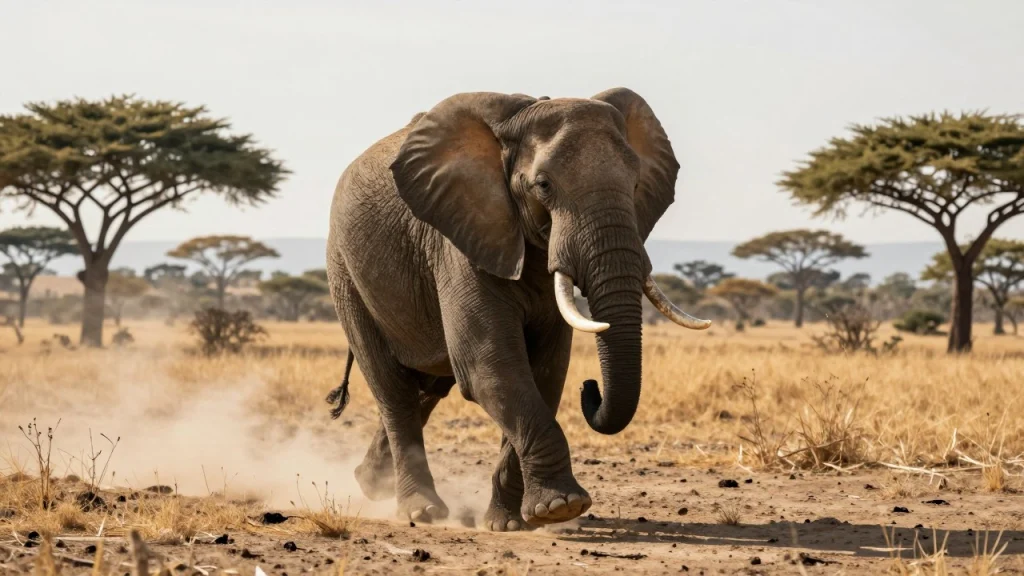
Despite their massive size and heavy build, elephants can achieve surprising speeds when moving quickly. An elephant can run at a top speed of about 15 miles per hour (24 kilometers per hour) in short bursts. While this pace may seem moderate compared to predatory big cats, it is remarkably fast for the largest land mammal on Earth.
An elephant’s speed is typically reserved for moments of perceived danger, defending offspring, or charging to assert dominance. Most of the time, elephants walk at a relaxed pace of around 2 to 4 miles per hour (3 to 6 kilometers per hour) to conserve energy and reduce wear on their massive joints.
The Mechanics of How Elephants Run
Elephant limb structure and motion are unusual compared with those of other animals. Because adult elephants typically weigh 2.7 to 6.8 tons, with the largest recorded bull reaching about 10.9 tons, their locomotion differs significantly from that of smaller, faster mammals.
The Footfall Pattern and Biomechanics
Unlike horses, dogs, or cheetahs, elephants never lift all four feet off the ground at once, even at top speed. Classical biomechanics ties running to a whole-body aerial phase, in which all four feet leave the ground at once, but elephants show that a bouncing running gait is possible without one. Instead, they maintain at least one foot on the ground at all times.
Researchers often describe an elephant’s fast movement as a high-speed walk or a “run-walk” gait. Their front feet appear to walk while their hind feet may show mechanics similar to running, absorbing impact and propelling their massive bodies forward smoothly.
Foot Adaptations for Support and Traction
An elephant’s feet are remarkably adapted to support its weight at high speeds.
- Cushioning pads: Beneath the bones of the feet lies a thick pad of fatty tissue that acts as a natural shock absorber, dampening impact forces with every step.
- Flexible toes: Elephants actually walk on their toes, with the heel supported by the fatty pad, allowing for efficient weight distribution.
- Traction ridges: The soles feature rough, pitted skin that provides excellent grip on varied terrain, preventing slips during quick movements.
Comparing African and Asian Elephant Speeds
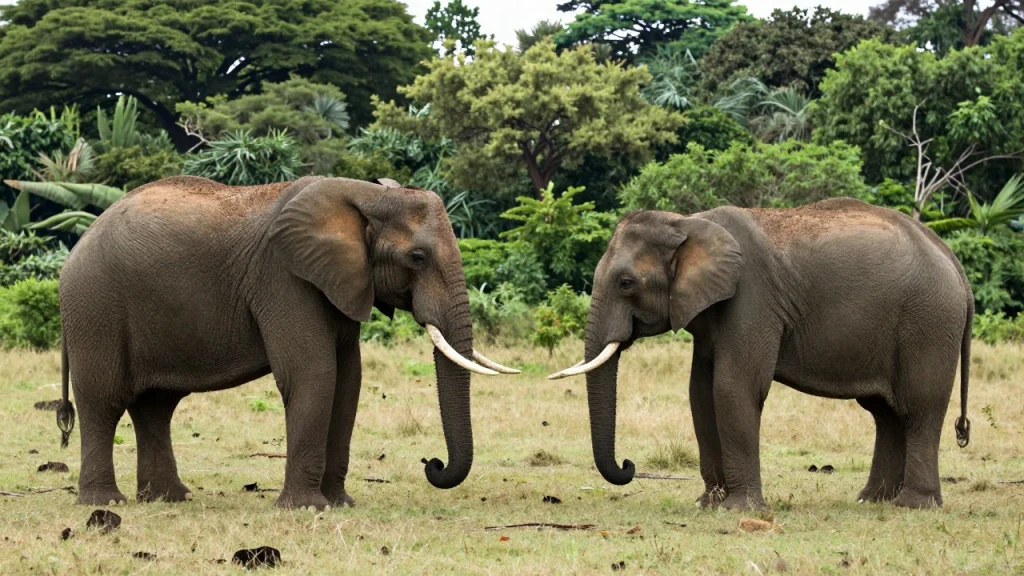
Both African and Asian elephants share similar top speeds, though slight differences exist based on body mass and environmental conditions.
African Bush Elephants
As the largest living land animals, African bush elephants typically weigh up to 6.8 tons, and the largest individual on record weighed about 10.9 tons. Despite their enormous scale, healthy adults can reach speeds near 15 miles per hour (24 kilometers per hour) when running. Their longer limbs provide a wide stride length that covers ground rapidly.
Asian Elephants
Asian elephants are smaller than African elephants and live in grasslands, tropical evergreen forests, moist deciduous forests, and scrub forests. Asian elephants can run at roughly 15 miles per hour (24 kilometers per hour). The denser vegetation of their natural environment rarely allows for long, open sprints.
Why Elephants Cannot Jump or Gallop
The physical structure of an elephant presents strict anatomical limits to its movement.
Because their bones are dense and lack the flexibility found in lighter quadrupeds, elephants cannot jump or leave the ground. Their leg bones are stacked in a straight vertical line, similar to pillar columns, which efficiently supports weight but restricts spring-like leaping actions.
Additionally, galloping requires rapid trunk and spine flexing alongside an aerial phase. An elephant’s rigid spine and enormous mass make galloping physically impossible and dangerous, as a fall at high speed could prove fatal to such a heavy animal.
How Elephant Speed Compares to Other Large Herbivores
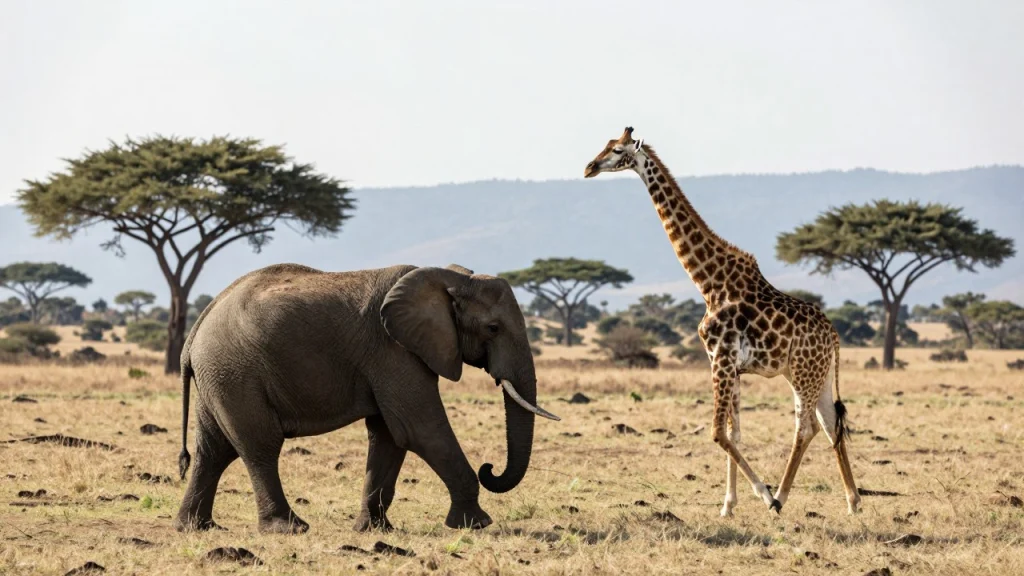
While an elephant’s top speed of 15 mph is impressive for its size, it occupies a distinct niche when compared to other prominent wild mammals.
| Animal | Top Speed (mph) | Top Speed (km/h) | Primary Movement Style |
|---|---|---|---|
| Cheetah | 60 – 70 | 96 – 112 | High-speed aerial sprint |
| Lion | 45 – 50 | 72 – 80 | Short bounding sprint |
| Giraffe | 35 – 40 | 56 – 64 | Long-strided gallop |
| Rhinoceros | 30 – 35 | 48 – 56 | Heavy gallop |
| Hippopotamus | 19 – 30 | 30 – 48 | Fast land charge |
| Elephant | 15 | 24 | Fast power walk |
Elephants do not rely on speed to outrun predators; their immense size and herd structure offer near-complete protection from natural threats.
Why and When Elephants Move quickly
In the wild, energy conservation is vital for survival. Asian elephants spend 12 to 18 hours a day searching for and eating food, and may travel long distances between water sources and feeding grounds.
Moving at top speed consumes massive amounts of energy and elevates body temperature quickly. Therefore, wild elephants seldom run, and seemingly only for short distances.
Understanding how fast elephants can run highlights the incredible balance between massive physical power, biomechanical efficiency, and evolutionary design in wild mammals.
Sources
- Proceedings of the National Academy of Sciences: Integration of biomechanical compliance, leverage, and power in elephant limbs
- Journal of the Royal Society Interface: The three-dimensional locomotor dynamics of African (Loxodonta africana) and Asian (Elephas maximus) elephants reveal a smooth gait transition at moderate speed
- Animal Diversity Web: Loxodonta africana (African bush elephant)
- Animal Diversity Web: Elephas maximus (Asiatic elephant)
- San Diego Zoo: Elephant