
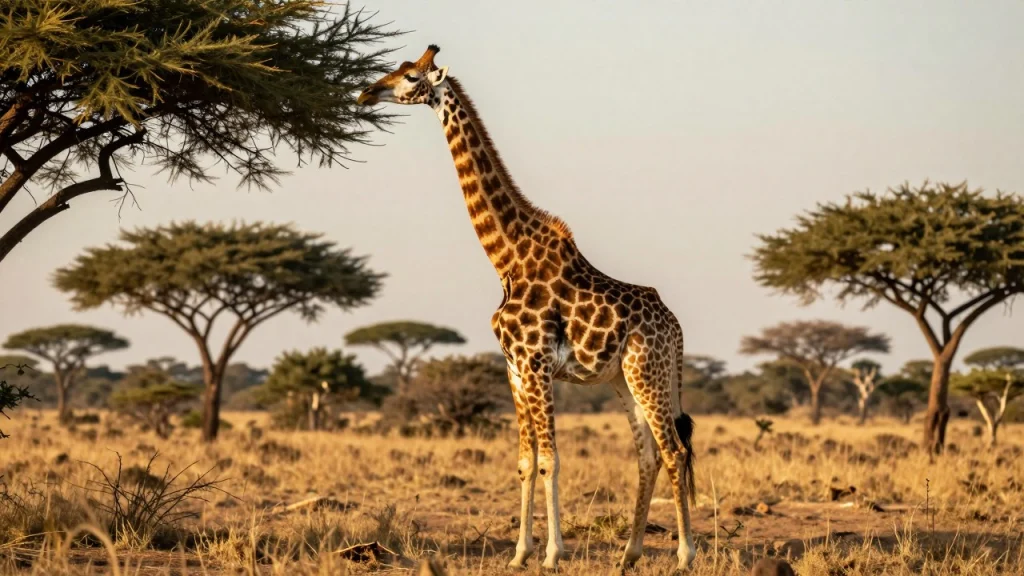
Although giraffes and okapis look remarkably different at first glance, they are actually each other’s closest living relatives. Together, they make up the only surviving members of the Giraffidae family. While the tall, spotted giraffe is a familiar sight roaming open African savannas, the shy, zebra-striped okapi remains hidden deep within dense tropical rainforests.
Understanding the differences between a giraffe and an okapi highlights how two closely related mammals evolved distinct physical traits and behaviors to thrive in entirely different environments. From their physical proportions and distinctive coat patterns to their wild habitats and social habits, here is how these extraordinary animals compare.
Physical Differences: Heights, Necks, and Coats
The most obvious contrast between giraffes and okapis lies in their size and stature. The giraffe (Giraffa) is the world’s tallest land animal, with adult males reaching heights of 14 to 19 feet (4.3 to 5.8 meters). Its iconic elongated neck allows it to browse foliage high in the tree canopy that other herbivores cannot reach. In contrast, the okapi (Okapia johnstoni) stands roughly 5 feet (1.5 meters) tall at the shoulder and features a much shorter, more robust neck suited for navigating thick jungle undergrowth.
Their coat patterns and coloration also differ dramatically:
- Giraffe Coat: Covered in a distinctive pattern of brown, reddish, or chestnut patches separated by white or cream-colored borders. These spots provide camouflage in the dappled light of open woodlands.
- Okapi Coat: Features a dark reddish-brown to velvety chocolate body with striking horizontal white stripes on its legs and hindquarters. These stripes act as camouflage in shadowy rainforests and help calves follow their mothers through dense brush.
Despite these differences, both species share unique evolutionary traits. Both possess short, skin-covered horn-like structures called ossicones on their heads, as well as exceptionally long, prehensile blue-purple tongues used to strip leaves from branch stems.
Habitat and Geographical Range
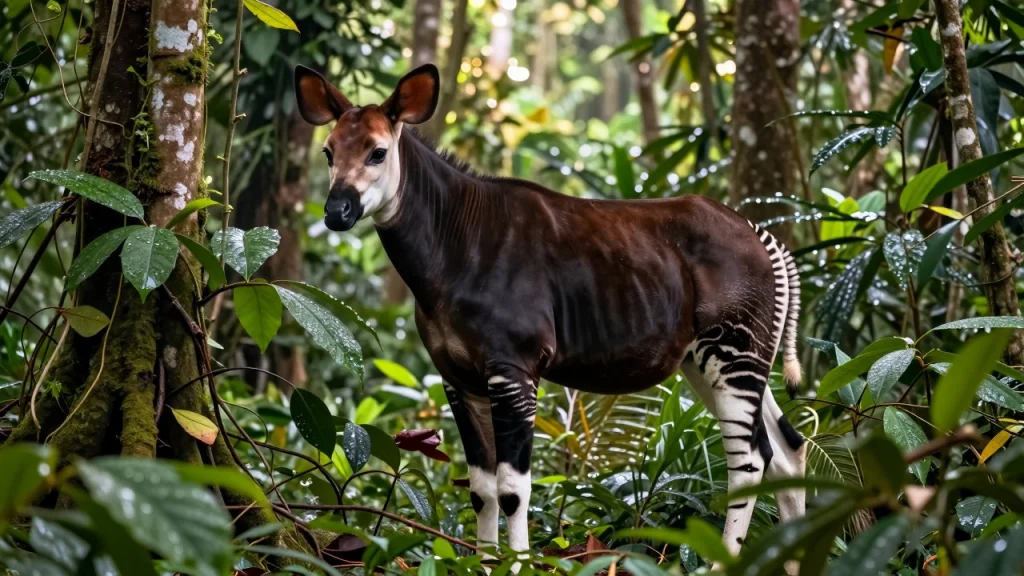
Giraffes and okapis adapted to entirely different ecosystems within Sub-Saharan Africa, shaping their evolutionary paths:
- Giraffes: Inhabit open savannas, grasslands, and arid woodlands across eastern, southern, and parts of central and western Africa. Their height gives them a sweeping view of open landscapes to spot predators from great distances.
- Okapis: Live mainly in the dense tropical rainforests of the Democratic Republic of the Congo (DRC) in central Africa, with occasional records in western Uganda. They rely on thick canopy cover, heavy rainfall, and secluded foliage for food and protection.
Because okapis live hidden in remote undergrowth, scientists did not know of okapis until 1901.
Dietary Habits and Browsing Behavior
Both species are strict herbivores and specialized browsers, consuming leaves, buds, shoots, and fruit. However, their specific diets reflect their home environments. Giraffes feed predominantly on thorny acacia trees, using their tough, flexible lips and long tongues to avoid thorns. Because of their immense size, an adult giraffe can eat up to 75 pounds (34 kilograms) of foliage a day, and large males up to about 145 pounds (66 kilograms).
Okapis browse on over 100 species of rainforest plants, including leaves, twigs, fruits, and fungi. Because rainforest plants can contain natural toxins, okapis also ingest reddish clay and mineral-rich soils along riverbanks to absorb essential minerals and neutralize plant toxins.
Social Structure and Behavior
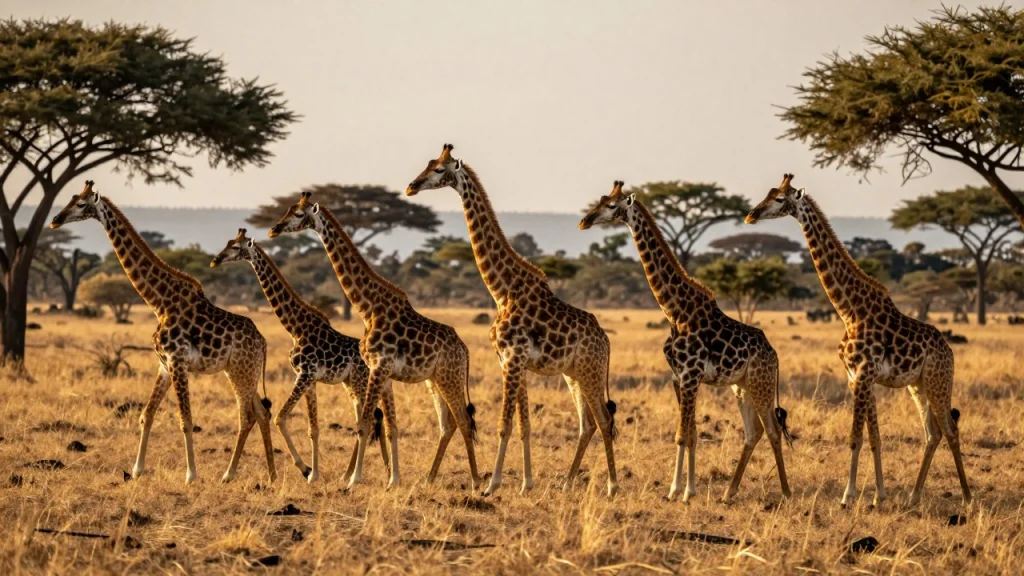
Giraffes and okapis exhibit very different social behaviors in the wild:
- Social Giraffes: Giraffes are non-territorial, social animals that live in loose, fluid groups known as towers or herds. These herds often change members frequently, working together to keep watch for predators like lions and hyenas.
- Solitary Okapis: Okapis are solitary, secretive creatures. Except for mothers raising young or pairs mating briefly, okapis live alone across large, overlapping individual ranges. They rely on scent marking from glands on their feet to communicate silently without attracting predators like leopards.
Conservation Status and Survival Threats
Both members of the Giraffidae family face growing environmental challenges in the wild:
- Giraffe Status: Classified as Vulnerable overall by the International Union for Conservation of Nature (IUCN), though specific subspecies are Endangered or Critically Endangered due to habitat fragmentation, human encroachment, and illegal hunting.
- Okapi Status: Listed as Endangered by the IUCN. Okapis face severe threats from habitat destruction due to deforestation, logging, illegal mining, and armed conflict within their restricted native range in the DRC.
While the giraffe reaches toward the sky and the okapi remains hidden in the shadows of the forest floor, both mammals showcase the impressive diversity of adaptation within Africa’s wildlife ecosystems.
Sources
- National Geographic: Giraffe | National Geographic
- San Diego Zoo Wildlife Alliance: Giraffe | San Diego Zoo Animals & Plants
- San Diego Zoo Wildlife Alliance: Okapi | San Diego Zoo Animals & Plants
- Animal Diversity Web (University of Michigan): Okapia johnstoni (okapi) | INFORMATION | Animal Diversity Web
- Journal of Heredity (Oxford University Press): A Chromosome-Scale Genome Assembly of the Okapi (Okapia johnstoni)