
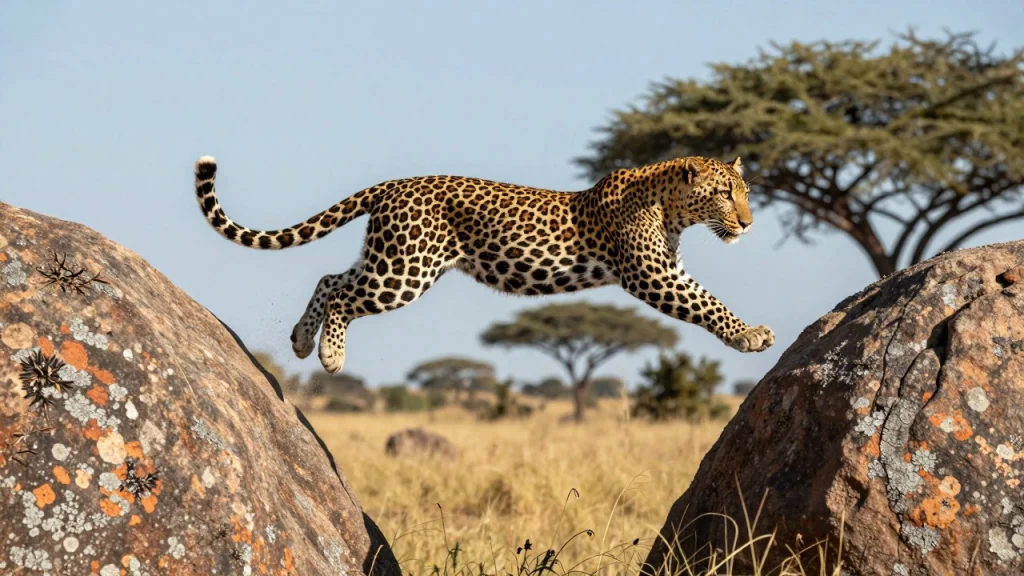
A leopard can jump horizontally up to 20 feet (6 meters) in a single bound and leap vertically up to 10 feet (3 meters) into the air.
These dynamic physical feats serve crucial functions in the wild. A leopard relies on explosive horizontal leaps to ambush fast-moving prey before it can escape. Simultaneously, vertical jumping power allows the big cat to leap directly into low-hanging tree branches to secure heavy carcasses out of reach from ground scavengers.
Horizontal Leaping Distance of a Leopard
When bounding across open ground or over obstacles, an adult leopard can cover a horizontal leap of up to 20 feet (6 meters). This capability relies on rapid exertion rather than sustained running.
Unlike cheetahs that rely on short sprints, leopards are ambush predators. They stalk stealthily through dense cover, crouching low to get as close as 10 to 33 feet (3 to 10 meters) from their target before pouncing. From a low, crouching posture, the leopard unleashes its stored kinetic energy to close the final gap instantaneously.
- Ambush tactics: A powerful horizontal bound minimizes the time prey has to react.
- Terrain navigation: Long leaps allow leopards to clear wide ravines, boulders, and fallen trees without losing momentum.
- Landing precision: Broad, padded paws absorb the impact upon landing, allowing the animal to maintain control over its trajectory.
Vertical Jumping Height of a Leopard
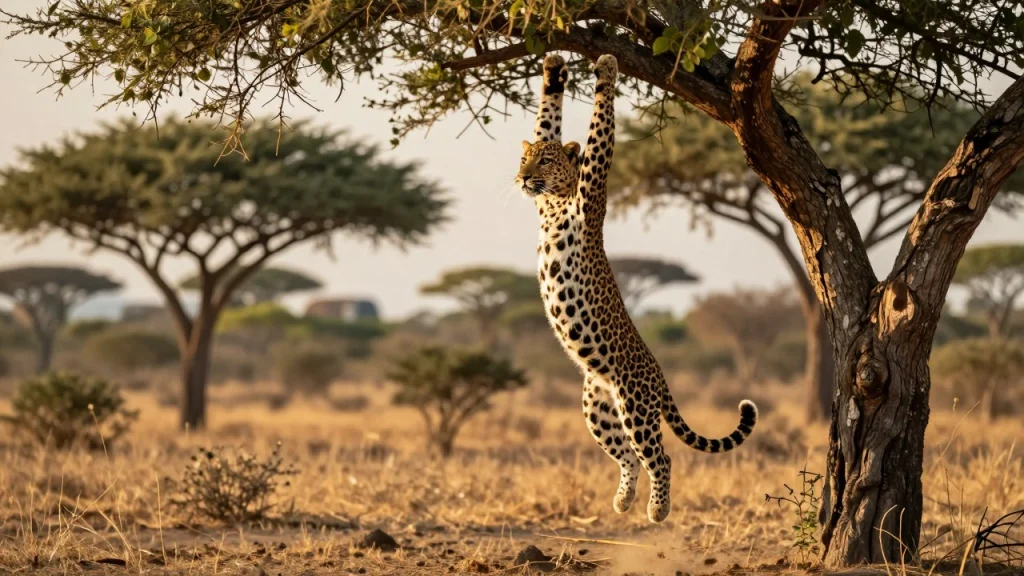
Vertical leaping is equally vital for a leopard’s survival strategy. From a standing or short-running start, a leopard can jump up to 10 feet (3 meters) straight up into the air.
This vertical agility is key to their arboreal habits. Leopards frequently use this elevation gain to leap onto lower tree limbs, rock ledges, or high earthen banks. By leaping directly upward rather than scrambling up a trunk, a leopard saves energy and maintains surprise when pursuing tree-dwelling prey or retreating from danger.
Furthermore, this vertical strength combined with exceptional muscular coordination enables leopards to haul heavy prey up into trees. While climbing trunks using their claws is common, overcoming initial height gaps often requires an explosive vertical spring.
Physical Adaptations Behind the Leopard’s Leap
The jumping prowess of the leopard is driven by specialized anatomical features that turn muscle contraction into powerful momentum.
Rear Leg Musculature and Fast-Twitch Fibers
A leopard’s hindquarters are disproportionately strong compared to its body size. The back legs contain a high concentration of fast-twitch muscle fibers, which contract rapidly to generate maximum force in short bursts. The long thigh bones (femurs) act as levers, amplifying propulsion when the cat launches off the ground.
Spine Flexibility and Elasticity
The leopard’s spine is exceptionally flexible, connected by elastic ligaments and flexible intervertebral discs. During a leap, the spine coils tightly like a spring during the preparation phase and extends completely during takeoff. This stretching adds extra distance and height to the jump beyond what the legs alone produce.
Tail Balance and Aerial Steering
A leopard’s long, muscular tail acts as a counterweight during mid-air flight. By swiveling its tail in flight, the cat can adjust its center of gravity, alter its body angle mid-jump, and ensure a balanced, stable landing on narrow branches or uneven ground.
How Leopard Leaping Compares to Other Big Cats
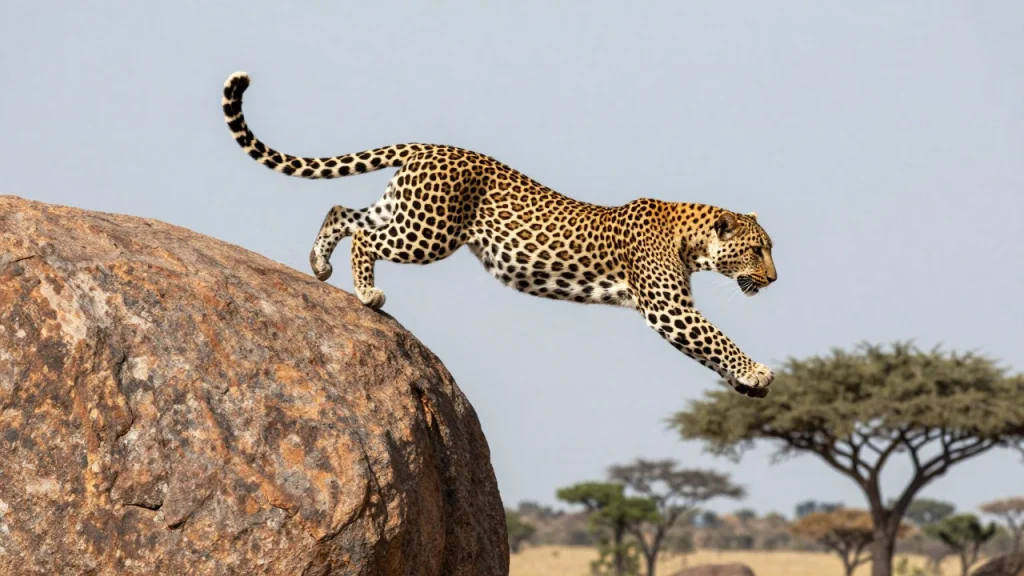
While leopards are accomplished jumpers, comparing their performance to other large felids shows how they measure up in both leaping distance and climbing strength.
| Big Cat Species | Max Horizontal Leap | Max Vertical Leap | Primary Functional Use |
|---|---|---|---|
| Leopard | Up to 20 ft (6 m) | Up to 10 ft (3 m) | Ambush strikes & leaping into trees with heavy prey |
| Snow Leopard | Up to 50 ft (15 m) | Not verified in available sources | Navigating steep mountain cliffs and deep chasms |
| Cougar (Puma) | Up to 40 ft (12 m) | Up to 18 ft (5.5 m) | Ambushing ungulates across rugged terrain |
| Tiger | Up to about 33 ft (10 m) | Not verified in available sources | Overpowering large ungulates on flat ground |
| Lion | Not verified in available sources | Not verified in available sources | Tackling large prey during group hunts |
Snow leopards and cougars outdistance the African leopard in horizontal leaping due to their longer hind limbs and specialized alpine environments. However, the leopard (Panthera pardus) combines a ten-foot (3-meter) vertical leap with the strength to climb a tree while carrying a kill larger and heavier than itself.
The Role of Leaping in Hunting and Prey Retrieval
Jumping is not merely a mode of locomotion for leopards; it is an essential hunting and defensive mechanism.
When hunting, a leopard relies on a sudden horizontal pounce to pin prey under its weight. The explosive leap helps a leopard pounce on prey before it can react, catching mid-sized ungulates such as gazelles off guard.
After a successful hunt, vertical leaping comes into play. To protect their kill from lions and hyenas, leopards can drag carcasses, sometimes heavier than themselves, up into trees. They can climb as high as 50 feet (15 meters) up a favorite tree while holding the kill in their mouth, keeping it out of reach of terrestrial competitors.
Through a combination of dense fast-twitch muscle, a flexible spring-like spine, and precise tail balance, the leopard’s leaping ability supports its hunting and climbing survival strategy.
Sources
- San Diego Zoo Wildlife Alliance: Leopard | San Diego Zoo Animals & Plants
- Animal Diversity Web, University of Michigan: Panthera pardus (leopard) | INFORMATION | Animal Diversity Web
- Smithsonian’s National Zoo and Conservation Biology Institute: Cheetah
- National Geographic: Cougar
- National Geographic: Snow leopard, facts and photos