
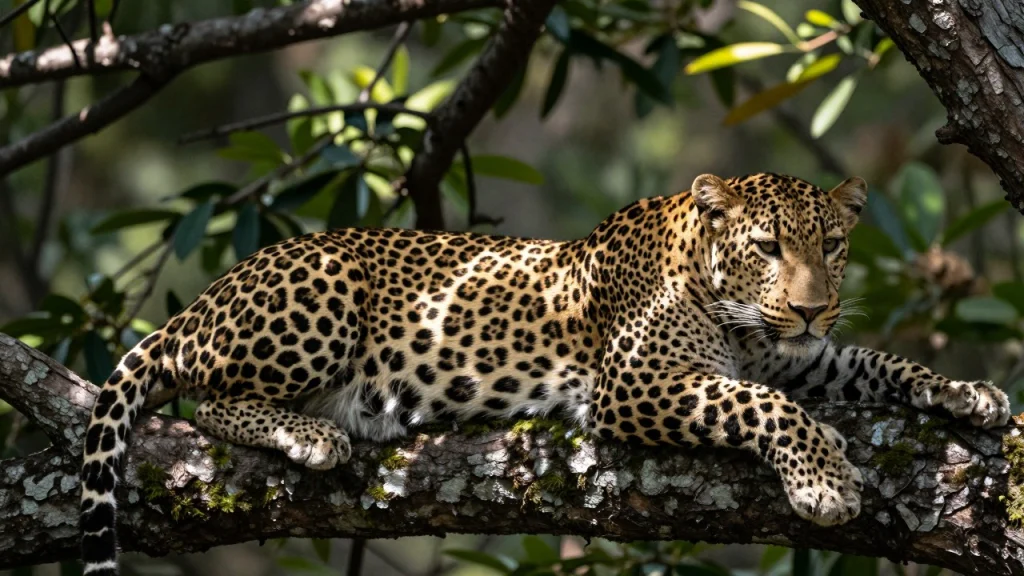
Leopards are famous for their beautiful, patterned coats, which feature circular markings known as rosettes rather than simple solid spots. These distinctive rose-like markings serve a vital evolutionary purpose: they provide disruptive camouflage that allows leopards to blend seamlessly into complex, shadowy environments such as forests, dense brush, and tall grasslands.
While solid spots work well in open, flat terrain, rosettes mimic the shifting patterns of dappled sunlight and shadow created by tree foliage and ground cover. This natural camouflage conceals the leopard’s outline, enabling this stealthy predator to stalk prey up close without being detected.
The Evolutionary Role of Rosette Patterns
Leopards’ rosettes help them hide from prey and break up their body outline, aiding stealth while hunting. As ambush predators, leopards rely on stealth rather than long-distance speed to catch their prey.
Disruptive Camouflage and Shifting Shadows
Rosettes break up the sharp contours of a leopard’s body. Unlike uniform solid spots, rosettes feature an irregular ring of dark spots surrounding a darker tawny center. When light passes through tree leaves, it creates broken patterns of light and dark shadows. A leopard’s rosette pattern matches this uneven environment almost perfectly, making the animal virtually invisible when sitting still in vegetation or high up in tree branches.
Background Matching Across Habitats
Leopards are the most widespread of the large cats, with subspecies in Africa and Asia, and inhabit varied habitats from high mountains to deserts to rainforests. The rosette pattern is versatile enough to provide effective cover across all these mixed habitats, providing camouflage in both high-contrast sunlight and low-light conditions at dawn or dusk.
How Rosettes Form and Function
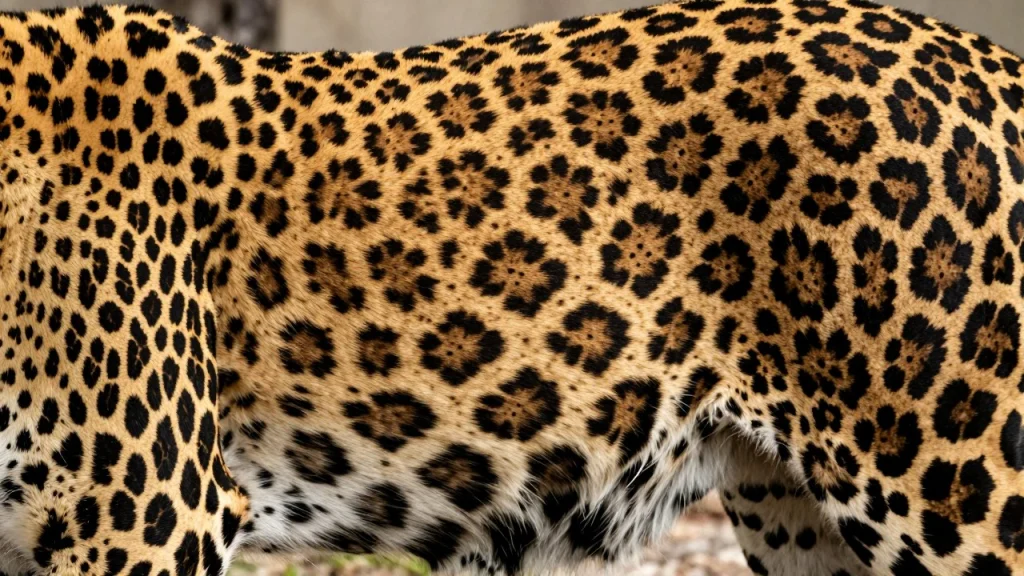
The physical structure of a rosette is distinct from other coat patterns found in the animal kingdom, serving specific functional roles based on the big cat’s anatomy.
- Cluster Design: Each rosette is made up of a cluster of smaller spots arranged around a warm brown center, creating a multi-tonal depth that solid spots cannot achieve.
- Variation Across the Body: Rosettes are not identical across the cat’s body. Smaller, tighter rosettes cover the head, limbs, and neck, while larger, more complex rosettes line the back and flanks.
- Transition to Solid Spots: Interestingly, leopards do have solid spots, but primarily on their chest, feet, and face, with rings marking their tail.
Leopard Rosettes vs. Jaguar Spots
Although leopards and jaguars look similar at first glance, their coat markings reveal key differences in their evolution and habitat adaptation.
Jaguars’ main stronghold is the Amazon Basin, and they are typically found in tropical rainforests; their spots are more complex and often have a dot in the center. Leopards, however, have rosettes with no dot in the center. This subtle difference reflects the denser canopy of the jaguar’s jungle environment compared to the varied, open-to-forested terrain favored by leopards.
Melanism and the Hidden Rosettes of Black Panthers
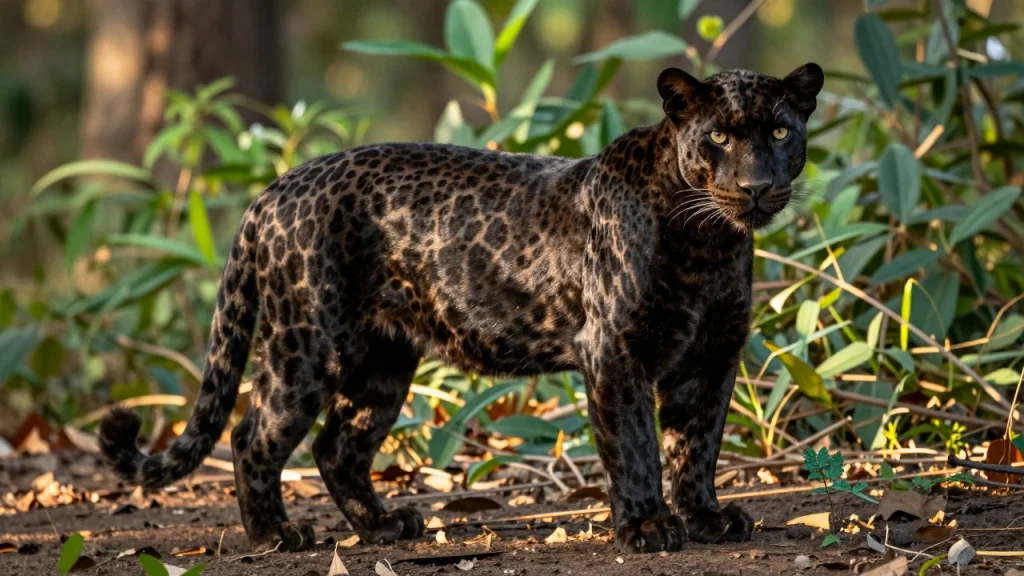
A common misconception is that melanistic leopards, frequently called black panthers, do not have rosettes. In reality, black panthers possess the exact same rosette patterns as standard leopards.
Their dark coloration is caused by an overproduction of pigment called melanin. Under direct sunlight or infrared light, the underlying rosette pattern, often referred to as ghost rosettes, is still clearly visible against their dark coat.
Why Stealth Matters for Leopard Survival
For a solitary hunter like the leopard, remaining hidden is critical. Leopards primarily hunt primates and mid-sized ungulates, including small antelopes, gazelles, deer, and wild pigs. Without effective camouflage, a leopard would struggle to creep within striking distance before the prey flees.
Furthermore, rosettes protect leopards from larger competitors, such as lions and hyenas, which may attempt to steal their food or harm their young. By blending into the surrounding brush or tree branches, leopards maintain a vital advantage in the wild.
Sources
- San Diego Zoo Wildlife Alliance: Leopard | San Diego Zoo Animals & Plants
- National Geographic: Leopard | National Geographic
- National Geographic: Jaguar, facts and photos | National Geographic Animals Photo Ark
- Animal Diversity Web, University of Michigan: Panthera pardus (leopard)
- Columbus Zoo & Aquarium: African Leopard