
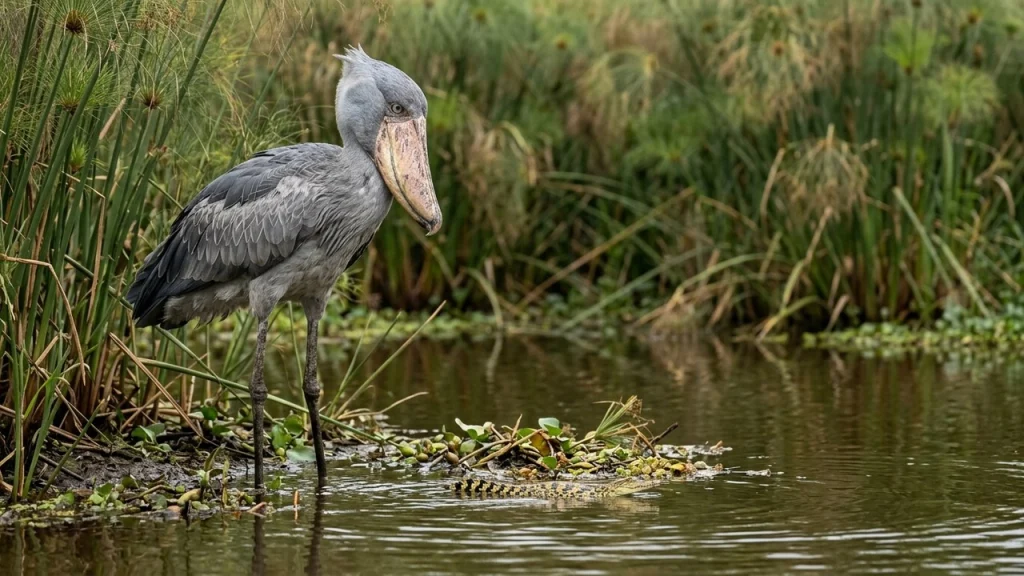
Yes, a shoebill can eat a crocodile, but only a very small one.
The core diet centers on big fish, especially lungfish, bichirs, catfish and tilapia, plus watersnakes. That fish focus explains why reptiles stay on the menu edge rather than at its center, and why size sets a strict limit on which crocodilians can be taken.
Keepers who watch them daily report long motionless waits ending at times with a baby crocodile taken. Records also note baby crocodiles and Nile monitor lizards among the larger items grabbed.
Why baby crocodiles are possible but rare
A shoebill does not chase down strong swimmers or wrestle large reptiles. It waits, watches and strikes once, so small and slow animals offer the best return. Patience matters more than speed for this hunter, and youth makes a crocodile vulnerable.
Zoo observations describe mainly large fish like lungfish as the favorite, with eels and catfish also important. On occasion the menu widens to young crocodiles and mollusks, alongside frogs, turtles and monitor lizards. Shoebills also take small crocodiles plus eels, catfish and water snakes when the chance appears.
What a lungfish tells us about the menu
The lungfish holds special status as the favorite, with marsh dwellers reaching six feet in length and nearly eight pounds. Such prey demands a powerful bill and a calm approach, because a miss wastes energy. A young crocodile fits the same pattern: large enough to be worthwhile, small enough to handle.
Low oxygen water makes this strategy pay, because fish must rise to breathe more often and become easier to find. Shoebills therefore favor spots where prey comes to the surface on its own. Hatchling crocodiles basking or drifting near vegetation can enter the strike zone in the same way.
A bill built for large slippery prey
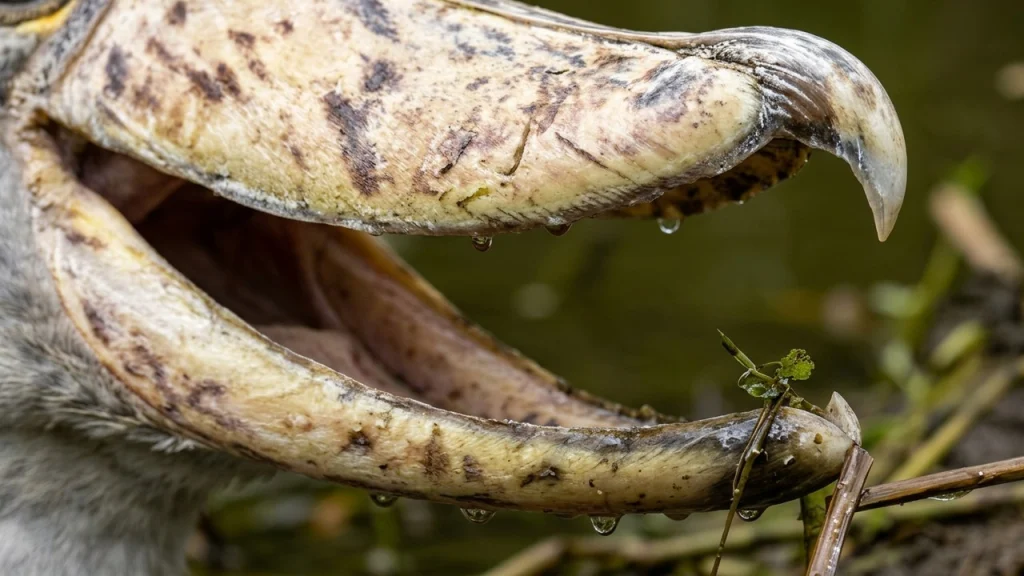
Adults stand 110 to 140 cm tall, which helps them wade and reach into marsh water. The bill looks like a wooden shoe, the feature that gives the species its common name. It forms a huge frame tipped with a sharp, curved hook for gripping slippery animals.
One zoo team measured that structure at nine inches in length and four inches in width, roomy enough to scoop a struggling fish. That tool scoops huge fish, then stabs with the pointed hook and cuts with razor sharp edges before swallowing. Often the bird removes the head before swallowing, which simplifies handling of spiny or toothy prey.
Their wings stretch almost eight feet across, creating an intimidating silhouette. Despite that bulk, flight stays slow and deliberate, used mainly for short moves between feeding areas. Standing near a person, the bird can look almost eye to eye, which explains its startling presence.
How the freeze and lunge hunt works
Shoebills hunt with two patient tactics, either waiting in place or wading and walking at a slow pace. They hold still and silent in or beside shallow water until the moment feels right. Stillness is camouflage, because prey notices movement more than shape.
Key steps in a strike include:
- freeze in shallow water or on floating plants and watch without moving
- track the target until it moves in range
- tip forward in a sudden collapse that drives the open bill underwater
- swing the head sideways to shed weeds while keeping the catch
After spotting movement, the bird begins the collapse, tipping forward toward the water. The head and neck shoot forward so fast that momentum pitches the whole body down and ahead. That lunge, also called a collapse, takes only seconds yet lands with great accuracy and power.
The strike usually traps vegetation as well, so the bird swings its head sideways to empty plant material while holding the catch. This shaking and tossing action explains how mud, stems and water leave the bill. Although mostly quiet, they clatter their bills as a greeting and around the nest, a sound that carries across the marsh.
Where this ambush happens
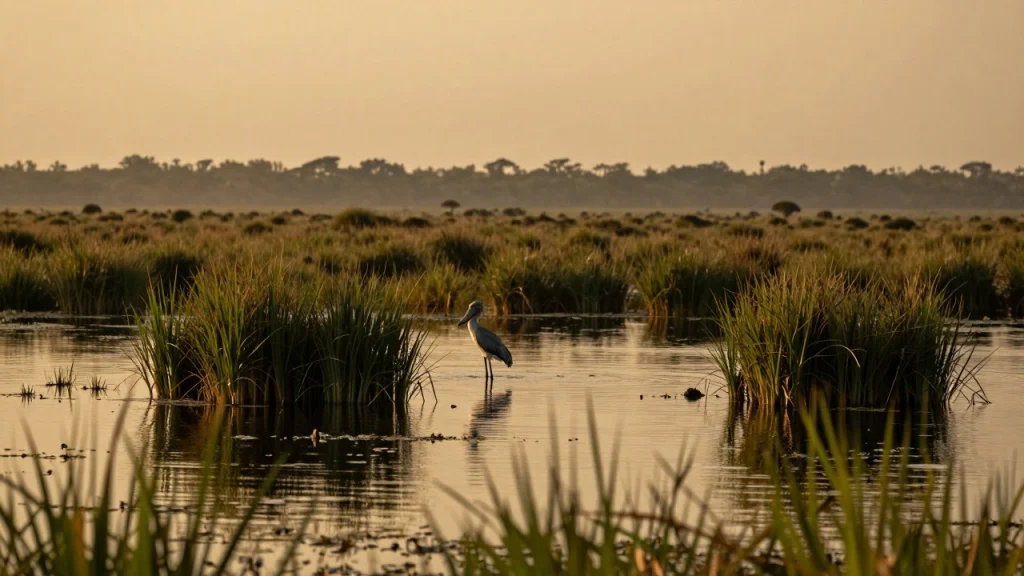
These hunters live only in Africa, mainly in its east central wetlands. They favor freshwater swamps and extensive, dense marshes threaded with floodplain channels. Dense beds, reed edges and floating mats give both cover and footing.
In eastern Africa they patrol huge marshes across the Nile watershed, hidden among tall grasses and reeds. Such cover lets a grey giant disappear at close range. A lungfish rising for air may not register the danger until the bill drops.
Solitary life and slow reproduction
Records note they never gather in groups. Only when food runs short do neighbors tolerate foraging close together. Breeding pairs defend large areas, with territories measuring approximately 3 square kilometers.
A clutch holds 1-3 eggs, with hatching following after about 30 days of incubation. Usually only one chick survives to independence, due to predation or limited food availability. Wild birds can live to almost 36 years, so a successful adult may breed across many seasons.
Long life helps offset slow reproduction, but it also means wetland loss affects the same individuals year after year. Protecting nesting marshes therefore protects birds that may return for decades.
A rare wetland specialist worth protecting
Conservation listings mark the bird as Vulnerable, reflecting pressure on wetlands. The world conservation assessment puts the adult total at between 3,300 and 5,300 birds worldwide. Small numbers make every nesting marsh important.
Land clearing for pasture removes habitat, and cattle sometimes trample nests. Burning, pollution from oil work and tanneries, disturbance by people and capture for trade add further strain. Shallow marshes are nurseries, not wastelands, and losing them removes both fish spawning areas and shoebill feeding grounds.
So can a shoebill eat a crocodile? Yes, when the crocodile is small, slow and close. Adults remain far beyond its power, while hatchlings fit the same hunting formula as lungfish and large catfish: wait long, strike hard and swallow it.