
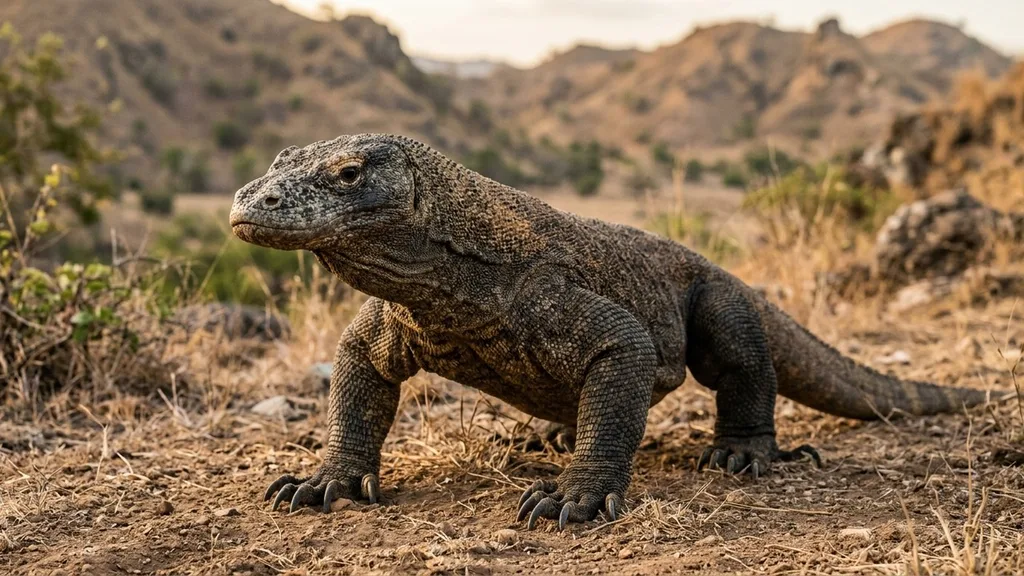
Yes, Komodo dragons are venomous, and scientists count them among a small group of lizards that bite with venom. Researchers classify these lizards as Varanus komodoensis. International reviewers now list the species as Endangered after a steep modern decline. The short answer is that poison, not germs alone, explains why bitten animals often weaken, bleed and collapse.
These reptiles hold the size record among living lizards. Wild adults commonly weigh about 154 pounds, while the longest checked animal measured 10.3 feet and the heaviest reached 366 pounds. Males usually grow bigger and stockier than females. That bulk helps explain why bites can prove fatal even when prey initially escapes.
Teeth and venom form one killing system
Sharp teeth open the wound, and venom keeps it bleeding. The mouth carries large curved teeth with sawlike edges that slice flesh cleanly. Adults carry about 60 short teeth with serrated edges, and they replace dentition through four or five sets during life.
A poison gland sits in the lower jaw. Its secretions lower blood pressure, block clotting and push prey toward shock. In practical terms, the toxins widen vessels, prolong hemorrhage and drop circulation until the animal cannot keep fleeing.
Delivery is simple and effective. Unlike snakes with hollow fangs and high pressure injection, dragons let fluid seep from gland ducts into cuts made by teeth. Separate ducts leave each gland chamber and empty between neighboring serrated teeth, so every slash can carry poison deeper.
Imaging work revealed unexpected complexity. Scans showed a compound gland in the lower jaw with a large rear chamber plus 5 smaller front chambers. That layout, with several independent outlets, is unusually complex for a reptile venom gland.
Weak jaws make this partnership more important. Studies found the light skull generates relatively low bite force for its size but resists pulling very well. That weakness makes venom more important.
The result is a combined tooth and venom arsenal rather than brute crushing force. Deep parallel cuts admit toxins that encourage bleeding and low pressure.
Why bacteria no longer get most of the credit
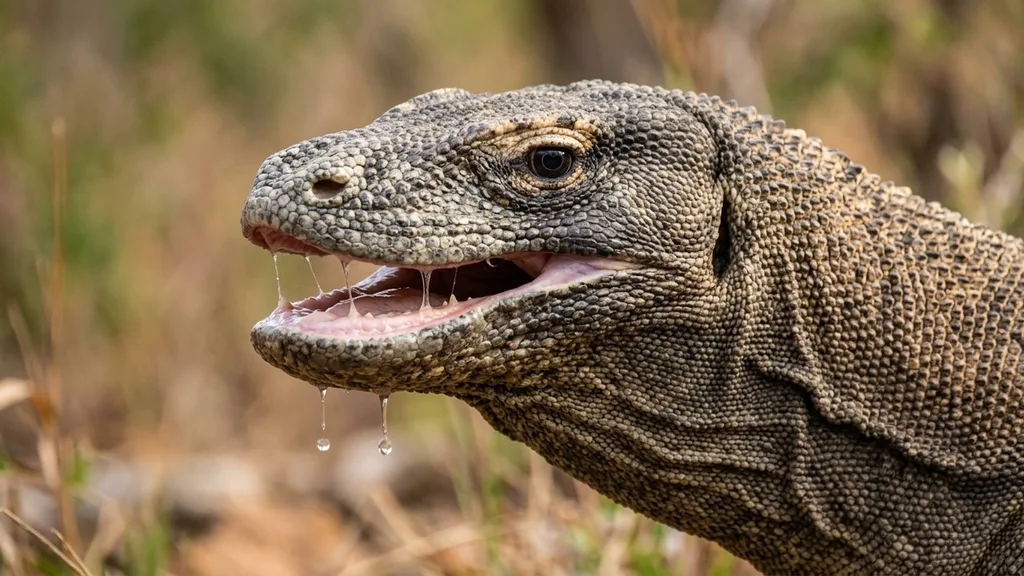
Bacteria help dirty a bite, but venom drives the kill. Older accounts argued that rotting meat wedged among tooth serrations seeded fatal infection. Mouth samples did yield about 50 bacterial strains, with at least seven forms described as highly septic.
Modern work rejects that older model as the main explanation. One research team stated plainly that toxic bacteria use should be dismissed, then showed that deep wound effects gain strength through venom actions that include anticoagulation and shock induction.
That shift matters because bacterial loads vary widely between individuals. Germs picked up from prey, carrion or water cannot reliably produce the same rapid collapse in every hunt. By contrast, active glands with substantial stored secretion argue for regular use, and experiments link the fluid to vessel relaxation and pressure loss.
Dragons themselves appear protected during fights. Animals cut while sparring with rivals show little effect from mouth microbes or poison.
How dragons find, catch and finish prey
Smell leads, vision assists, and patience does the rest. Dragons sample air constantly with forked tongues. They can detect carrion up to 2.5 miles away, which explains long walks to carcasses. They also see moving objects as far as 985 feet away, so motion gives away nearby prey even when scent is faint.
Hunting often looks undramatic at first. A dragon waits along a trail, bites a passing animal, then follows as the victim weakens from bleeding or infection. If saliva enters the wound, death can follow within a few days while the tracker stays on the trail.
Large targets are not exempt. Water buffaloes that escape the first attack can still die from their wounds several days later. Even when escape seems successful, shock and continued blood loss often prevent recovery.
Feeding is famously fast once the animal drops. Dragons can swallow up to 80% of their own weight in one sitting, and observers have watched them gulp 5.5 pounds of flesh in one minute. That speed lets them process huge chunks quickly and then fast for long periods.
Young dragons hunt small and climb high
Juveniles avoid adults by staying off the ground. Young animals spend much of early life in trees, which lowers the chance of being eaten by larger dragons. There they take anything small enough to swallow, such as:
- eggs
- grasshoppers and beetles
- geckos and other small reptiles
Around age 4, when roughly 4 feet long, survivors become heavy enough to forage on the ground and begin tackling larger prey and carrion.
Reproduction supports this high risk strategy with numbers. Clutches run from 20 to 30 eggs, hatchlings emerge at about 12 inches long, and both sexes mature at 5 to 7 years. Wild dragons can survive up to 30 years on their home islands, so successful females have many seasons to replace lost young.
Where giants live and why numbers fell
The entire wild range fits inside a tiny island cluster. Current distribution covers less than 350 square miles across six Indonesian islands. As of 2021, researchers counted about 3,500 juveniles and adults split into eight subpopulations on:
- Flores
- Gili Motang
- Komodo
- Nusa Kode
- Padar
- Rinca
Three groups occupy Flores, yet almost 70% of all animals live between Komodo and Rinca. The islands provide cover, nesting banks and trails used by prey species.
That concentration creates vulnerability. From 1981 to 2021, estimates fell from 5,000 to 3,500 animals, a 30% loss in 40 years that moved the category from vulnerable to endangered. Habitat fragmentation limits breeding between island groups, while prey competition, human encroachment and illegal trade add pressure outside parks.
Protection therefore focuses on connected habitat, steady prey and reduced conflict. With secure island strongholds and continued study of venom, senses and growth, these giant monitors can remain apex scavengers and hunters rather than fading island relics.
Sources
- Smithsonian’s National Zoo: Komodo dragon
- San Diego Zoo Wildlife Alliance: Komodo Dragon
- Columbus Zoo and Aquarium: Komodo Dragon
- Proceedings of the National Academy of Sciences: A central role for venom in predation by Varanus komodoensis (Komodo Dragon) and the extinct giant Varanus (Megalania) priscus