
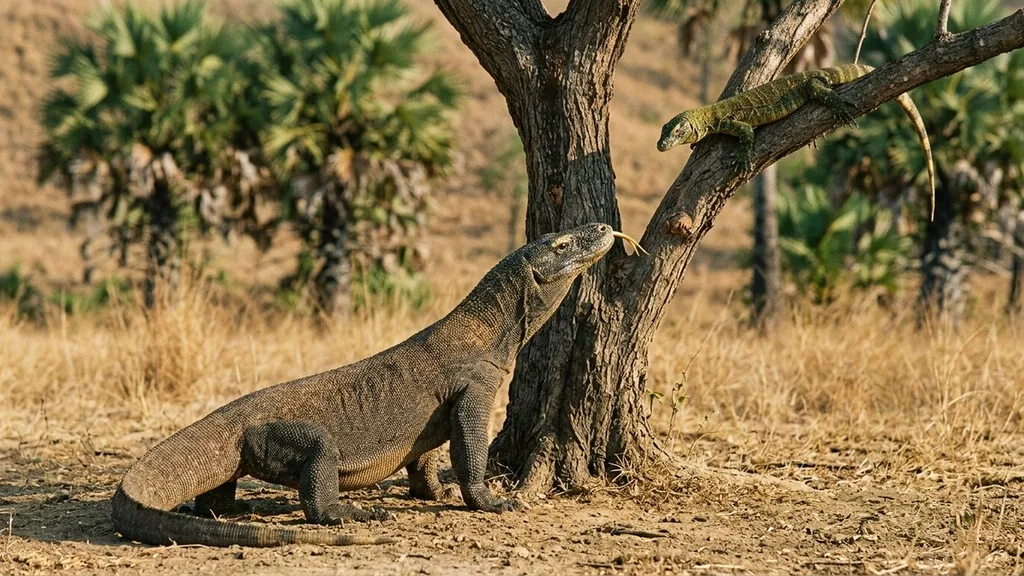
No wild animal regularly kills a grown Komodo dragon. The species sits at the summit of its island food chain with nothing hunting it, and the explanation is partly ecological: no mammalian carnivores live on these islands, so a monitor lizard of enormous size ends up filling the top job itself. A 2013 camera-trap survey in Komodo National Park credits that position to the same two ingredients, the missing rivals and the bulk of the dragons.
Death comes much earlier in life, and it comes mostly from within the species. A hatchling averages 16 inches (40 centimeters) and weighs less than 100 grams, a body size that turns its own kind into a predator, and the young that survive do it by staying off the ground. Once a dragon is fully grown, the force that reliably kills it is our own species, acting through direct killing, habitat loss and the illegal animal trade.
No predator hunts a full-grown dragon
Being the largest animal around is not the same as being safe, and adult Komodos face no hunters because nothing in the range is big or armed enough to challenge one. Animal Diversity Web states the case bluntly: adult dragons sit at the top of the food chain and have no predators at all. The camera-trap study reaches the same verdict from a different direction, tying the shortage of mammalian carnivores and the sheer size of the dragons to their place as the top predator across the range.
That empty niche shapes how a Komodo feeds and moves. An average wild adult weighs about 70 kg, and the heaviest verified specimen measured 3.13 m and weighed 166 kg. A dragon of that mass can afford patience, and it is a patient feeder, taking carrion that it removes from the landscape and adding the occasional ambush. A single dragon also needs remarkably little ground, less than any other large predator’s range according to the San Diego Zoo Wildlife Alliance, which is one reason scattered groups can persist on small islands.
The most common killer is the Komodo dragon itself
The species is cannibalistic, and it is the one killer that reliably shows up in the life of every young dragon. A hatchling is a small, defenceless thing next to an adult, and Animal Diversity Web reports a high mortality rate among them, with the pressure coming from adults of the same species as much as from anything else. Young Komodos therefore climb trees and stay there to keep clear of older members of their species.
Adults eat a wide menu:
- deer, wild pigs and water buffalo, the prey the Red List singles out for adult Komodos
- carrion, which makes up most of a normal adult’s diet
- other Komodo dragons, juveniles included
For a young dragon, a feeding site is the most dangerous place on the island, and the order of access is fixed. The biggest males reach a carcass first, then come the smaller males and females, and only once the adults have walked off do juveniles risk coming down from the trees. Timing and patience, not strength, decide whether a young dragon eats that day or becomes a meal.
Nests are defended indirectly as well. Females dig decoy chambers, and the San Diego Zoo Wildlife Alliance reports that the purpose is to discourage predators, males and other nesting females among them, from disturbing the real nest sites while a female digs her own.
Predators other than the Komodo dragon itself
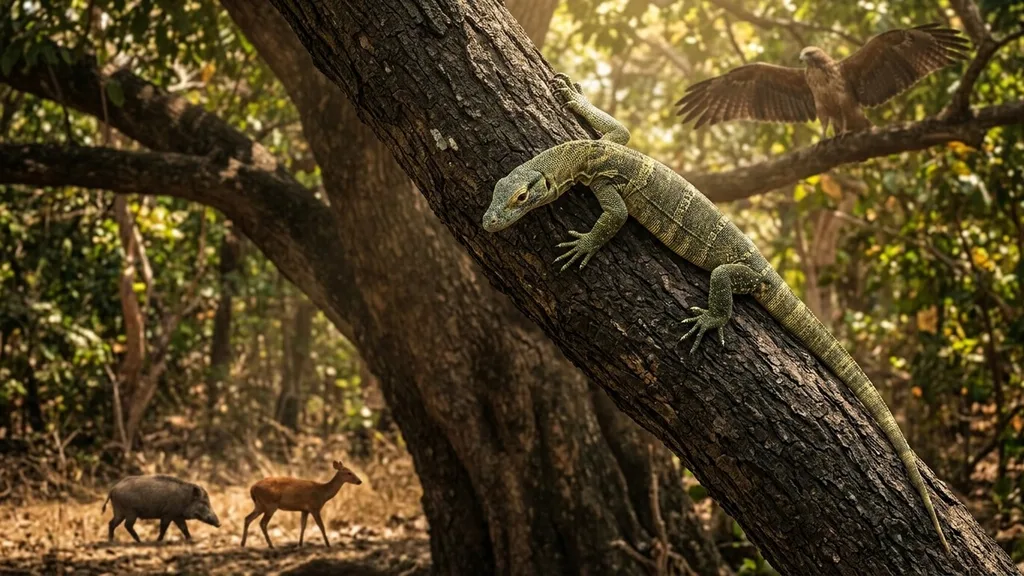
Adults of the same kind are only part of the pressure on young dragons. Animal Diversity Web lists larger mammals and birds among the predators that juveniles fall to, and those animals are part of the reason a hatchling’s first instinct is to leave the nest and climb the closest tree, the safest spot within reach.
Tree life is a good answer, but the protection expires with size. The San Diego Zoo Wildlife Alliance puts the switch to ground life at 1.2 meters, the length at which a young dragon is around 4 years old, and Animal Diversity Web makes the same point in general terms: young dragons avoid predation by remaining arboreal until they become larger. The dangerous stretch of a life is therefore spent above the ground, and its length decides how many young survive to breed.
How a Komodo kills without being killed
A bite is the whole killing mechanism, and it is chemical as well as mechanical. The Smithsonian’s fact sheet records roughly 50 strains of bacteria in the saliva, at least seven of them highly septic, plus a venom gland in the lower jaw. The venom stops blood clotting, which turns a wound into heavy blood loss and shock, so an animal that escapes can still bleed out over the following days. Death may take as long as four days, and the dragon follows the scent of the dying animal, picking up carrion from 4 kilometers away.
The twist is that none of this works on a Komodo. Its bite is deadly to prey, yet a dragon that spars with another shows no sign of that effect, and a single kill is often shared by many dragons without anyone dying of it. Researchers are still hunting for antibodies in dragon blood that might explain the resistance. That protection clearly does not extend to hatchlings, which are bitten much as a deer is.
What makes an adult hard to kill
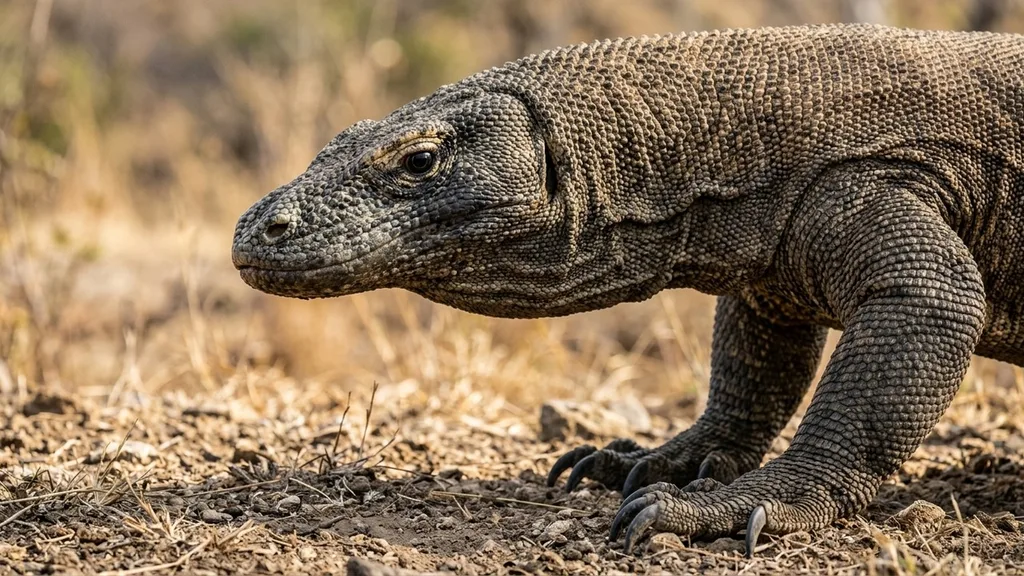
Having no rivals helps, but armor and teeth do the rest. The skin is rough and durable, reinforced with osteoderms, small bony plates that take the punishment of scratches and bites. The teeth are the real weapons: about 60 short, serrated teeth, and a dragon works through four or five complete sets in a lifetime. Speed helps only in bursts, up to 20 kph, enough to close a short gap but not to run anything down, which is why ambush rather than pursuit is the method. A wild dragon that reaches adulthood can expect about 30 years, and researchers are still refining that figure.
A shrinking archipelago and an Endangered listing
The whole population lives in a small corner of Indonesia. The species survives only in Indonesia’s Lesser Sunda region, and the remaining range covers less than 900 sq km spread across six closely grouped islands. A 2021 count put about 3,500 dragons, adults and juveniles together, in eight separate subpopulations, and the Red List lists the species as Endangered under criteria C1.
The classification rests on numbers that are both small and broken apart. Fewer than 1,400 adults remain, with no subpopulation above 500 individuals, and 1,383 of those are mature animals. The population trend is recorded as stable, yet a single subpopulation holds no more than 34% of the animals and gene flow between groups is very low, so stability in the strongholds can mask decline elsewhere. The Red List reports that the remaining Flores groups may be shrinking, under pressure from shrinking habitat and from people who kill or remove individuals, and it also records live dragons being smuggled out for zoos and the international pet trade. Climate models add a slow squeeze, with a drop of at least 30% in suitable habitat over 45 years described as a plausible assumption.
Where the risk actually sits
One island shows what that pressure looks like in practice. No Komodo has been recorded on Padar since the 1970s, even though the 2021 estimate still counts the island among its six, and a UNEP datasheet for the national park blames an old chain of killers around their prey, feral dogs taking the deer and wild boar, together with poaching and fire, for the loss of that island’s dragons. A predator with no natural enemies can still lose an island.
What protects an adult Komodo is a working island system rather than armor: prey to feed on, ground to range over, and enough dragons to spare a few. Small populations, isolated subpopulations and shrinking habitat remove those buffers one by one, which is why an apex predator that nothing can hunt is listed as Endangered. For a young dragon the answer has been the same all along: the animal most likely to kill it is another Komodo dragon.
Sources
- Animal Diversity Web, University of Michigan: Varanus komodoensis (Komodo Dragon) | INFORMATION
- IUCN Red List of Threatened Species: Varanus komodoensis (Komodo Dragon) | The IUCN Red List of Threatened Species
- San Diego Zoo Wildlife Alliance: Komodo Dragon
- Smithsonian’s National Zoo and Conservation Biology Institute: Komodo dragon
- PLOS ONE: Can Camera Traps Monitor Komodo Dragons a Large Ectothermic Predator? PLoS ONE 8(3): e58800
- UNEP World Conservation Monitoring Centre: Komodo National Park World Heritage Datasheet