
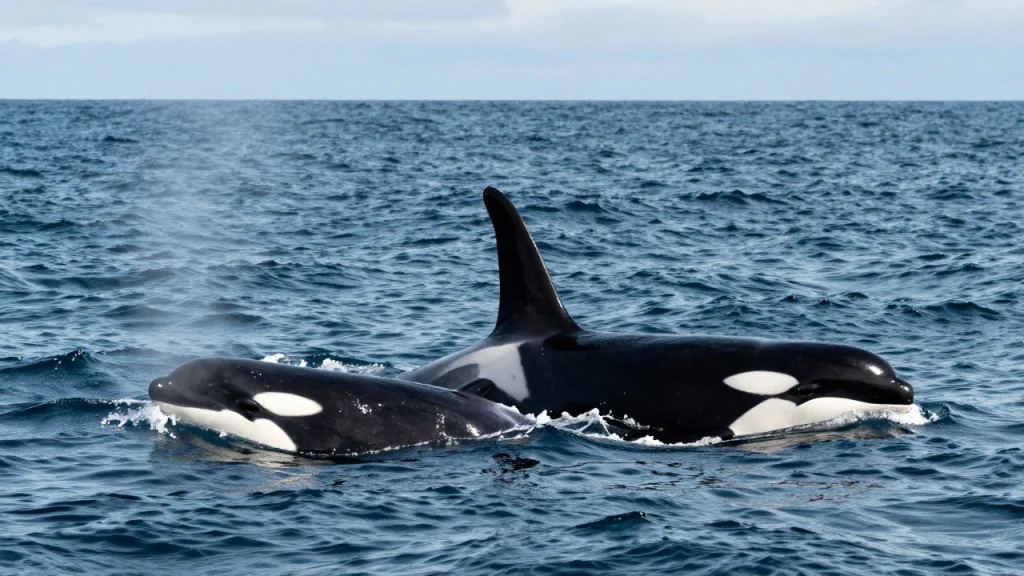
An adult orca has no natural enemies. Nothing in the ocean hunts killer whales once they are grown, which is why the honest answer to this question has two halves: animals rarely qualify, and people reliably do. The threat that actually shrinks orca populations is human activity, from fishing gear and engine noise to industrial chemicals and lost prey.
That distinction is not a technicality. Orcas occupy the top rung of the marine food chain, so nothing is positioned above them to eat them. The same position works against them in a different way, because every problem humans create in the ocean grows more concentrated as it travels up the food web before it reaches a whale at the top. A line lost at sea, a chemical discharged near shore, or a salmon stock pulled down by overfishing all arrive at the orca in their strongest form.
Why grown orcas have no rivals
Nothing reliably kills an adult killer whale. Predators that dominate the oceans, including the great white shark, are prey for orcas rather than the reverse. A mature male carries an average mass near 7200 kg, and the male dorsal fin can rise 1.8 m, taller than that of any other cetacean. Size and position are not the whole story, though. A group of orcas is a genuinely coordinated hunting unit that often works the way a wolf pack works, and that teamwork is what allows them to take animals larger than themselves, including other whales.
The protection only covers grown animals. Young orcas are the vulnerable stage, and they can be attacked by other killer whales or by large sharks. Even so, predation is not considered a primary cause of early death in orcas, which is telling. Studies suggest that a large share of newborn calves do not reach their first birthday, yet researchers do not point to predators as the main reason. Mother and calf are protected instead by the pod, by constant attendance, and by an unusually long childhood that gives young orcas years to learn.
How an orca grows up
A newborn measures 2 to 2.4 m and weighs roughly 136 kg, which sounds enormous until it is compared with a full-grown male, who averages 7200 kg. Gestation runs about 14 months, with one captive record of 539 days, and mothers typically raise a single calf. That calf nurses, stays with the natal pod for life, and learns hunting techniques as part of the family rather than through individual trial and error.
Slow development is the hidden cost of the safety adult orcas enjoy. A female in the wild averages roughly 63 years and can reach 80 to 90, while males fare worse, averaging about 36 years and topping out at 50 to 60. Because females stop breeding well before the end of those decades, a population with only a few dozen breeding animals has almost no buffer.
The tools orcas use to stay ahead
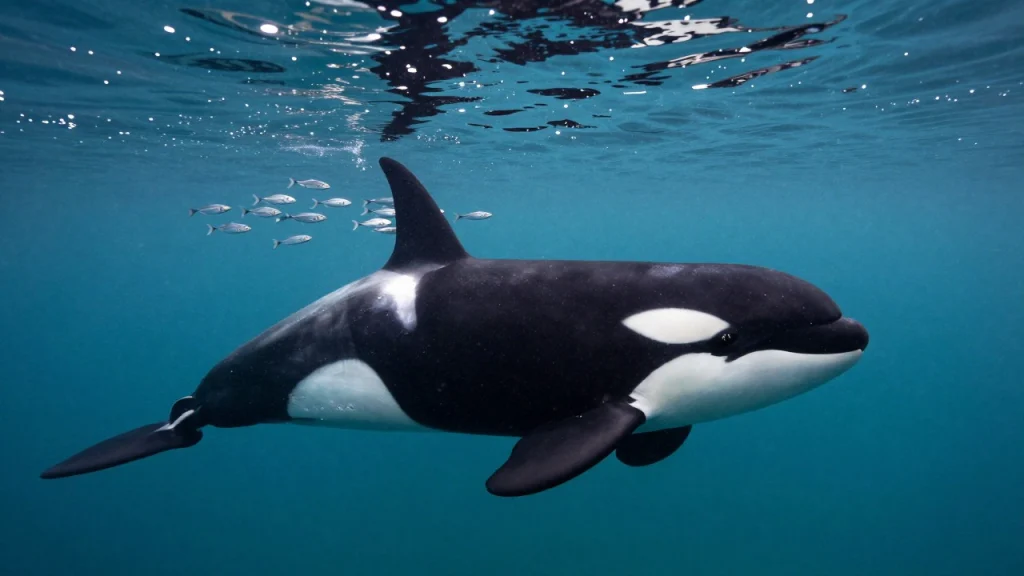
Orcas are noisy, social, and unusually well adapted to finding prey in dark or murky water. They vocalize in different ways, and clicks appear to be reserved for echolocation, meaning they paint a picture of the seafloor and of nearby animals with sound alone. Each pod also holds a distinct dialect that stays recognisable across several generations, so a group of orcas effectively knows its own voice and the voices of its neighbours.
The practical result is search efficiency. Individuals have been recorded swimming up to 160 km a day, and an adult consumes about 45 kg of food daily, and far more when prey is abundant. That intake is only possible because the animals cooperate, spread out, and specialise. Populations differ in their foraging behavior and diet, and in Washington waters the split is stark: Southern Residents eat almost exclusively fish, with Chinook salmon making up almost 80% of the diet, while transients hunt marine mammals including seals, sea lions, porpoises, and other whales. These two ecotypes are genetically distinct and are not known to socialize or interbreed.
The real enemy: human activity
Once humans are included, the list of enemies becomes long and specific. State biologists studying the Southern Resident population name three pressures as the main drivers of its decline: too little prey, chemical contamination, and noise from vessels. Each one works slowly, which is precisely what makes them dangerous to a population that recovers over decades.
- Fishing gear entanglement. Snagged line can drag an orca for long distances, pin it where it cannot swim or reach the surface for air, or cause severe injury that ends in death.
- Vessel noise and traffic. Underwater sound from engines and industrial activity interrupts the ability to use echolocation, which means hunting, communication, and orientation are all disrupted at once. Orcas also respond to boats by hunting less and travelling more, spending energy on avoidance instead of food.
- Chemical contamination. Orcas carry unusually high contaminant loads because of their long lives, their position at the top of the food web, and the large quantity of blubber that stores these substances over time. Pesticides and industrial chemicals accumulate in tissue and organs and harm immune and reproductive function.
- Vanishing prey. Too little food lowers reproductive rates and raises mortality rates. This matters most for the fish-eating residents, whose preferred salmon are themselves depleted.
- Oil. Spills kill orcas directly and also shrink the prey base underneath them. The 1989 Exxon Valdez spill in Prince William Sound, Alaska, was strongly linked to individual whale deaths.
Two of these deserve extra emphasis because they are easy to misunderstand. Noise is not a background irritation for a whale that navigates by sound; it is the equivalent of blinding a sighted animal. And contaminants are not flushed out, because orcas live long enough and store fat fast enough to accumulate them for decades.
History: a species once treated as a pest
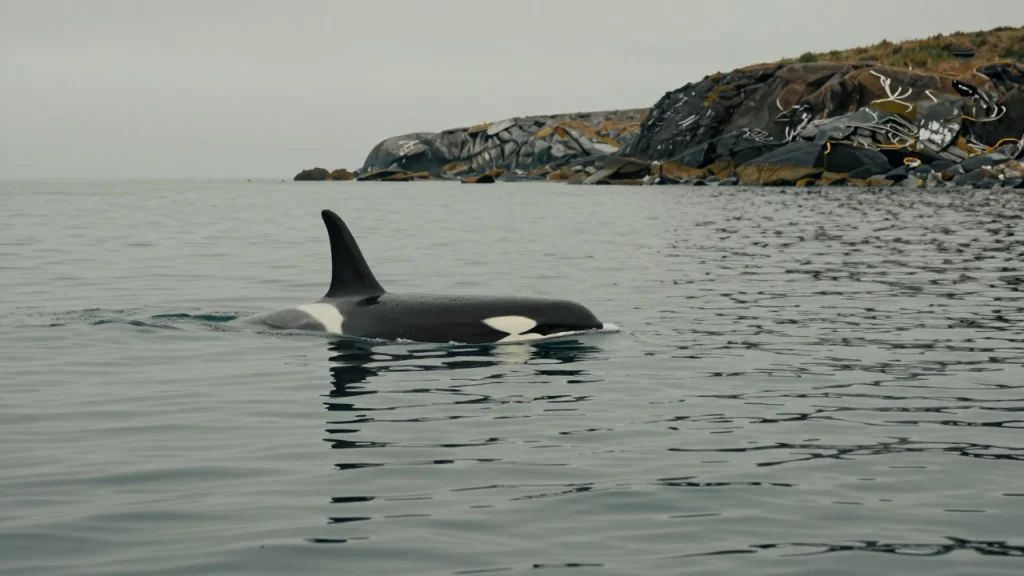
The relationship with people was openly hostile not long ago. Orcas were hunted in order to protect the fishing industry, and dozens were captured for public display. Capturing them for marine parks no longer happens in the United States, though it continues elsewhere in the world. That history explains part of the current baseline, since centuries of direct killing removed animals that a species this slow to reproduce cannot replace quickly.
Legal protection is now broad. Federal law protects killer whales nationwide, and the Southern Resident group carries endangered status under the Endangered Species Act. Washington took a further step, requiring boaters to hold 1,000 yards off Southern Residents in state waters from 1 January 2025, with separate rules for commercial viewing.
Which orcas face the most risk
The answer depends heavily on which orca you mean, because a single species-wide label hides a very uneven picture. The Pacific Northwest groups are the ones in visible trouble. A July 2024 census counted 73 Southern Residents, divided among the J, K, and L pods. A 2020 count had recorded 72 animals, after a decline of nearly 20% in the late 1990s. Meanwhile transient groups along the same coast are described as doing well within a range that is expanding.
That gap makes sense once the ecology is understood. A population locked onto a single prey species inherits every problem of that species, including a fishery managed for other species. A population with a broad, flexible diet can shift between prey when one target thins out. Specialization buys efficiency, and it also buys fragility.
Globally, the picture is unfinished rather than rosy. The IUCN Red List records insufficient data on orca populations to judge their overall trend, a gap that is itself a problem, since the few well-studied groups are the ones showing decline.
The deeper answer
Asked directly, the biggest enemy of an orca is a human being, and everything that person puts into the sea. Adult orcas beat their competition and they have no predators hunting them, but they cannot adapt to a shrinking salmon run, a chemical load, or a louder ocean any more than a person can adapt to a lung full of smoke.
Their advantages are real but narrow. Speed, intelligence, cooperative hunting, and a long protected childhood work well against other animals. None of them help against a drifting net, and the ones that do not address human pressure will not. That is the strange risk an apex predator carries: nothing in the ocean can threaten it, so it rarely evolves the defenses it would need for a world shaped by people.