
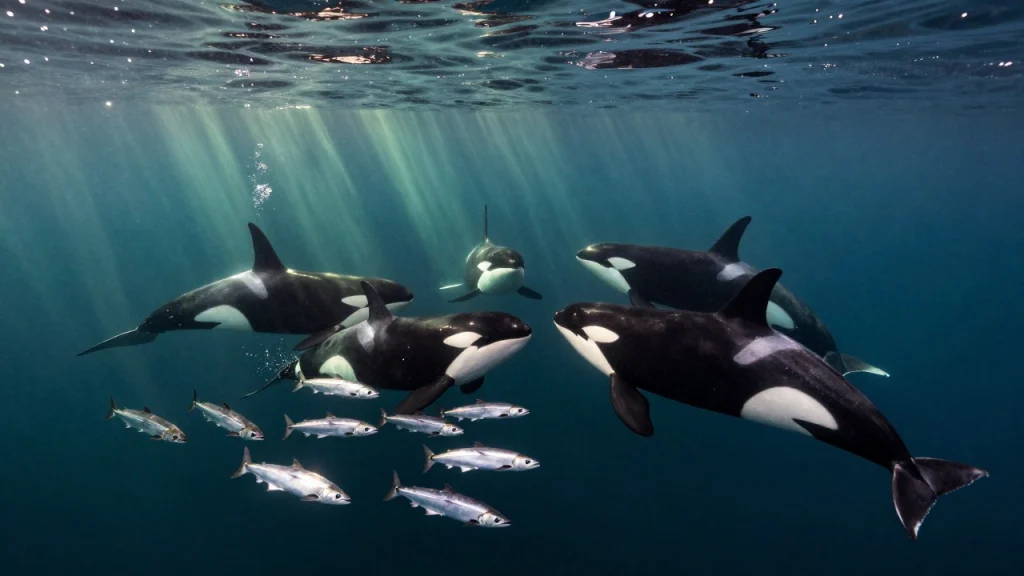
Orcas eat fish, marine mammals, squid and even sharks. Killer whales have the most varied diet of any whale or dolphin, but each population usually specializes in a few kinds of prey, guided mostly by hunting traditions learned within the group.
Orcas eat an extraordinarily wide range of prey, from tiny schooling fish to whales larger than themselves. No other whale species spreads its diet as broadly, and an average animal puts away roughly 45 kg per day. Recorded prey includes:
- Swimming prey: fish, squid and octopi
- Pinnipeds and cetaceans: dolphins, porpoises, sea lions, seals and various smaller whales
- Other vertebrates: sea turtles, sea birds, river and sea otters, and sharks
What makes the orca interesting is that this huge menu is not shared out evenly. Which prey a group depends on is decided less by what lives nearby than by hunting traditions that differ by ecotype.
The answer therefore depends on which orcas you mean. Populations that share the same water without mixing are treated as separate ecotypes, each with its own inherited menu, and in the North Pacific three of these types are recognised: residents, transients and offshores. The National Park Service notes that residents and transients share the same waters, yet what each one eats differs and the two have never been seen interbreeding. What follows is how each group feeds, and why that split matters for the survival of the whales.
Residents live on salmon, and little else
Residents are the fish specialists of the North Pacific. They eat nothing but fish, and salmon above all. The Southern Resident population of the Pacific Northwest lives almost entirely on salmon, with Chinook, the clear favourite, filling almost 80% of their menu.
Timing matters as much as species. Chinook salmon are an important prey item all year, making up roughly 50% of the fall diet, rising to 70–80% in midwinter and early spring, and climbing to nearly 100% in spring. The wider variety of species eaten during those winter months suggests the whales’ favourite salmon are scarcer then, and a wide diversity of Chinook stocks is consumed, many of which are themselves at risk. Samples from the outer coast covered 14 distinct stocks, with four river systems accounting for over 90% of them, mostly fish traced to the Columbia River.
Further north the menu widens a little. Alaskan state biologists list salmon, herring, halibut and cod as the core of a resident pod’s diet, and residents around the Kenai Fjords and the neighbouring Prince William Sound area take more silver salmon than any other fish, adding halibut and the occasional herring.
Transients hunt marine mammals
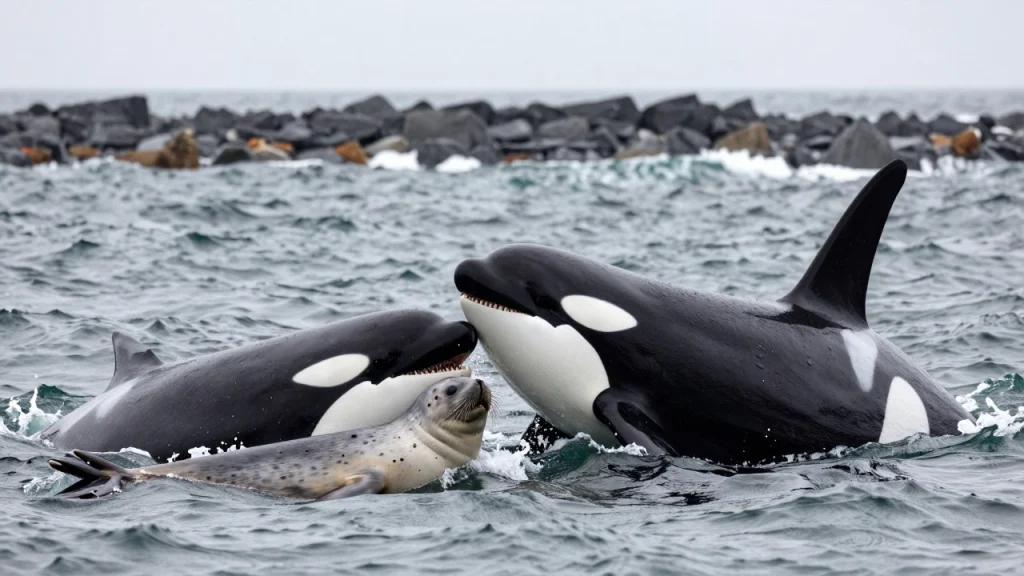
Transients fill the same seas and eat a different set of animals. Marine mammals dominate their table: seals, sea lions, porpoises and dolphins all feature, and they add squid and other whale species to the list. Which mammals they prefer changes from place to place. Around the Kenai Fjords, transients take harbor seals, Dall’s porpoise, the smaller harbor porpoise and sea lions, while an Alaskan group watched for more than 20 years feeds mainly on harbor seals and Dall’s porpoise.
Evidence often comes from stomachs. A whale stranded near Prince William Sound had a Steller sea lion in its stomach, alongside a harbor seal and a harbor porpoise, while other observations record kills of otters, including river otters and sea otters, plus squid and birds of several kinds. Their taste is broad, because they are opportunistic and will attack virtually any large marine animal they can reach.
Offshore orcas: the menu still being mapped
Offshore whales are the least understood of the three groups. They eat fish, sharks included, and their diet is poorly documented, varying with location and pod. What is known is striking: a few offshore orcas have been recorded feeding on baleen whales, while certain pods are thought to take sharks. They also range the farthest of the three types and are seen in large groups.
Menus far from the Pacific Northwest
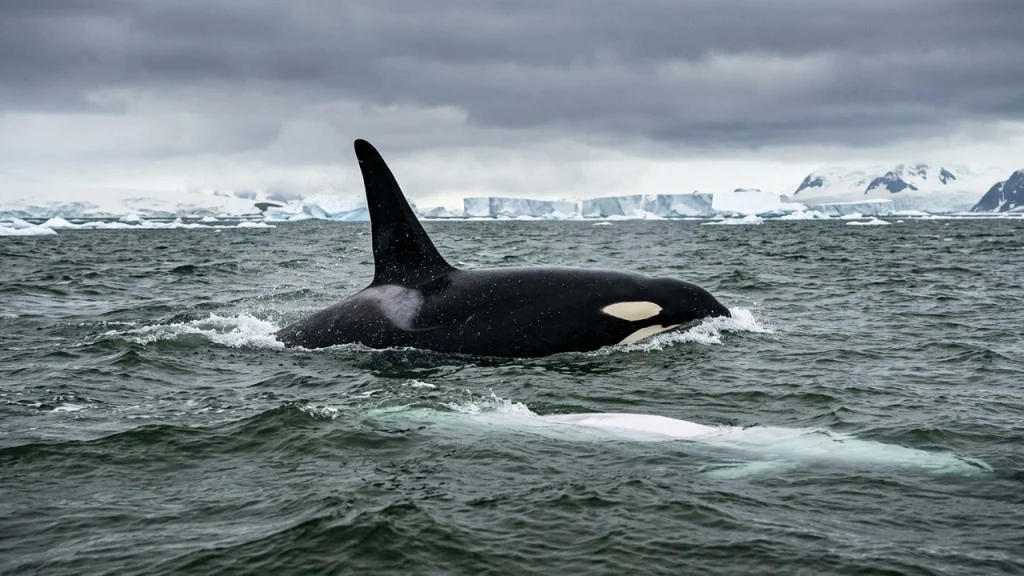
Specialisation follows geography. Off the Norwegian coast, killer whales feed on herring and similar schooling fish. Around New Zealand, some orcas eat stingrays and sharks. In Antarctic waters, the menu runs to minke whales, seals and Antarctic toothfish. In the Northeast Atlantic, these whales are thought to eat herring and seals alike, a combination that stands apart from the specialised diets typical of the North Pacific types.
Catching and swallowing a meal
Whatever the menu, the method is teamwork. They hunt as a coordinated team, closer to a wolf pack than to a school of fish. A pod numbers from a handful of animals up to about 20 close relatives, and larger groups form for socialising, for mating, or when prey concentrates seasonally, which is the moment a gathering pays for itself.
Attacking something as large as a gray or humpback whale means attacking in a pack and pulling at the animal from several angles at once. Mammal hunters also move more quietly than fish eaters, which suits alert prey, and they hug the shoreline where rocks can break up the outline of their dorsal fins. Underwater clicks do the locating, being used mainly for echolocation, while calls and whistles carry the social side of the hunt. Small prey is swallowed whole, whereas a larger animal is torn into pieces before it is eaten.
Why the menu decides survival
Orcas sit at the top of the marine food chain, and where they are abundant they hold down the numbers of familiar prey, including the seals and sea lions that gather at breeding beaches. Adults have no natural predators, though calves can be taken by other orcas or large sharks. That safety vanishes when food does. Overfishing and habitat loss have cut the prey available to some populations, shortages show up as falling reproduction and rising mortality, and low Chinook abundance has been linked to poor breeding and survival in the whales that depend on it.
Contaminants travel the same route as the food. Because pollutants build up along the food chain, chemicals such as PCBs reach top predators like orcas in their highest concentrations, and Washington names them as one of three main threats, alongside too little prey and vessel noise and disturbance. The Southern Residents show the strain: a census found only 73 animals across three pods, and that group carries federal protection as an endangered population under the Endangered Species Act, one of just two orca populations with such extra protection. Globally the species is still treated as data deficient, because too little is known about its populations to judge their status.
Do orcas eat sharks?
Yes, killer whales hunt sharks in multiple regions. SeaWorld notes that worldwide observations include attacks on sharks and rays, with offshore whales in the northeastern Pacific consuming Pacific sleeper sharks alongside salmon, sculpin, and Pacific halibut. The Natural History Museum notes that orcas are the sole known predators of great white sharks.
SeaWorld reports that around New Zealand, a group of seven killer whales was observed hunting a shortfin mako shark, biting and holding it until consumed. NOAA Fisheries states that in the waters around New Zealand, some killer whales feed on stingrays and sharks.
Do orcas eat dolphins?
Yes, orcas eat dolphins across several distinct populations. Type 2 killer whales specialize in cetaceans, taking dolphins, porpoises, and baleen species such as minke whales. SeaWorld states that although infrequently observed, killer whales around Hawaii seem to possess a more diverse diet that includes humpback whales, dolphins, octopuses, and squids.
What do baby orcas eat?
Baby orcas feed on milk before transitioning to solid prey. According to NOAA Fisheries, calves nurse exclusively for at least one year, but stay closely associated with their mother for at least their first two years.
In zoological parks, calves start eating a few fish when they reach two to three months old. At SeaWorld, one-year-old calves eat 23 to 27 kg of herring, smelt, and squid daily.
Sources
- NOAA Fisheries: Killer Whale | NOAA Fisheries
- U.S. National Park Service: Orca (Killer Whale), Kenai Fjords National Park
- Animal Diversity Web, University of Michigan: Orcinus orca (killer whale)
- Washington Department of Fish and Wildlife: Killer whale biology and conservation
- Alaska Department of Fish and Game: Killer Whale Species Profile
- PLOS ONE: Endangered predators and endangered prey: Seasonal diet of Southern Resident killer whales
- SeaWorld: All About KIller Whales – Diet & Eating Habits | United Parks & Resorts
- Natural History Museum: What do killer whales eat? | Natural History Museum