
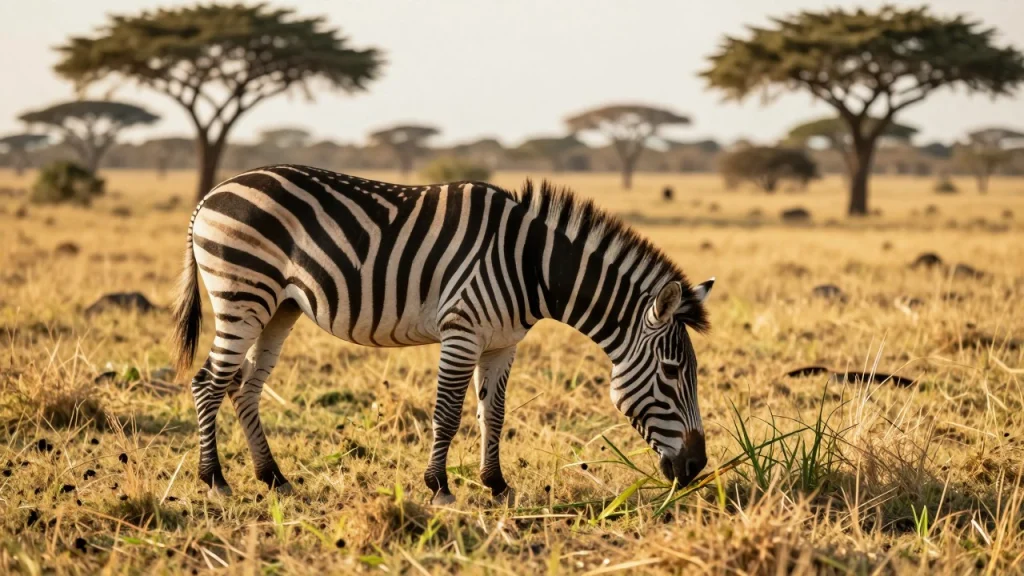
Zebras are herbivores that feed mostly by grazing on grasses. The San Diego Zoo Wildlife Alliance states that they might also browse a bit on the stems and leaves of bushes.
As native inhabitants of the African savannas, grasslands, and mountain slopes, zebras are strict herbivores whose survival depends entirely on plant material. Their primary diet consists of coarse grasses, but they can also consume leaves, bark, shrubs, and roots when food resources become scarce.
Understanding what zebras eat reveals how these iconic mammals adapt to harsh environments, avoid competition with other wildlife, and maintain the complex digestive systems necessary to process fibrous vegetation.
The Primary Diet of Zebras in the Wild
Grasses make up about 90 percent of a plains zebra’s daily food intake. Zebras are specialized grazers whose incisors clip vegetation and whose large, high-crowned molars grind down tough, silica-rich grasses close to the ground.
Depending on seasonal availability and location, zebras consume various native grass species across Africa’s ecosystems. When fresh green blades are available during the rainy season, zebras prefer tender leaves rich in moisture and nutrients.
During dry seasons, when green pastures dry up, zebras display remarkable dietary flexibility:
- Coarse dry grass: Older, fibrous stems left behind by other herbivores.
- Browse and foliage: Leaves, twigs, and small shoots from low-hanging trees.
- Shrubs and herbs: Woody shrubs, herbs, and fallen plant debris.
- Roots and bark: Underground plant tubers or tree bark dug up when vegetation is severely depleted.
How Zebras Digest Fibrous Vegetation
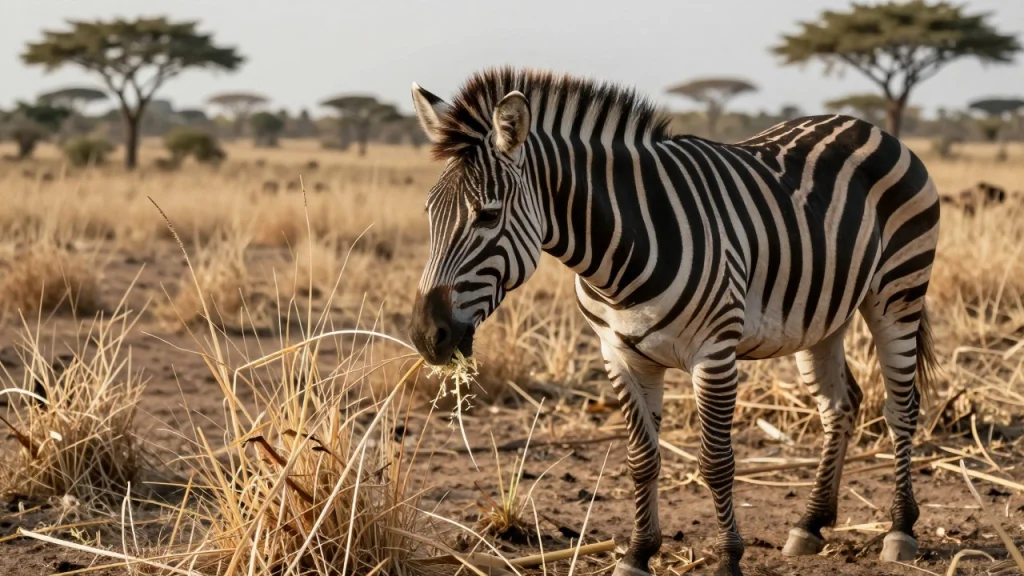
Zebras possess a digestive system known as hindgut fermentation. Unlike ruminants such as cattle, which have multi-chambered stomachs and chew their cud, zebras have a single-chambered stomach paired with an enlarged cecum for hindgut fermentation.
In this enlarged hindgut, specialized microbes break down cellulose and fibrous plant cell walls. This anatomical adaptation provides several key ecological advantages:
- Fast Passage Rate: Food moves rapidly through their digestive tract, allowing zebras to process large quantities of low-quality forage quickly.
- Pioneer Grazing Role: Because they can tolerate highly fibrous, nutrient-poor dry grass, plains zebras are often the first grazers to enter tall grass patches.
- Paving the Way for Others: By eating down the rough outer layers of tall vegetation, zebras expose the shorter, nutrient-dense grass shoots underneath for selective grazers like wildebeests and gazelles.
Daily Feeding Habits and Foraging Behavior
Grevy’s zebras spend about 60 percent of their day eating, and up to 80 percent when food is scarce. Because their hindgut digestive process is less efficient at extracting nutrients per bite than ruminant digestion, they must compensate by consuming higher volumes of plant material.
Water access plays an essential role in their daily routine. Although zebras can endure dry conditions better than many other African mammals, mountain zebras usually drink once or twice per day, while most Grevy’s zebras can survive without water for up to five days.
Variations Among Zebra Species
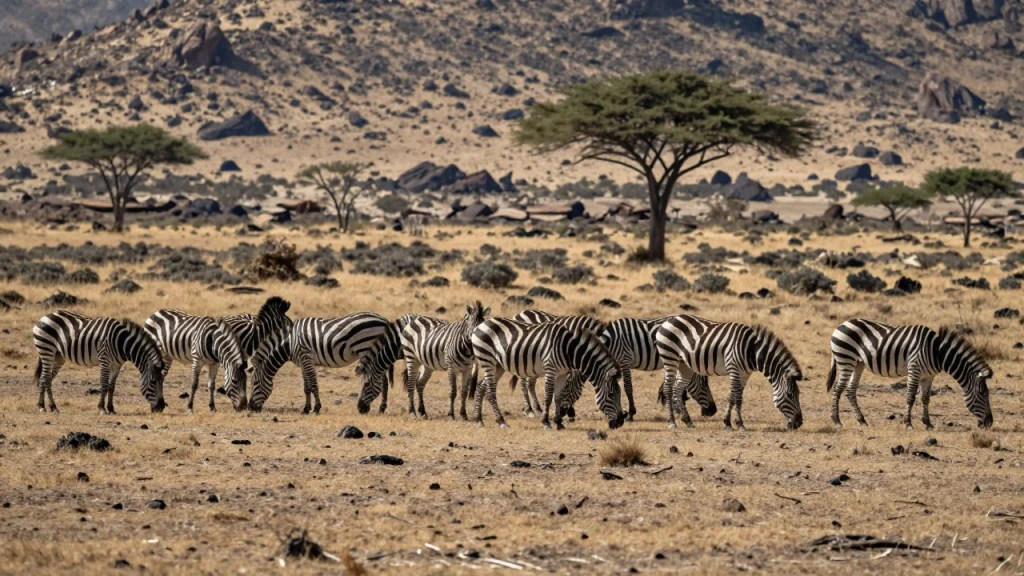
Dietary preferences and water reliance vary slightly depending on the specific zebra species and its natural habitat:
Plains Zebra
The most widespread species, the plains zebra, inhabits open grasslands, woodlands, and savannas. It eats a wide range of tall and short grasses and is highly adaptable to changing environmental conditions.
Grevy’s Zebra
Found in arid and semi-arid scrublands of East Africa, Grevy’s zebras can digest extremely tough, dry grasses. They can survive up to five days without drinking water when forage contains minimal moisture.
Mountain Zebra
Inhabiting mountainous areas of South Africa and Namibia, this species eats tough mountain grasses, bark, and leaves, using its agile hooves to navigate steep slopes in search of food.
Seasonal Migrations in Search of Grazing Lands
Food availability in African habitats fluctuates dramatically between rainy and dry seasons. To secure sufficient grass, plains zebras engage in some of the longest terrestrial migrations on the continent.
Guided by rainfall patterns and seasonal shifts, herds travel hundreds of miles to follow fresh vegetation growth. These movements ensure that zebras maintain access to energy-rich grasses while allowing previously grazed pastures time to regenerate.
Through their constant grazing, seed dispersal, and continuous movement, zebras play a vital role in keeping savanna ecosystems balanced, healthy, and resilient.
Do zebras eat meat?
Animal Diversity Web notes that Burchell’s zebras graze predominantly on grass while occasionally browsing on herbs, leaves, and twigs. Animal Diversity Web also notes that both mountain zebra subspecies are herbivorous.
What is a zebra’s favorite food?
For Burchell’s zebras, Animal Diversity Web reports that favored grasses include Themeda triandra, Cynodon dactylon, Eragrustis superba, and Cenchrus ciliaris. The San Diego Zoo Wildlife Alliance Library similarly identifies Panicum maximum, Themeda triandra, Cynodon dactylon, and Eragrostis superba as primary dietary staples for plains zebras. Among mountain zebras, Themeda triandra stands out as the chief grass eaten.
How long can zebras go without water?
Animal Diversity Web reports that most Grevy’s zebras survive without drinking for up to five days, whereas mountain zebras typically drink once or twice per day. Nursing Grevy’s zebra mares must drink at least every other day to sustain milk production. For Hartmann’s mountain zebras, the Louisville Zoo states that individuals can go four days without water.
What do zebras eat in zoos?
At San Diego Zoo facilities, zebras receive grass hay. Smithsonian’s National Zoo provides its Grevy’s zebras with a measured combination of manufactured pellets and hay, makes salt licks available, and offers leaf-eater biscuits during training. For an individual resident Grevy’s zebra named Moyo, daily rations include hay and grain, while training rewards consist of apple chunks, grain, hay, and herbivore biscuits. At Columbus Zoo, Grant’s zebras feed on timothy hay, formulated herbivore pellets, and savanna pasture grasses.
Sources
- Animal Diversity Web: Burchell’s zebra (Equus burchellii)
- Animal Diversity Web: Grevy’s zebra (Equus grevyi)
- Animal Diversity Web: Mountain zebra (Equus zebra)
- Smithsonian’s National Zoo: Grevy’s Zebra
- The Maryland Zoo: Plains Zebra
- San Diego Zoo Wildlife Alliance: Zebra | San Diego Zoo Animals & Plants
- San Diego Zoo Wildlife Alliance Library: Diet & Feeding – Plains Zebra (Equus quagga) Fact Sheet – LibGuides at International Environment Library Consortium
- Louisville Zoo: Zebra, Hartmann’s Mountain – Louisville Zoo
- Smithsonian’s National Zoo: How Do You Train a Zebra? | Smithsonian’s National Zoo and Conservation Biology Institute
- Columbus Zoo and Aquarium: Columbus Zoo | Zebra