
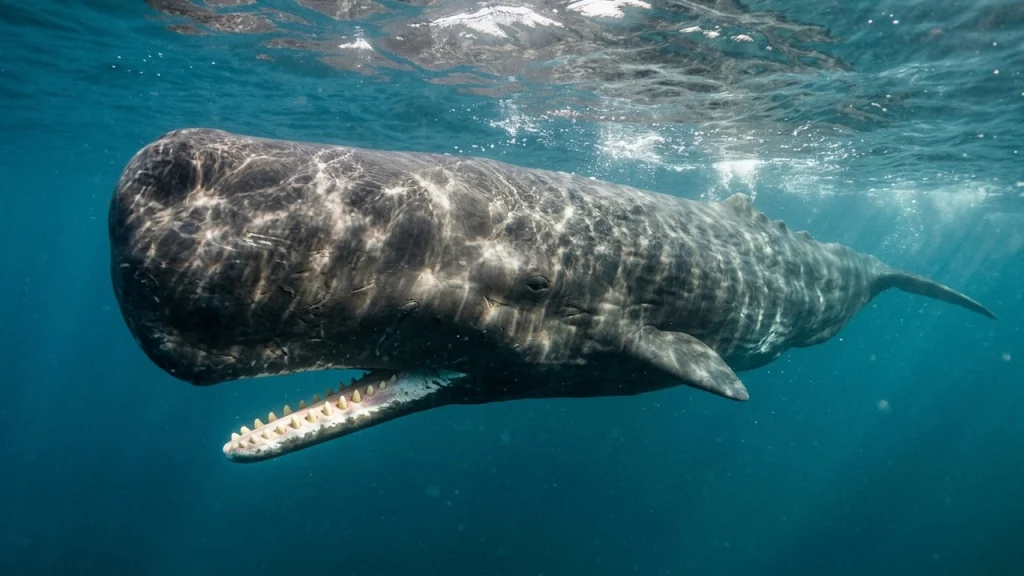
Lower jaw dental arrangement and anatomy
Do sperm whales have teeth? Yes, sperm whales possess genuine, robust teeth, yet their dental anatomy differs dramatically from other ocean predators. Among all toothed whales, sperm whales rank as the largest, maintaining one of the broadest distributions across global marine environments. These massive cetaceans navigate every deep ocean on the planet, displaying a feeding apparatus that surprises casual observers and experienced naturalists alike.
Unlike common marine mammals with matching dental rows across both jaws, this species confines its visible, erupted teeth strictly to the mandibular bone. Their most prominent physical markers include a bulbous squared head along with huge conical teeth set in the lower jaw.
Between 20 and 26 large teeth line each side of the lower jaw. These stout ivory cones rise directly from the gums to form an imposing grasping surface. Anatomical surveys also record between 18-28 functional teeth per side of the lower mandible, whereas upper teeth remain few, weak and nonfunctional. Within the upper jaw, teeth seldom emerge through the gums into open view.
When the mouth shuts, the lower teeth insert into corresponding sockets in the upper palate.
Oral pigmentation and cranial proportions
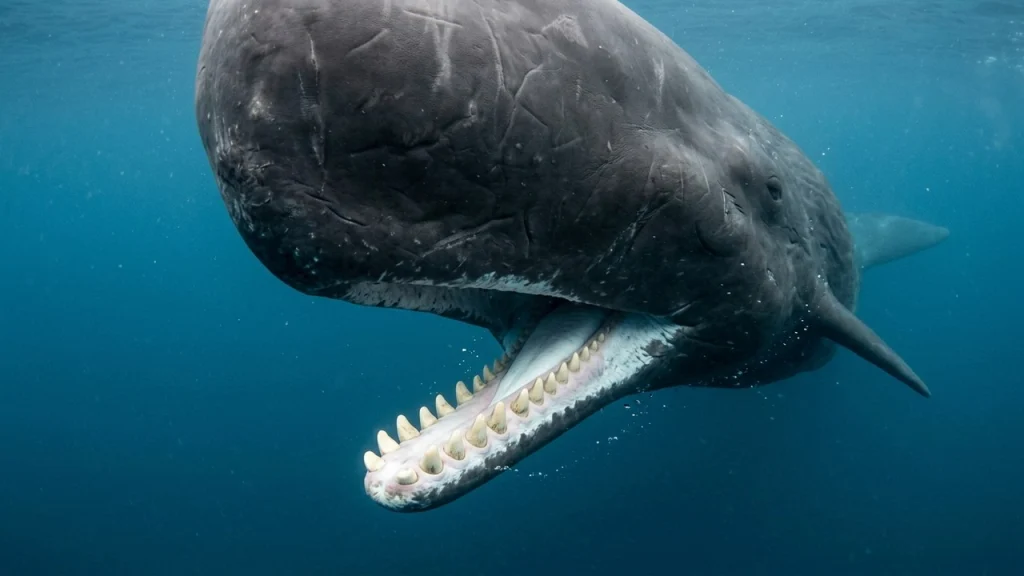
The lower jaw itself forms an unusually narrow structure beneath an immense facial complex. The whale possesses a narrow lower jaw where the region closest to the teeth displays a white hue. This luminous coloration provides striking visual contrast along the mandibular margins. The interior lining of the oral cavity is often bright white as well.
Distinctive white pigmentation is not restricted to the oral cavity, extending across other ventral zones. Both male and female individuals display white pigmentation in the genital and anal regions as well as on the lower jaws.
Centuries of taxonomic history reflect this unmistakable dental arrangement. The scientific name catodon derives from two Greek roots, with kata meaning “lower” and odon translating to “tooth.” This specific epithet points directly to the prominent row of mandibular teeth along the lower jaw.
Beyond dental structures, the head structure commands attention through its sheer scale. Their enormous heads are exceptionally huge, making up about one-third of the total body length. These marine giants get their common name from spermaceti, a waxy substance stored inside their huge heads. In terms of physical mass, the giant sperm whale possesses the largest of mammalian brains, weighing approximately 9 kg. A substantial blubber layer insulates the animal, measuring up to 35 cm in thickness.
Swimming appendages and sexual dimorphism
The overall body form shows marked structural divergence between males and females. Female sperm whales measure smaller than males while maintaining an unusual body outline distinct from other cetaceans.
The elongated body displays an overall grey colouration complemented by small stubby flippers alongside a massive tail. The pectoral flippers exhibit a paddle-shaped structure that is small in proportion to the body, whereas the flukes are triangular.
Unlike many oceanic dolphins that sport tall, sickle-shaped fins, this species features an understated profile along its dorsal ridge. They feature small dorsal fins that remain low, thick, and commonly rounded.
Members of both sexes inhabit tropical and temperate areas, yet only the adult males travel into higher latitudes within polar zones.
Deep-sea foraging and feeding adaptations
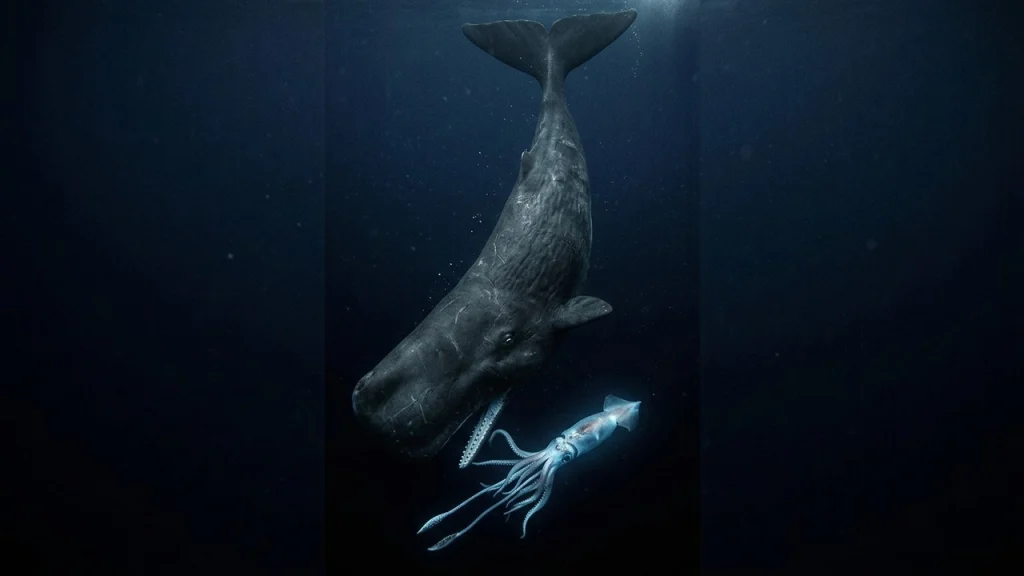
How does a marine predator with functional teeth only along its lower jaw secure its prey? Physeter catodon preys primarily on squid, including giant squid, alongside octopus and deepwater fishes, while also consuming sharks and skates.
Cephalopods represent the foundation of the animal’s nutritional intake across every ocean basin. Cephalopods such as squid and octopus constitute almost the entire diet, centering heavily on deep-water and benthic species. To support their immense physical mass, these deep-sea predators must consume staggering quantities of marine biomass every day. A foraging whale consumes roughly 3 per cent of its total body mass in squid per day.
Swallowing enormous prey whole requires an extraordinary alimentary canal. Physeter catodon has the largest gullet among all cetaceans, forming the only throat wide enough to swallow an entire human.
Hunting deep-water squid demands sustained excursions into bathypelagic ocean zones where sunlight never penetrates. Foraging dives reach depths beyond a kilometre, with underwater submergence lasting up to 90 minutes.
Prehistoric dentition and evolutionary change
The presence of functional teeth solely along the lower jaw represents the modern outcome of an ancient evolutionary transformation. Numerous fossil physeteroids preserved functional upper dentition alongside enamel caps, whereas lineages closer to Physeter developed reduced or vestigial upper teeth lacking enamel, including Aulophyseter morricei Kellogg.
Extinct medium and large physeteroids like Acrophyseter and Livyatan featured prominent upper teeth and alveoli that broadly matched their lower dentition in physical size and overall morphology.
Dental growth layers and cultural significance
In modern sperm whales, lower mandibular teeth serve as permanent biological chronometers for scientific research. To reveal internal dental growth layers, researchers sectioned each tooth along the sagittal plane with a low-speed diamond metallographic saw.
Once bisected, the tooth halves undergo careful chemical preparation in the laboratory. Both cut tooth halves were soaked in a 15% formic acid bath at room temperature for at least three hours until an etched surface formed.
Examining these etched dental cross-sections under magnification allows researchers to calculate precise individual ages across stranded populations:
- Dental growth analysis identified the smallest individual at 6.10 m of TBL as 3 years old.
- The largest examined male measured 12.16 m of TBL, with age estimated at 40–42 years.
These two examples show that sperm whales can live several decades in the wild.
Beyond their biological functions, sperm whale teeth have occupied a prominent place in maritime cultural history. Whalers historically carved and engraved these massive teeth to create the traditional marine folk art known as scrimshaw.
In the Pacific Islands, these dental structures acquired profound spiritual and social importance that persists to this day. Polished sperm whale teeth known as tabua serve as deeply significant cultural valuables in traditional Fijian society.
Sources
- NOAA Fisheries: Sperm Whale | NOAA Fisheries
- Animal Diversity Web: Physeter catodon (sperm whale)
- Australian Museum: Sperm Whale, Physeter macrocephalus Linnaeus, 1758
- Animals (Basel) / PubMed Central: Life History Traits of Sperm Whales Physeter macrocephalus Linnaeus, 1758 Stranded along Italian Coasts
- PLOS ONE / PubMed Central: Albicetus oxymycterus, a New Generic Name and Redescription of a Basal Physeteroid (Mammalia, Cetacea) from the Miocene of California, and the Evolution of Body Size in Sperm Whales