
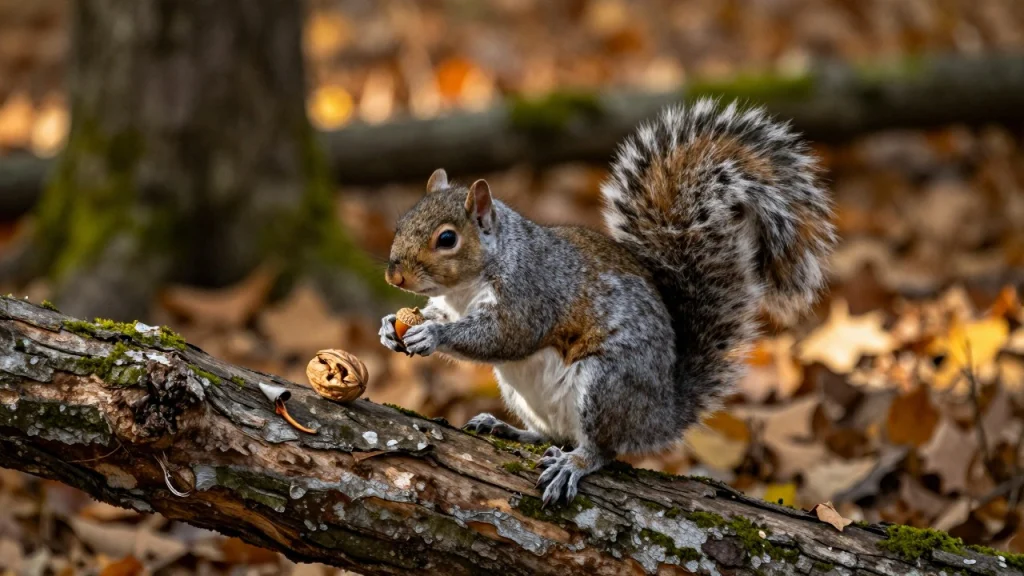
Yes, squirrels eat meat, but as an opportunistic supplement rather than a staple. Most of the family is largely herbivorous, built on seeds, nuts, fruit and fungi, with insects, eggs and now and then a small vertebrate taken whenever the chance appears. Both halves of that answer matter: the plant menu describes what a squirrel normally does, and the animal menu explains what it does when seeds run short or a nest sits within reach.
The answer also depends on which squirrel you mean. Sciuridae holds roughly 279 species divided among five subfamilies, and feeding habits inside that family vary widely enough that one member takes almost nothing but grass while another treats rotting meat as an ordinary food.
A mostly plant menu with animal food on the side
Most squirrels feed mainly on tree seeds and fruit, yet the family menu is far from narrow. Insects and eggs are both on it, joined by fungi, lichens and even small vertebrates. Fungi show how wide that range can be, running from a minor side dish for some species to nearly half the menu for others. Even among plant foods, quality varies sharply, because parts such as buds, shoots, flowers and lichens carry relatively little energy per unit weight and therefore stay a smaller share of what gets eaten.
Availability, not preference, sets the menu
What fixes the proportions is access. The quantity of each kind of food depends mainly on its availability and how easily it can be reached, and the upshot is a diet that swings between places, between seasons, and between years. A squirrel is not choosing between two lifestyles. It is taking whatever lies within reach this week.
Northern flying squirrels watched in interior Alaska show how far one population’s menu can shift. Those animals were recorded eating mushrooms, some of them dried, truffles, berries and tree lichens, and the seasonal pattern runs from fresh fungi in the warm months to mostly lichens in winter.
Summer brings the insects
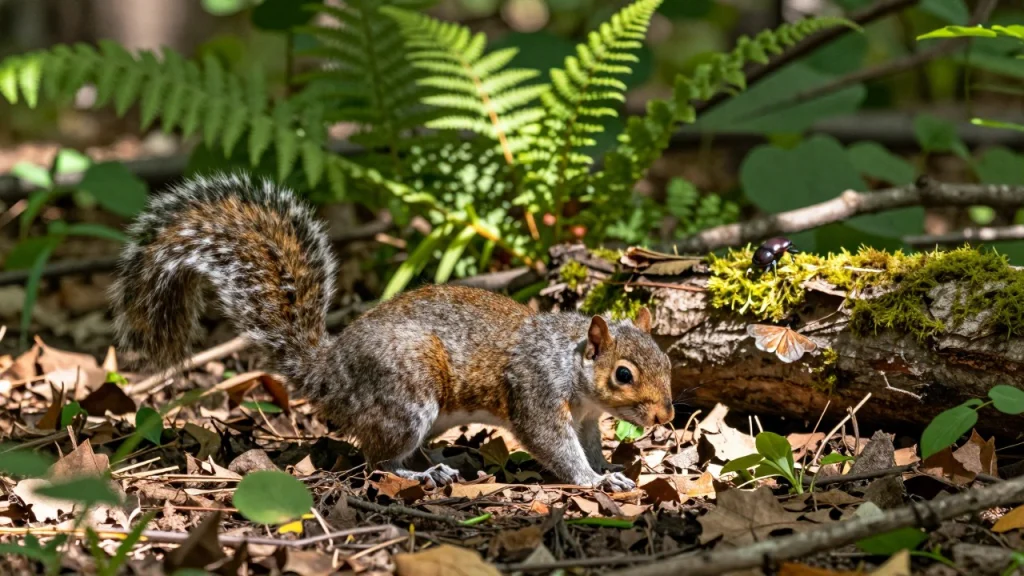
In the eastern gray squirrel, insects enter the menu in summer and are thought to matter most to juveniles. Through the rest of the year that species leans on tree nuts and seeds, drawing especially on oaks, of which more than 24 species are used, plus hickory, pecan, walnut and beech, and filling the gaps with other trees’ fruits, seeds, flowers and buds, conifer seeds and catkins, herbaceous plants and fungi. In the cold months the emphasis shifts again, with grain such as corn and wheat eaten especially then, and surplus food buried in scattered caches, which the squirrel later finds again by memory and by smell.
Three groups, three different menus
Tree squirrels that scavenge
The eastern fox squirrel takes a wider set of foods than the plant list suggests, spanning plant tissue along with gall insects, moths, beetles, eggs and dead fish. Acorns, hickory nuts, walnuts, mulberry and hawthorne seeds are the preferred items. Dead fish is the entry that surprises readers, and it places carrion firmly alongside insects and eggs as ordinary food rather than as an accident.
Ground squirrels that stay on grass
The black-tailed prairie dog shows the near-pure plant end of the range. The bulk of its intake comes from grasses and leafy vegetation, and plants supply 98 percent of the diet. Grasshoppers, cutworms, bugs and beetles come in only occasionally, so a squirrel whose meals looked anything like this would be a very different animal from a prairie dog.
Flying squirrels that list meat
The northern flying squirrel sits at the opposite pole and is described as omnivorous. Outside Alaska, where its own diet is poorly documented, the foods recorded for the species fall into three groups:
- Fungi and plants: mushrooms and truffles, plus lichens, fruits and green vegetation
- Nuts and buds: seeds and the tender tips of trees
- Animal foods: insects, plus meat in any state, from fresh to dried to rotted
Nestling birds and eggs can be added to that last line. The rotted category is the striking part, since it points to scavenging as a normal feeding strategy rather than a rare exception.
The eastern gray squirrel’s documented extremes
Records from that one species go further than most people expect. Cannibalism has been reported among them, and they may also consume bones, bird eggs, nestlings and frogs. Bones and nestlings are the entries that unsettle the usual picture of a creature described as a seed and nut specialist.
The mechanics are unglamorous but effective. Squirrels open nuts by levering with the lower incisors, and they become proficient at that quickly.
What squirrel meat eating does to bird populations
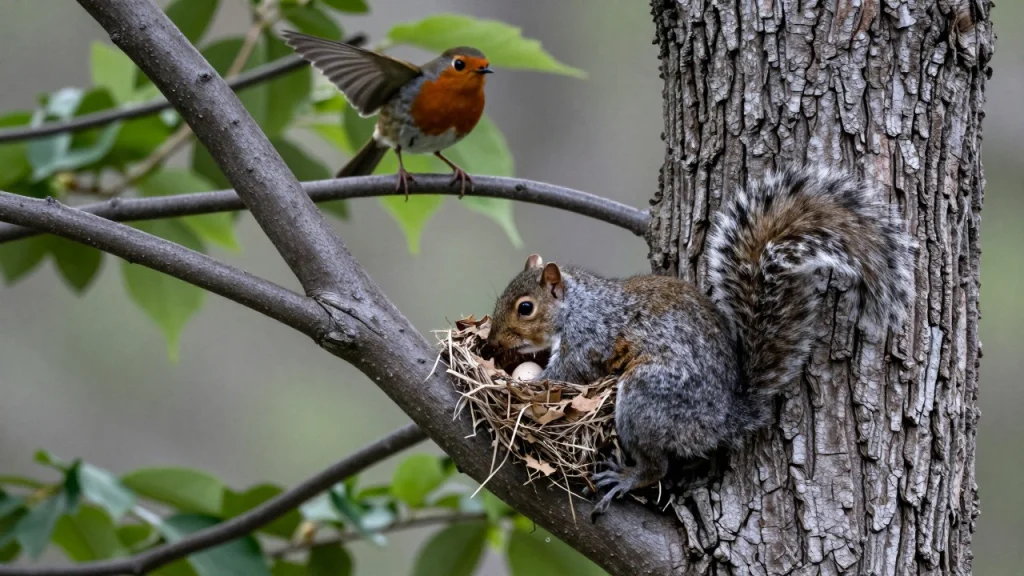
Nest predation is not a curiosity confined to one squirrel. Field research in Sheffield, in the United Kingdom, found a slight reduction in the numbers of the breeding birds most sensitive to squirrel nest predation, and the same study reports plainly that they sometimes predate birds’ nests. Even so, that study found the amount and quality of green space, measured as canopy cover, exerted a stronger influence on bird numbers than squirrels or feeding stations combined.
Prey as well as scavenger
Squirrels that add animal food to the menu are also heavily eaten themselves. They are important prey for a wide array of predators, including predators that are themselves threatened or endangered, and the black-footed ferret’s diet is almost all prairie dog. A squirrel switching to insects in midsummer is feeding itself and, at the same moment, feeding something larger.
The plant side rebuilds the forest
The seeds matter as much as the animal food. Tree and flying squirrels are indispensable to forest regeneration everywhere, largely because of how they move seeds around. Seeds that survive a trip out through the gut get deposited elsewhere, and the caching habits of many squirrels leave large numbers of nuts buried where they are never dug up again. A forgotten acorn is a tree.
So, do squirrels eat meat?
The short answer is yes, with a clear hierarchy in what that means:
- Plant first. Seeds, nuts, fruit and fungi carry the diet, and low-energy plant parts stay a small share of it.
- Animal food opportunistically. Insects, eggs, nestlings, small vertebrates and carrion all appear on family-level and species-level lists.
- By group, not by rule. A black-tailed prairie dog gets 98 percent of its food from grasses and leaves, while the northern flying squirrel is classed as omnivorous and the eastern fox squirrel is recorded eating dead fish.
- Driven by what lies close at hand. Availability and accessibility, not preference, decide how much animal food any individual squirrel consumes.
Sources
- Animal Diversity Web: Sciuridae (squirrels) | INFORMATION
- Animal Diversity Web: Sciurus carolinensis (eastern gray squirrel) | INFORMATION
- Animal Diversity Web: Sciurus niger (eastern fox squirrel) | INFORMATION
- Smithsonian’s National Zoo: Black-tailed prairie dog
- Alaska Department of Fish and Game: Northern Flying Squirrel Species Profile
- PLOS ONE (via PubMed Central): Relative Roles of Grey Squirrels, Supplementary Feeding, and Habitat in Shaping Urban Bird Assemblages