
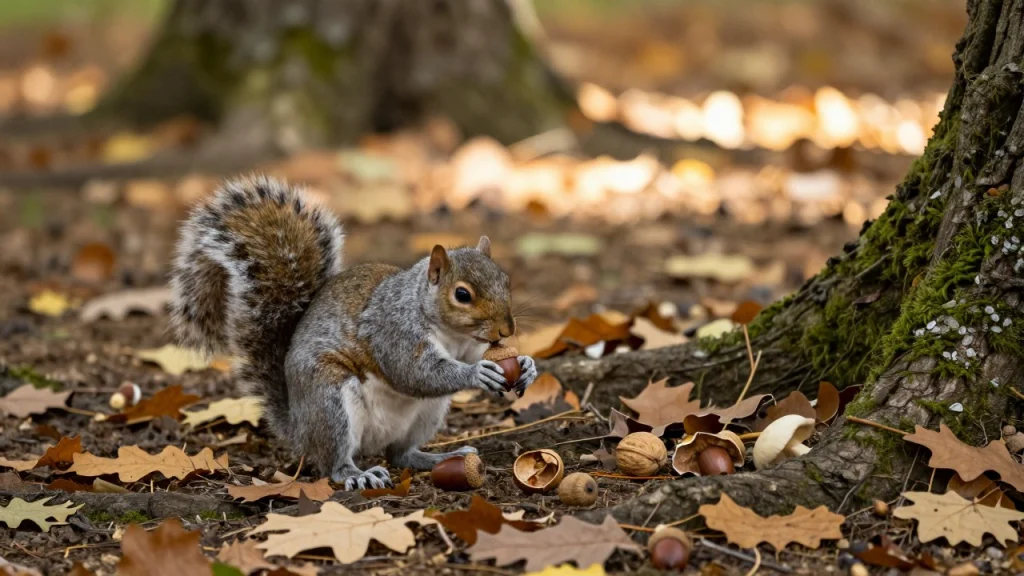
Squirrels eat nuts and seeds along with tree flowers and buds. Many species also consume fungi, fruit, green vegetation, and small animals such as insects and bird eggs. During spring, green vegetation accounts for 80% of the California ground squirrel’s diet, while eastern gray squirrels consume crops like corn and wheat, especially in the winter.
Squirrels are omnivores, so the short answer to what they eat is a wide range of plant and animal food, with tree seeds and nuts doing most of the work. The exact menu depends on which kind of squirrel you mean, because tree squirrels, ground squirrels and flying squirrels each exploit a different part of the landscape.
The eastern gray squirrel, the species most people picture, builds its diet on tree seed. More than 24 species of oak and 10 species of hickory supply most of its nuts, flowers and buds, with pecan, walnut and beech adding to the mix. Add insects in the warm months and garden crops in winter, and the picture is of an animal that will try almost anything.
The main items on a squirrel menu
- Tree nuts and conifer seed. Acorns, hickory and walnut are the classic items, and together with conifer seeds they make up the bulk of the diet for gray and red squirrels.
- Fruits, blossoms, buds and catkins. Maple, mulberry, hackberry and elm all contribute, along with wild cherry, dogwood and hazel.
- Fungi. Mushrooms are a substantial item, not an occasional treat.
- Insects and other animals. Beetles, ants, termites and grasshoppers turn up, along with the eggs and nestlings of birds.
- Cultivated and human food. Corn and wheat in farmland, and in towns, whatever sits in garden beds, bird feeders, composts and bins.
Why oaks, walnuts and conifers keep coming up
Acorns and walnuts feature so heavily because they store well. Gray squirrel density peaks in forests with tree species whose crop survives winter storage, such as oaks and walnuts. Conifers supply a parallel larder: cedar, hemlock, pine and spruce give up their seeds and catkins, alongside herbaceous plants and fungi.
Red squirrels are the seed specialists. Their diet centers on seeds, though they turn opportunistic omnivores when the seasonal crop fails. They are also picky harvesters, taking cones in order of how much usable energy each one holds and then moving down the list of conifers by that same measure.
Fungi deserve more attention than they usually get. Red squirrels are enthusiastic mushroom eaters, taking at least 45 different kinds in the Cascade Mountains alone. When ordinary food is scarce they attack the tree itself, stripping bark and girdling whole trees in winter, spring and early summer to reach the phloem and cambial tissues underneath.
From insects to bird eggs: the animal side
Plant food is the default, not the whole menu. Insects belong on the summer menu, and they seem to matter most to juveniles. The same species is recorded taking bird eggs, nestlings, frogs and even bones, and cannibalism has been reported.
Flying squirrels push the carnivory further. Southern flying squirrels are the most carnivorous feeders in the family Sciuridae, even though they remain omnivores. Their diet runs from insects and seeds to berries, carrion and the eggs of birds, and wood-boring beetles are a documented part of the prey. They forage through the night and rarely travel far, staying within 160 meters of the nest and taking whatever is at hand.
Tropical tree squirrels eat a comparable mix. Prevost’s squirrel, a tree squirrel of Southeast Asia, feeds on soft fruit, hard nuts and seeds, tree buds and blossoms, insects and the eggs of birds.
Ground squirrels eat greener, wetter food
The contrast is sharpest with burrowing species. The California ground squirrel eats mostly green vegetation, then seeds, with insects a distant third. In spring, 80% of its diet is green vegetation, 15% seeds and 5% insects, and through summer the diet is entirely green vegetation. Only in winter does the balance swing back toward seeds.
Moisture explains the rest. Living in desert conditions, this squirrel cannot survive on dry food, and the average water content of its diet is 80%.
The menu changes with the season
Corn and wheat show up in the diet especially in the winter, when wild foods are thin, while insects come into their own in the summer.
Red squirrels ride a steeper curve than most. Their staple, conifer seed from trees such as white spruce, swings wildly from year to year, and in some years the gap between a failed crop and a heavy one spans three orders of magnitude. A single poor autumn can therefore push a population onto whatever else is available.
Two ways of storing food for winter
Tree squirrels commonly use scatter hoarding. The eastern gray squirrel buries food in winter caches and finds them again by memory and by smell, spreading the season’s supply across many small hiding places rather than one store.
Red squirrels do the opposite. They are primarily larder hoarders, gathering cones in late summer and autumn into a small number of central middens that competitors find hard to raid. The limit is size, since a midden covers only about 37 days of food. Some individuals bury stores underground and still recover seeds under 4 meters of snow.
Southern flying squirrels stash their food in the tree itself. From November onward they gather and stash winter food in the cracks and cavities of the nest, sometimes in partly finished woodpecker holes, filling them with hickory nuts and acorns among other kinds of nut. Since tree squirrels do not hibernate, a winter store is not optional.
What squirrels leave behind
A cache that is never recovered is really a seed planted. Red squirrels disperse seeds and fungi by burying them and then failing to return, and the fungi riding along in those caches help young trees take up nutrients and grow. Southern flying squirrels do the same job for fungi, spreading spores in their droppings after eating the fruiting bodies.
The flip side is forestry. On some sites, red squirrels wipe out 60 to 100% of the cone crop and hurt trees outright by eating buds and stripping bark.
Squirrels in gardens, feeders and bins
City life widens the diet again. In urban habitats, eastern gray squirrels raid gardens, bird feeders and compost piles, and they readily help themselves to trash.
One study that watched gray squirrels at campus bins recorded what they carried away. Of the food retrieved, 76.2% was starchy, including bread and fries, with 8.9% vegetables, 7.9% red meat and poultry and 3.0% fruit. Timing explains the appeal: squirrels took the most of it during the coldest period of the study, when natural food is least available and they are living on fat reserves and stored caches.
Feeding posture is a useful field clue. Squirrels squat on their haunches, gripping food between their front paws.
Why the diet matters beyond the squirrel
Everything on this menu feeds something else. Eastern gray squirrels fall prey to a long list of hunters, among them American mink, red foxes, bobcats, coyotes and raptors such as the red-tailed hawk.
Not every squirrel is doing well. The Prevost’s squirrel of Southeast Asia has lost much of its natural habitat as plantations expanded, and elsewhere in its range many are captured for the pet trade.
Understanding the menu therefore explains much of the rest of a squirrel’s life: why oaks and conifers decide where it lives, why a forgotten acorn can turn into a tree, and why a squirrel spotted in deep winter is probably living off what it stored rather than searching for something new.
What should you feed squirrels?
Penn State Extension suggests offering squirrels cracked corn, peanuts, or dried ears of corn at a spot away from feeding stations. The same organization also lists peanut butter, shelled walnuts or pecans, and sliced apples and oranges as suitable baits. At the Smithsonian National Zoo, captive Prevost squirrels receive prepared scenic feed and leaf eater biscuits alongside vegetables, greens, nuts, and crickets.
Should you feed squirrels in your yard?
Oregon State Extension recommends against feeding squirrels because high population density can displace birds and other valued wildlife. Squirrels that receive food often lose their fear of humans and become more prone to biting and behaving aggressively.
Which foods are bad or dangerous for squirrels?
Human food is dangerous for wild squirrels because it often fails to provide suitable nutrition and can trigger illness when eaten, according to University of Illinois Veterinary Medicine. In addition, Illinois veterinary experts point out that most commercial store-bought diets prepared for feeding wildlife lack balanced nutrition.
What do baby squirrels eat?
Baby squirrels begin life consuming maternal milk, with red squirrel mothers nursing their young for the first 70 days. In eastern gray squirrels, weaning begins during the seventh week and finishes by the tenth.
Sources
- Animal Diversity Web: Sciurus carolinensis (eastern gray squirrel)
- Animal Diversity Web: Tamiasciurus hudsonicus (red squirrel)
- Animal Diversity Web: Glaucomys volans (southern flying squirrel)
- Animal Diversity Web: Spermophilus tereticaudus (California ground squirrel)
- Smithsonian’s National Zoo and Conservation Biology Institute: Prevost’s squirrel
- Springer Nature via PubMed Central: Gray squirrels consume anthropogenic food waste most often during winter
- Penn State Extension: Squirrels and Bird Feeders
- Penn State Extension: Tree Squirrels
- University of Illinois Veterinary Medicine: Should You Feed Wildlife?