
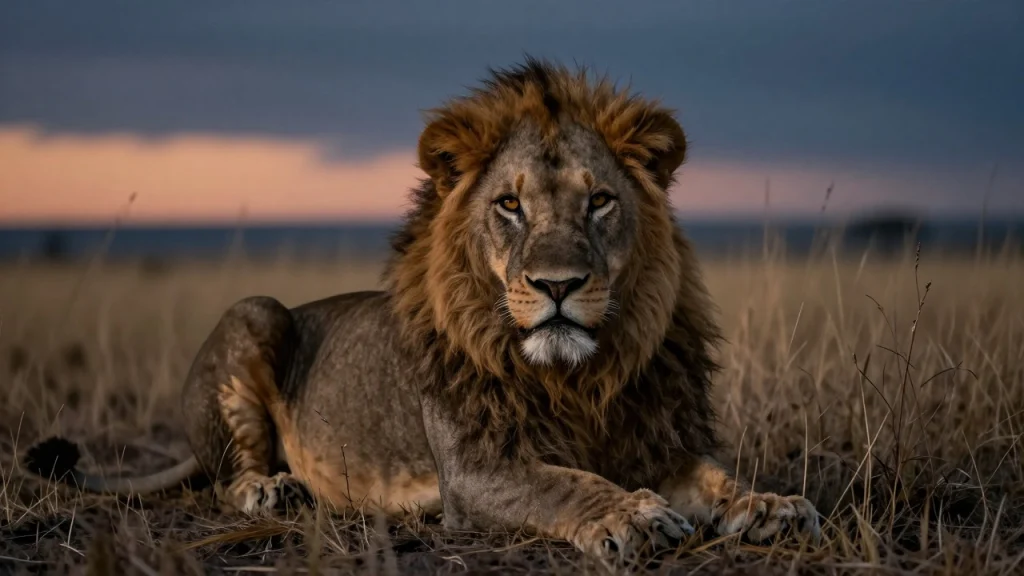
Lions are famous for stalking the African savanna under the cover of night, but can lions see in total darkness? The short answer is no. Like all animals, lions require at least a minimal amount of light, such as faint moonlight or starlight, to see. Lions are expected to have slightly better acuity than humans in dim light, although this needs physiological verification.
Understanding how lions navigate and hunt in the dark reveals fascinating biological adaptations. From specialized eye structures to a reliance on complementary senses, lions have evolved strong low-light vision, though image-forming vision still requires some light to be present.
Can Lions See in Pitch-Black Conditions?
To understand a lion’s nocturnal vision, it helps to distinguish low light from total darkness. Total darkness means the complete absence of photons or light waves. In a deep cave or an enclosed room with zero light sources, a lion is just as blind as a human. Light is essential for eyes to process visual images; without light reflection, visual perception is physically impossible.
In nature, absolute darkness is rare. Savannas, grasslands, and woodlands usually receive faint illumination from stars, the moon, or atmospheric glow. In these low-light environments, lions excel. Their eyes are specially structured to gather and amplify small amounts of light, giving them exceptional night vision.
Biological Adaptations for Night Vision
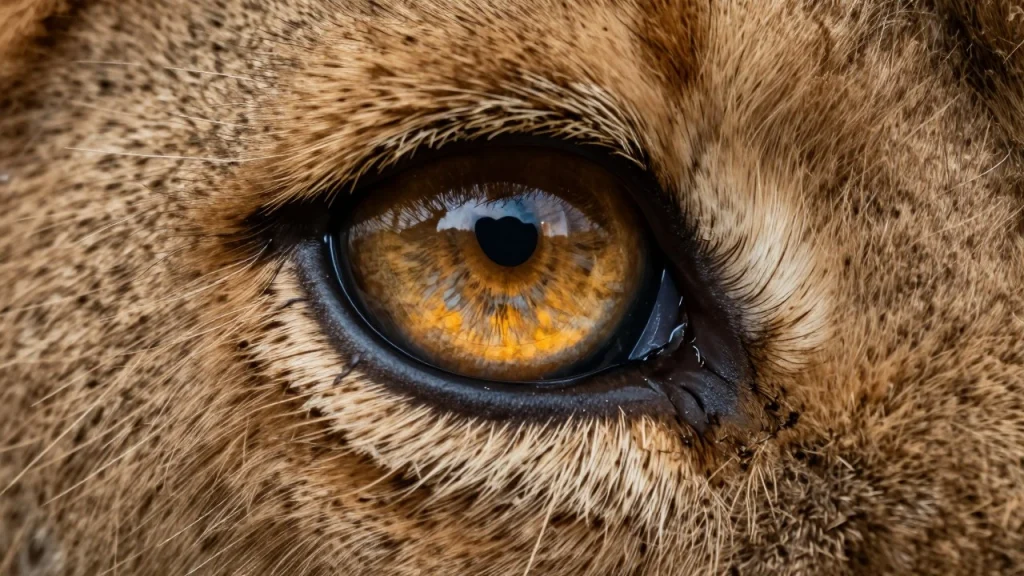
Lions possess several anatomical adaptations in their eyes that maximize light gathering and enhance contrast in darkness.
The Tapetum Lucidum: Nature’s Reflector
The tapetum lucidum is an important component of low-light vision that reflects light back through the retina.
- Light Amplification: When light enters a lion’s eye, it passes through the retina and hits the tapetum lucidum, which acts like a mirror.
- Double Exposure: The tapetum reflects light back through the retinal photoreceptors a second time, giving the eye another opportunity to absorb light signals.
- Eye Shine: This reflective layer is also why a lion’s eyes appear to glow bright yellowish-green when hit by a flashlight or headlights at night.
High Density of Rod Cells
Most vertebrate retinas comprise two photoreceptor types: rods for dim-light (scotopic) vision and cones for bright-light (photopic) and color vision. Cones process fine details and vibrant colors in bright daylight, while rod cells detect movement and light intensity in low-light conditions.
A lion’s retina is densely packed with rod cells and has relatively few cone cells. This shift allows lions to detect tiny movements in dim surroundings, although it sacrifices color precision and sharp daytime clarity.
Large Pupils and Corneas
Lions feature wide corneas and pupils that can expand significantly wider than human pupils. In low light, the pupil dilates to let in more light; larger pupils require proportionally larger lenses to maintain effective light transmission.
How a Lion’s Night Vision Compares to Humans
Studies report that domestic cats are about six times more sensitive to light than humans; lions share the same basic feline eye design.
| Visual Feature | Human Vision | Lion Vision |
|---|---|---|
| Low-light Sensitivity | Standard | High (~6x, per domestic cat studies) |
| Retinal Cell Dominance | Balanced (Rods & Cones) | Rod-dominant (Night/Motion focused) |
| Reflective Layer (Tapetum) | Absent | Present |
| Color Perception | Rich, trichromatic | Limited, dichromatic |
While humans excel at distinguishing colors and fine details in bright daylight, lions sacrifice color depth to gain superior movement detection and visibility at night.
White Fur Marking Beneath the Eyes
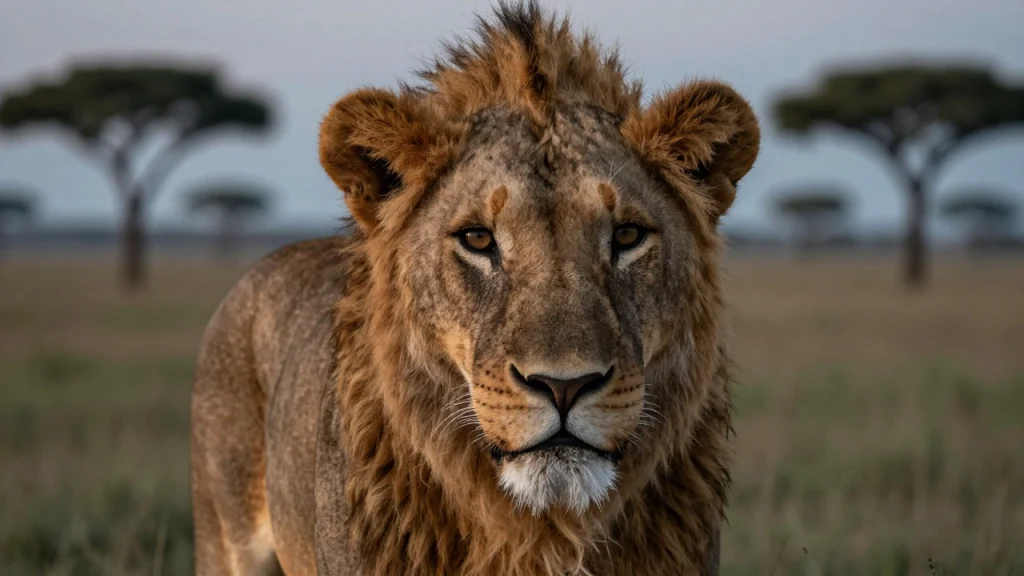
An intriguing physical trait supporting night vision is the white patch of fur under a lion’s eyes.
These pale patches help reflect faint ambient light into the eye. Field researchers believe these markings also assist pride members in tracking each other’s visual focus and movements during nocturnal group hunts without alerting prey.
How Lions Hunt and Navigate at Night
Lions hunt prey including zebras and wildebeests; Burchell’s zebras are listed as diurnal, while blue wildebeests are active both during the day and at night.
Combining Vision with Superior Hearing and Smell
When ambient light levels drop extremely low (such as during heavily clouded, moonless nights), lions rely heavily on their other senses:
- Acute Hearing: A lion can swivel its ears independently to pinpoint the rustle of grass or animal movements from impressive distances.
- Keen Sense of Smell: Scent cues allow lions to track herds, locate pride members, and detect carcass locations across vast distances.
- Tactile Whiskers: Sensitive facial whiskers assist in sensing nearby obstacles and wind directions in dense vegetation.
Stalking Advantage on Moonless Nights
Studies show that lion hunting success rates vary with lunar phases. Lion hunting success is highest on dark nights. The combination of stealth, low-light vision, and sensory coordination makes lions formidable apex predators after dusk.
Summary: Lion Low-Light Capability
In summary, while lions cannot see in complete, total darkness without light photons, their evolutionary adaptations make them apex nocturnal hunters. Through large pupils, rod-dominated retinas, and the light-reflecting tapetum lucidum, lions turn subtle ambient starlight into a clear picture of their surroundings, maintaining their status as masters of the African night.
Sources
- BMC Veterinary Research: Descriptive comparative morphology of the eye and ocular adnexa in Felidae: observations from a clouded leopard (Neofelis nebulosa), African lion (Panthera leo), and Pallas’s cat (Otocolobus manul)
- Science Advances: Pushing the limits of photoreception in twilight conditions: The rod-like cone retina of the deep-sea pearlsides
- PLOS ONE: Zebra Stripes through the Eyes of Their Predators, Zebras, and Humans
- PLOS ONE: Fear of Darkness, the Full Moon and the Nocturnal Ecology of African Lions
- Behavioral Neuroscience: Light aversion in mice depends on nonimage-forming irradiance detection