
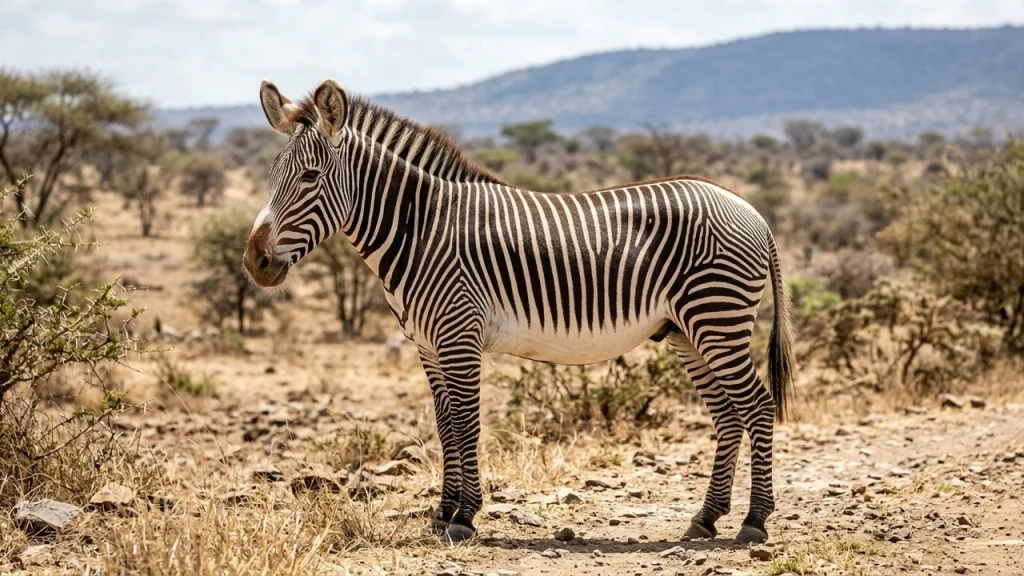
Understanding the differences between a plains zebra and a Grevy’s zebra comes down to examining their physical traits, social structures, and natural habitats. While both belong to the horse family Equidae, they are distinct species with clear visual and behavioral contrasts. Identifying these distinctions allows wildlife enthusiasts to appreciate how each species has adapted to survive in different parts of the African continent.
The main difference between a plains zebra and a Grevy’s zebra lies in their size, stripe patterns, and ears. Grevy’s zebras are noticeably larger and feature fine, narrow stripes with a plain white belly and large, round ears. In contrast, plains zebras are smaller, have broader stripes that extend beneath the belly, and possess smaller ears than Grevy’s zebras.
Physical Differences in Size and Appearance
Comparing the physical attributes of both species reveals striking contrasts in overall build and stripe design. Observing these features makes distinguishing between the two animals straightforward in the wild.
Body Size and Shape
The Grevy’s zebra (Equus grevyi) is the largest of all wild equids. An adult Grevy’s zebra stands significantly taller at the shoulder and weighs noticeably more than its plains counterpart. It possesses a taller, mule-like silhouette with a thick, upright mane.
The plains zebra (Equus quagga), on the other hand, exhibits a more compact, horse-like body structure. It is shorter, stockier, and lighter, making it well-suited for nomadic movement across varied terrain.
Stripe Patterns and Coloration
Stripe patterns offer the most reliable way to identify each species:
- Grevy’s zebra: Features numerous narrow, closely set stripes that run vertically down the body. These thin stripes end abruptly at the lower body, leaving a bright white, unstriped belly. A thick black stripe also runs along the spine down to the tail.
- Plains zebra: Has broad stripes that extend under the belly. Some subspecies also have brownish “shadow” stripes between the black stripes.
Ears and Muzzle
Head features provide additional visual clues. Grevy’s zebras have large, rounded ears and a brown muzzle, with a long, narrow, mule-like head; plains zebras have smaller ears than Grevy’s zebras and are the smallest of the three zebra species.
Habitat Preferences and Range
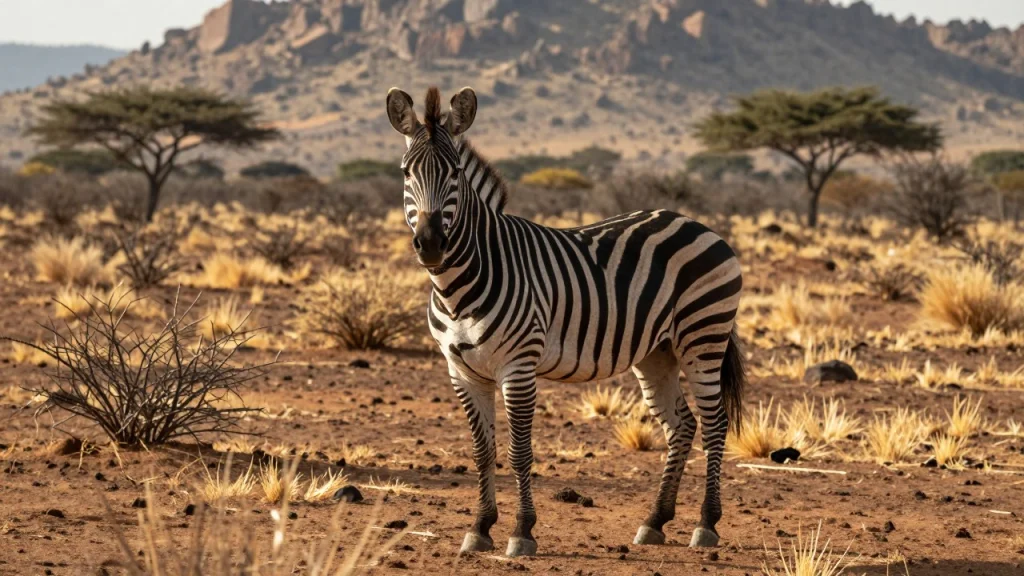
The geographical distribution and habitat preferences of these two zebra species reflect their ecological adaptations.
Plains zebras are widely distributed across eastern and southern Africa. They inhabit a diverse range of environments, including grasslands, open savannas, and woodlands. Plains zebras are more dependent on water than Grevy’s zebras, and the plains-zebra subspecies Grant’s zebras migrate during the rainy season in the Serengeti.
Grevy’s zebras inhabit a much narrower geographical range, restricted primarily to arid and semi-arid scrublands and grasslands in northern Kenya and southern Ethiopia. They are highly drought-tolerant and can survive in harsh areas with limited water resources for several days at a time.
Social Structure and Behavior
Social interactions and herd dynamics differ dramatically between the two species due to their evolutionary adaptations to different environments.
Family Harems vs. Territorial Males
Plains zebras live in tight-knit, permanent family groups called harems. A typical harem consists of one dominant stallion, several mares, and their offspring. These family units maintain strong bonds and often merge with other harems to form massive herds during seasonal migrations.
Grevy’s zebras do not form permanent harems. Instead, adult males establish large, solitary territories around scarce water and food resources. Females and young move fluidly through these territories, forming loose, transient associations rather than stable social units.
Conservation Status
Conservation needs differ greatly between these two African mammals:
- Grevy’s zebra: Classified as Endangered on the IUCN Red List. Habitat loss and competition with domestic livestock for water and food are threats to Grevy’s zebras, whose numbers have declined.
- Plains zebra: Classified as Near Threatened. Plains zebras are the most common zebra species in a range from East to southern Africa; their population trend is decreasing, and zebras face habitat loss and poaching.
Recognizing these physical, behavioral, and ecological differences highlights the diversity within Africa’s wild equids and underscores the importance of targeted conservation efforts for each species.