
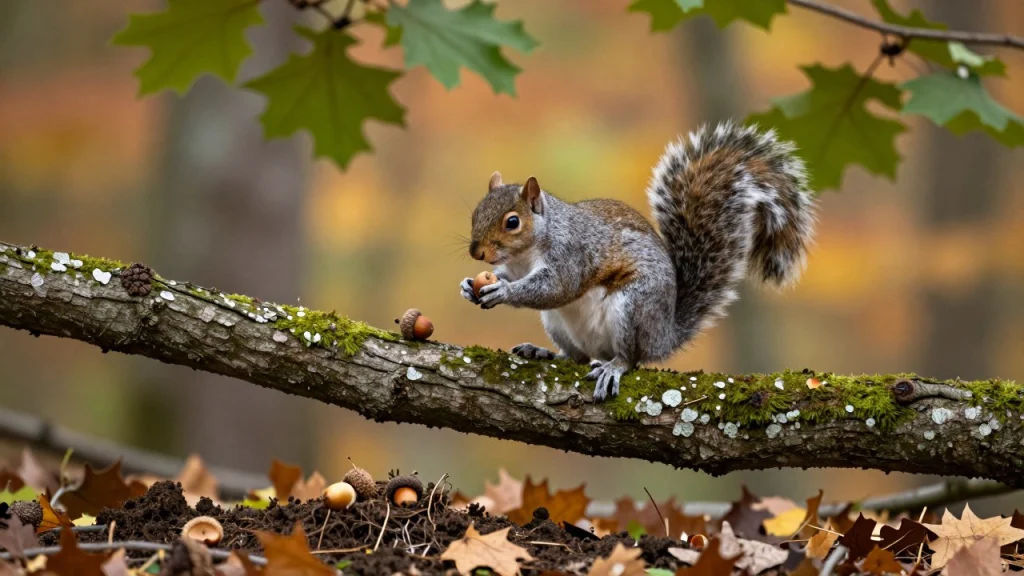
Squirrels have a bad reputation earned by a short list of visible behaviors: fruit stripped from the tree, bird feeders emptied, turf dug up, an attic chewed into. They have a good name earned by the same instinct, because a seed that gets buried and forgotten comes back as a tree. So the answer is neither yes nor no in general, only yes or no in a particular place.
Most of what people complain about happens close to home, where tree squirrels are active in daylight and live largely on nuts, seeds and vegetation, so a garden full of birdseed, nuts and fruit works as a buffet. In a hardwood woodland the same animal does the planting work that keeps the forest coming back, and a forest that stops regenerating is a bigger problem than a ruined vegetable bed.
The caching habit behind both sides of the reputation
Squirrels are food storage specialists. They bury food in winter caches spread around their home range, a habit called scatter hoarding, and later recover those caches using both memory and smell. Because stored food removes the need for hibernation, tree squirrels stay active through the coldest weeks instead of sleeping through them.
Those forgotten caches, plus seeds that pass through the gut, are why squirrel caching is treated as essential to forest regeneration worldwide. In deciduous forests the same animals change sides, spending far more effort moving seeds than destroying them.
Conifer forests are where the ledger tips the other way. There tree squirrels act as significant seed predators, consuming seeds in quantities that often approach entire seed crops, which places strong selective pressure on the conifers themselves.
Some of that gnawing is not what it looks like. When an acorn starts to germinating, a squirrel may cut out the embryo to stop it, a behavior first documented in eastern gray squirrels, and germination studies show that a notable portion of half-eaten acorns still grows into seedlings.
Other work squirrels do
- Food for rare predators. Snow leopards and northern spotted owls depend on squirrels for a large part of their diet, so squirrel numbers matter in food webs far beyond the forest edge.
- Pollination by accident. Squirrels that take flowers or drink nectar can end up aiding pollination as a side effect of feeding.
- Human health research. Scientists in Alaska study arctic ground squirrels in hibernation to learn about strokes and heart attacks in people.
- Soil engineering. The burrows of prairie dogs and other ground squirrels aerate the soil and fertilize it with their droppings.
Why squirrels earn a bad name
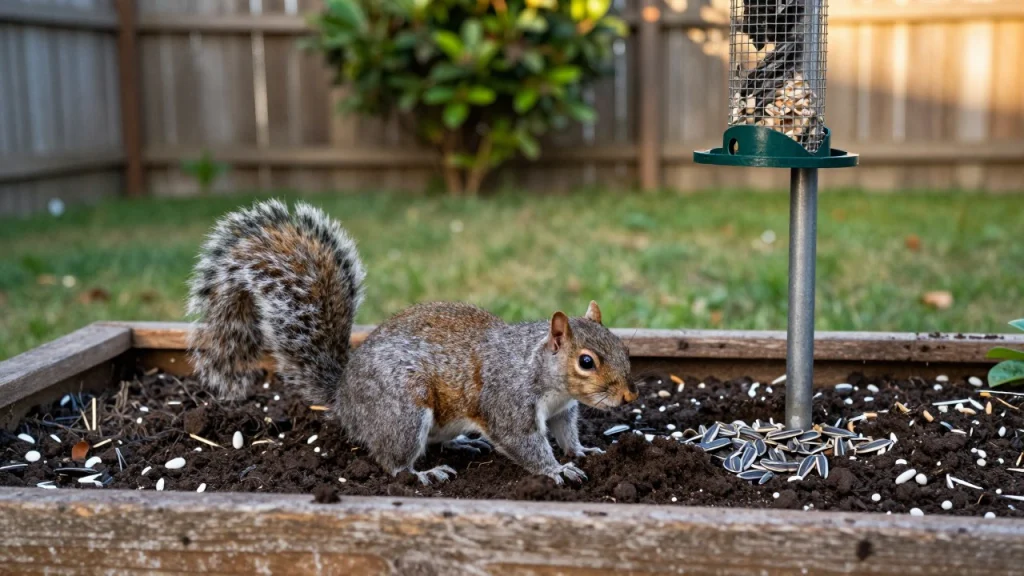
Most conflicts with people come from appetite rather than aggression. They dig up seed that farmers planted and eat crops outright, and where fruit, nuts or grain are ripening, one squirrel can empty a tree’s crop in a short time.
Bark is the second big issue. Stripping bark to reach the juicy inner layer, the cambium, injures trees, and the consequences can be severe: growth may be stunted, fruit production cut back, and in the worst cases the tree dies. In California, pest specialists single out the eastern fox squirrel as the most troublesome of the state’s four tree squirrels for suburban gardens.
Damage around a house follows a few predictable routes:
- Gardens and lawns. Most digging happens in the fall, when squirrels bury nuts, acorns or other seeds in garden soil and turf. Caches they never retrieve leave beds and lawns in ruins afterwards.
- Buildings and cables. They gnaw telephone cables, work their way into wooden buildings, and reach loft spaces wherever a vent screen is broken or a gap is left open. Even a small opening is enough, because they enlarge it by gnawing.
- Wiring and power lines. Insulation, house siding and electrical wiring suffer the same fate, and squirrels that stash food in transformers or generators have caused power outages for whole communities.
- Bird feeders. If squirrels are present around feeders they will raid them and steal the food.
Two quieter concerns are health and what they hunt. Plague can be carried by squirrels and passed on to people and domestic animals, and fleas and mites travel along as ectoparasites. The diet is not purely vegetarian either, since gray squirrels also eat bones, bird eggs, nestlings and frogs.
Which squirrel is on your property
Species and setting decide how much trouble you get. Size differs even among close relatives: the Delmarva fox squirrel of the Delmarva Peninsula runs bigger than the eastern gray squirrel most people meet in towns. Agility is shared by all of them, since their ankles rotate about 180 degrees, which lets the wrists take the load as they climb in any direction.
Plenty of squirrels, with a few exceptions
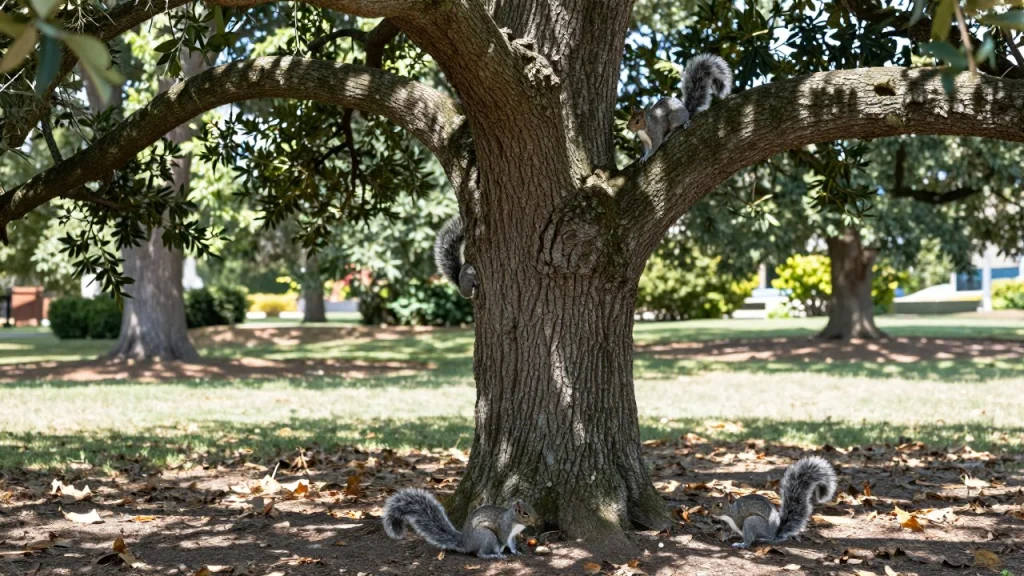
Numbers favor squirrels in most places. The eastern gray squirrel is abundant and is not considered endangered or threatened, and females raise one to two litters per year, with the number of young following how much food is around.
Abundance at the species level does not mean every population is safe, though. The Delmarva fox squirrel lost so much forest that by the 1960s it held less than 10 percent of what it had once covered, which put it on the 1967 endangered species list. It recovered, and in 2015 the federal endangered species list no longer included it, following a U.S. Fish and Wildlife Service decision, and it remains rare in Delaware.
Living with squirrels instead of against them
They are hard to control for two reasons: how mobile they are, and how often people feed them and provide nest boxes, which encourages their presence. Excluding squirrels from a building is straightforward; excluding them from a yard or garden is an ongoing problem.
The workable approach is to change what invites them rather than chase them away. Cut back branches that overhang roofs or sit near telephone lines to slow their routes around the yard. For fruit and nut trees, full exclusion is virtually impossible because of squirrels’ superb climbing and jumping ability. For bird feeders, purpose-built exclusion hardware is the practical answer.
Squirrels are best read as forest infrastructure with a poor reputation in vegetable beds. Weighed as a group, their services outweigh their nuisances; weighed as one animal in one raised bed, the verdict flips. The real choice is not whether squirrels are good or bad, but whether a woodland full of scattered, half-forgotten seeds is worth the cost of a dug-up lawn.
Sources
- Animal Diversity Web: Sciuridae (squirrels)
- Animal Diversity Web: Sciurus carolinensis (eastern gray squirrel)
- U.S. National Park Service: Eastern Gray Squirrel, Big Thicket National Preserve
- University of California Statewide IPM Program: Tree Squirrels, Home and Landscape
- Frontiers in Ecology and Evolution: Squirrel-Seed Interactions: The Evolutionary Strategies and Impact of Squirrels as Both Seed Predators and Seed Dispersers
- Delaware DNREC, Division of Fish and Wildlife: Delmarva Fox Squirrel Conservation