
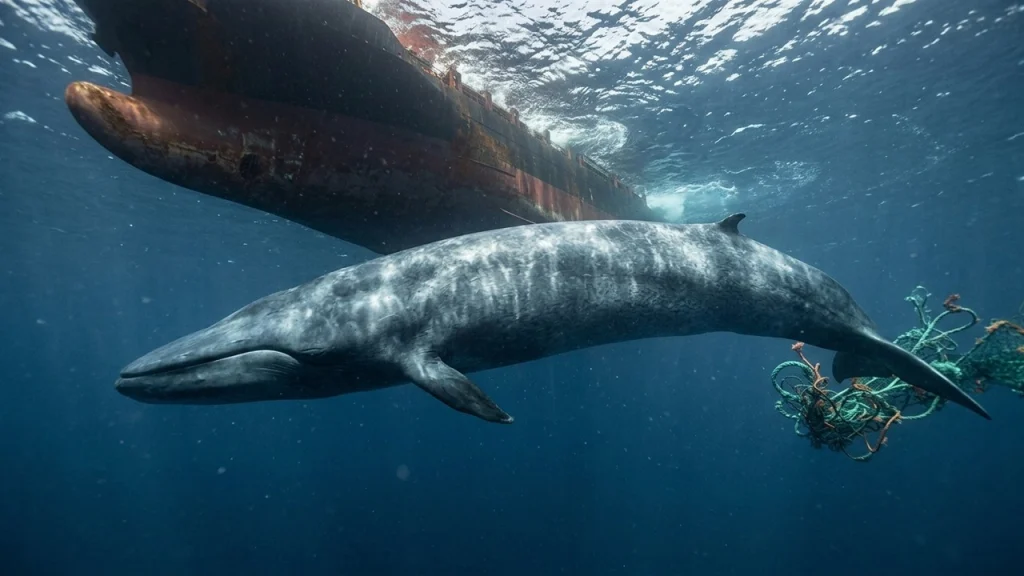
The blue whale’s biggest enemy is not an animal. It is human activity, and it reaches the whale through steel hulls, ropes and nets. American fisheries scientists name two leading current dangers for the species: collisions with vessels and snags in fishing gear. Neither would exist without us.
That answer sounds simple, and the interesting part is why it is so one-sided. A blue whale is the heaviest animal that has ever lived, and yet it is formally classified as endangered. Nothing in the ocean can explain that. Separating what nature does to a blue whale from what we do to it is the whole story of the species’ survival.
Nothing in the ocean hunts an adult blue whale
Scale is the reason. A body of that size has virtually no natural predators, and the consequence is unusual for a large animal: adults face no recurring threat of attack. An orca would have to take on too much mass, and a shark would be working through 80 to 150 tons of muscle and blubber for a single meal. Left alone, an adult blue whale is effectively invulnerable.
The vulnerable stage is infancy. Young animals can be taken by orcas and by large sharks. Even so, the pressure comes from a handful of predators, not from a rival species capable of pushing a global population toward extinction, and a lost calf can be replaced within a few years.
Size also explains what the animal can eat and how. Krill, a tiny shrimp-like creature, is the foundation of the diet, and the whale harvests it by forcing seawater through comb-like plates that hang from the roof of the mouth. Quick reference figures for the species:
- Length: 110 feet at the very top of the range
- Lifespan: 80 to 90 years
- Range: every ocean except the Arctic
The ceiling for the biggest animals is 6 tons of krill in a day, reached only because the feeding apparatus is enormous. Around 50-90 throat grooves cover the stretch from the chin to a point just short of the navel, and these folds expand as the whale gulps a huge mouthful of water, then squeeze that water back out to leave the krill behind. Farther south, the staple prey is the Antarctic krill Euphausia superba, a planktonic crustacean that swarms in enormous numbers.
Whalers nearly ended the species
The historical enemy was the harpoon ship. Intensive hunting in the 20th century pushed the species almost to extinction, and the arithmetic behind that phrase is brutal. In the North Atlantic region alone, over 10,730 whales died in harpoons between 1868 and 1965, taken for blubber and oil at a time when no protection existed anywhere.
Commercial whaling depleted the species across the world, not in one region, and that hole has never been fully refilled. The present total is nowhere near the numbers recorded before modern whaling. A 1966 moratorium ended licensed blue whale hunting, though the last planned kill came in 1978, which means animals were still dying after the rules were written.
The trend has turned upward since then, and numbers are growing in several regions, yet the global IUCN assessment still lists the species as endangered. In the United States it is legally an endangered species, and the Marine Mammal Protection Act adds a second layer of protection. Both designations can feel contradictory alongside a rising population, but they measure different things: a legal status compares the present count against the historical baseline, not against last year’s count.
Why ship strikes are the deadliest enemy
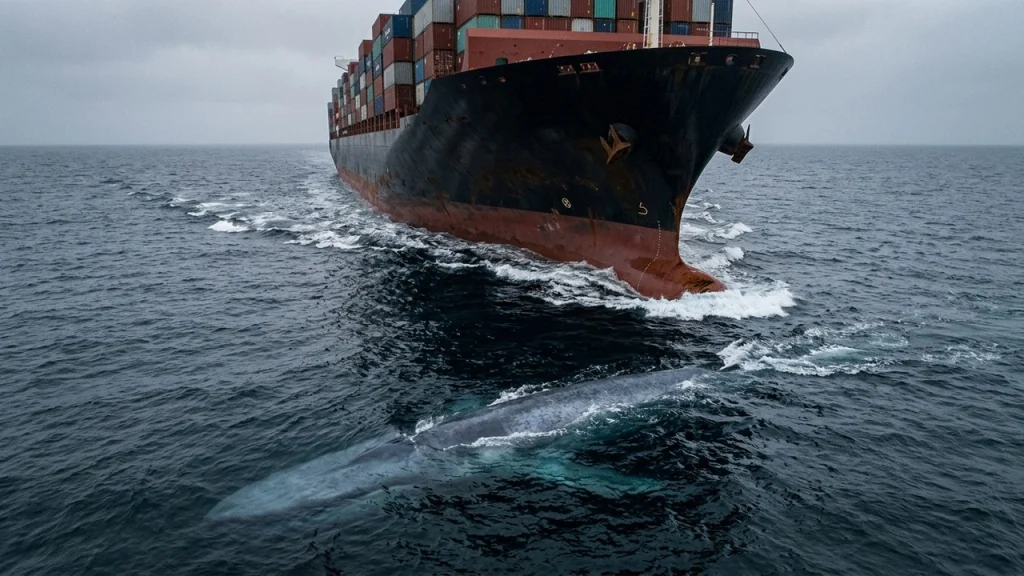
Boat collisions account for a large share of whale injuries and deaths, and a ship strike can badly injure or kill a blue whale. The risk is not spread evenly. It climbs sharply around ports, inside shipping lanes, and wherever large or fast-moving vessels pass.
Speed and vessel size decide the outcome. One model of recorded collisions in American waters found the death rate for collisions involving a very large ocean-going ship above 0.80 for every speed above 5 knots. A whale hit by a big ship rarely survives. That is why the guidance is short: slow to 10 knots or below in whale habitat and keep a proper lookout.
Whale biology helps create the hazard. A blue whale stays where the krill is, and rich feeding patches often sit a few dozen kilometers offshore, along the shipping approaches to major ports. Modeling of United States West Coast waters put most deaths about 24 Nm (44.5 km) from shore, along the lanes that serve big ports. Encouragingly, 74% of modeled blue whale deaths landed inside 10% of the surveyed area, which means conservation effort aimed at a small slice of ocean can do real work.
Fishing gear is the quieter enemy
Entanglement is the other main threat, and it is the one most people do not picture as dangerous. A whale can pick up traps, pots and nets, either swimming away trailing the gear or becoming anchored in place. A whale carrying gear is difficult to spot from a boat, so these incidents often go unrecorded.
The rope is rarely what kills. An entangled animal may tow the gear for long stretches, and the harm accumulates as exhaustion, lost feeding ability and severe wounds, which can also reduce reproductive success. In some regions no entanglement has ever been documented, though that reflects missing observation rather than an absence of risk.
The numbers show how badly this is underestimated. Even a deliberately cautious model put losses at 7.8x the U.S. recommended limit that applies to blue whales. Entanglement is also seldom witnessed: a whale can survive a net and be seen swimming away, so the visible count is a floor rather than a total.
Slower pressures on the same species
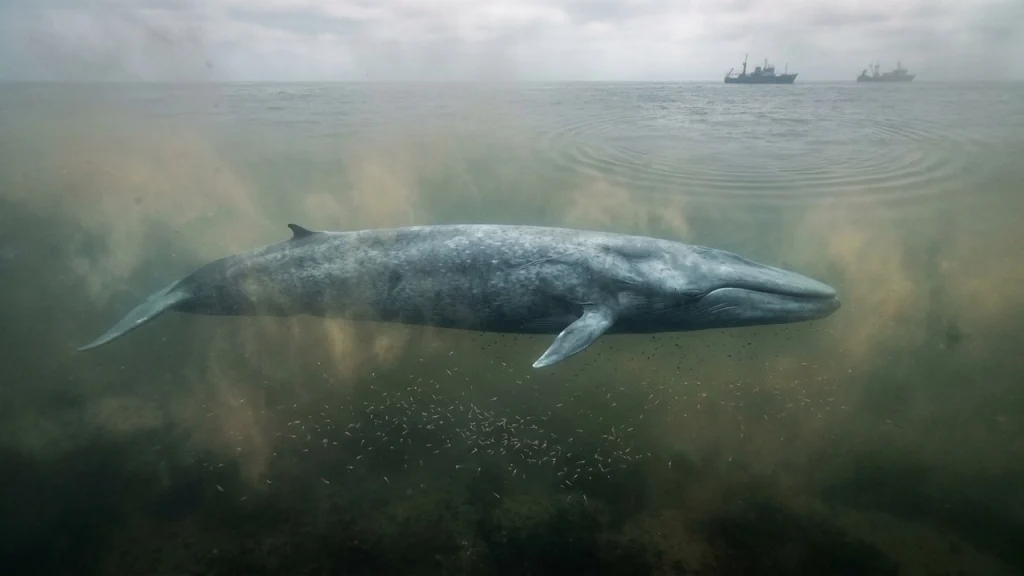
Scientists also flag pressures they understand less well, among them noisy shipping and seismic work, damaged habitat, chemical pollution, disturbance from vessels, and a changing climate. Underwater noise can interrupt feeding, which is expensive for an animal that must find and process enormous quantities of tiny prey.
Pollution affects these long-lived whales, yet feeding near the bottom of the web leaves them partly shielded from accumulated toxins. That is one reason blue whales carry a lighter chemical burden than predators higher up the food web. Climate change reaches the whale one step further down, through the krill it depends on, so the effects arrive as a feeding problem rather than a single dramatic event.
Why each death is expensive
Blue whales reproduce slowly, so every avoidable loss stretches recovery. Maturity is thought to arrive between 5 and 15 years, and a female calves every 2 to 3 years on average. A small population has almost no margin for error, and losses of breeding females or calves are the ones that matter most.
The same slow pace shapes the daily fight against ships. Blue whales cruise near 5 miles an hour and can burst past 20 miles an hour briefly, but they feed in polar waters during summer and make lengthy migrations toward equatorial waters as winter arrives. Steady speed offers some protection in open water and almost none near a shipping lane.
Sound is the other line of defense, and a noisy ocean weakens it. Blue whales are among the loudest animals alive, calling with pulses, groans and moans, and other whales can pick those sounds up 1,000 miles away. Because five subspecies are currently recognized across every ocean basin except the Arctic, no single country can protect the whole species, and the animals in busy coastal water carry more risk than those in open ocean.
What the answer comes down to
No predator threatens the blue whale as a species, yet two human hazards kill it regularly: ships that cannot see it soon enough to stop, and fishing gear that closes around it. Both are manageable with ordinary policy, involving speed limits, shifted shipping lanes and gear rules, which makes them preventable in a way that natural predation is not.
The hopeful reading is that a species once reduced to a sliver of its former numbers is now expanding in parts of its range, which shows what protection delivers. The sobering reading is that an animal with no natural enemies remains the biggest victim of a hazard it never evolved to expect.
Sources
- Animal Diversity Web, University of Michigan Museum of Zoology: Balaenoptera musculus (blue whale)
- NOAA Fisheries: Blue Whale | Species
- NOAA Fisheries: Blue Whale: Conservation Management
- OSPAR Commission: Blue whale
- Frontiers in Marine Science: The effects of vessel speed and size on the lethality of strikes of large whales in U.S. waters
- PLOS ONE: High mortality of blue, humpback and fin whales from modeling of vessel collisions on the U.S. West Coast suggests population impacts and insufficient protection