
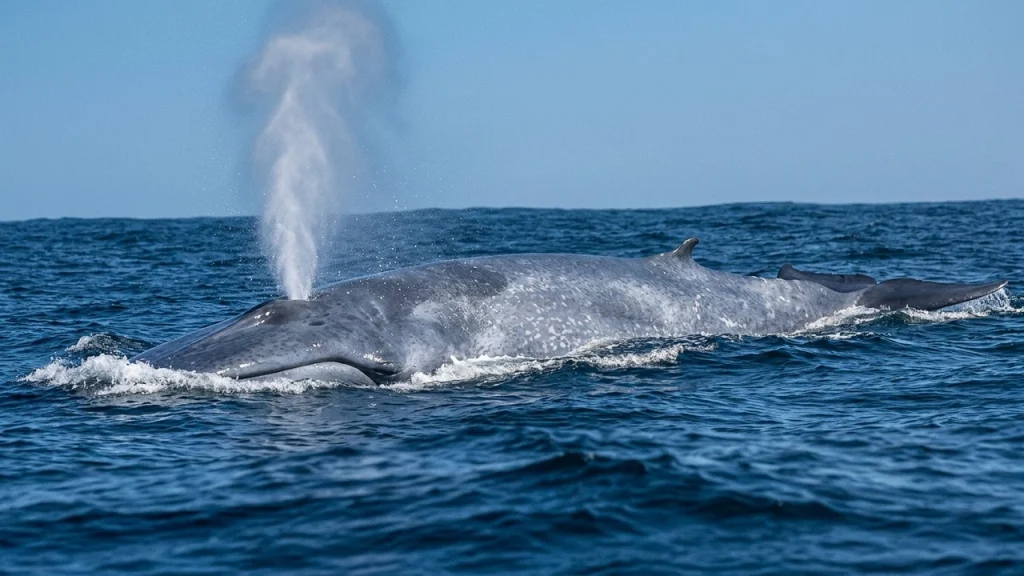
Blue whales are rarely seen for two separate reasons, and both have to be true at the same time. Very few of the animals are left, because industrial whaling cut the global population to a small share of its former size. And those survivors are scattered across every ocean on Earth, favoring deep water and dense krill patches well away from the coast, so they are seldom where people happen to be looking. Neither reason has much to do with how the animal behaves.
In fact, no predator has been found to hunt adult blue whales, and nothing researchers have observed keeps them away from boats. Their rarity is a problem of numbers and geography rather than shyness, which is why the same few coastlines draw whale watchers year after year, and why listening stations now locate blue whales more reliably than the human eye does.
A depleted population, not a shy animal
Blue whales were not the first whales taken by the industry, because their great size, their speed and their remote habitat kept fleets at a distance until new technology made the giants worth chasing. The 20th century kill is estimated at 350,000 animals, and by the 1960s the species stood on the edge of extinction. Protection came only after the 1965/66 whaling season, and even then recovery took decades to register.
The latest global assessment still classifies the species as Endangered, under criteria A1abd. It estimates 5,000 to 15,000 mature individuals, against at least 140,000 mature blue whales in 1926, which puts today’s population between 3% and 11% of the 1926 level. NOAA Fisheries counts every animal rather than only mature ones, and puts today’s total at about 10,000 to 25,000 worldwide, against about 300,000 before whaling.
That total is still small because of how the species reproduces. The youngest age recorded for a first calving is 11 years in the eastern North Pacific, sexual maturity arrives at around 10 years of age, and a calf follows only every 2 or 3 years. Gestation runs about 10 to 12 months, blue whales are thought to live 80 to 90 years, and the Red List puts generation length at 30.8 years. In a whale that matures late, breeds slowly and lives for decades, every adult lost is a long stretch of future calves lost with it.
The open ocean is their habitat, not the coast
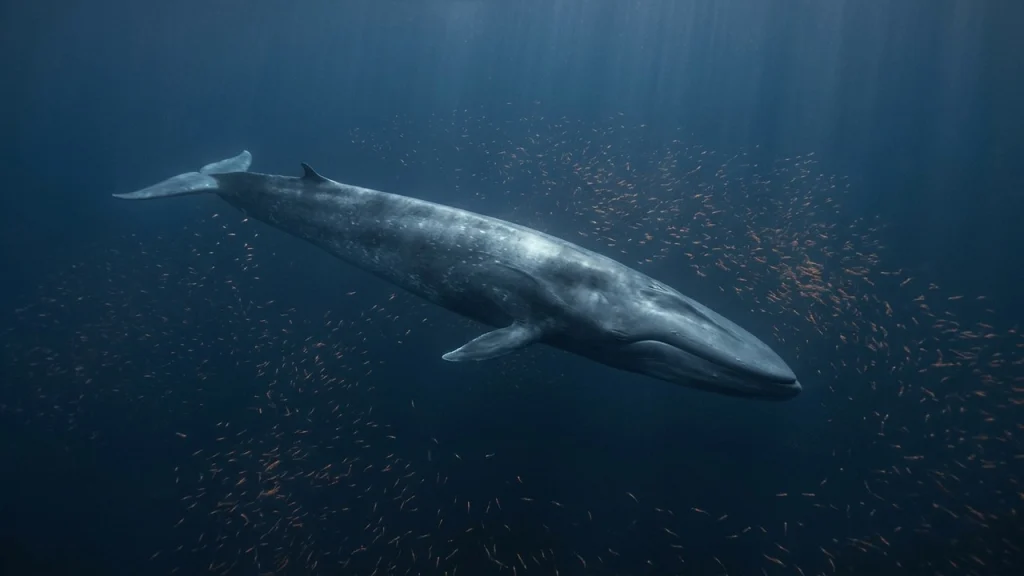
The Red List calls the animal cosmopolitan, placing it in every major ocean while some regional seas, including the Mediterranean, Okhotsk and Bering, hold none, and NOAA Fisheries places them in every ocean except the Arctic. Where they go is decided mostly by food, since they turn up in waters where krill is concentrated. Because krill patches shift with currents and seasons, the whales shift with them, and the routes are poorly documented: movement patterns differ from one area to the next, and migration paths are not well known.
Deeper water is the deciding factor. A decade of hydrophone recordings across the western North Atlantic showed that these whales favor deep water over coastal water, so their seasonal movements are hard to study, and that off the southeastern United States they register only a few days of presence in inshore waters. Across the same study, blue whales registered fewer confirmed detection days than any other baleen whale examined, so animals tracked by ear alone still went unaccounted for on most days.
Southern California shows how far offshore that can get. The Channel Islands National Park puts the main feeding habitat beyond San Miguel and Santa Rosa, and reports that migrating animals pass well outside the park boundary.
Why a surface watch comes up empty
Most of the animal is underwater
Blue whales strain krill through baleen plates, and that feeding happens below the surface. A normal dive runs 10 to 20 minutes, with only 8 to 15 blows in between, and feeding usually takes place at depths under 100 m. Records from harpooned whales put them as deep as 500 m. A whale that disappears for minutes at a stretch is not going to be picked out from a boat deck, which is why captains so often report that there was no whale in sight at all before a collision.
Encounters are small gatherings
Blue whales do not crowd together the way smaller whales do. Groups as large as 60 animals have been reported, though lone animals and very small pods are the usual sight, so a quiet day offshore means no blue whale rather than a distant back.
You are more likely to hear one than see it
The species is among the loudest animals on the planet, and it is thought that in the right oceanographic conditions other whales can hear its calls from up to 1,000 miles away. The blow is a smaller clue, since the spout rises about 30 feet and shows itself only for the seconds between dives. Researchers run into the same difficulty: the low frequency band where blue whale song sits is often overlapped by boat or background noise, so a hydrophone has to pick up repeated phrases before anyone confirms the animal is there.
The few places an encounter is likely
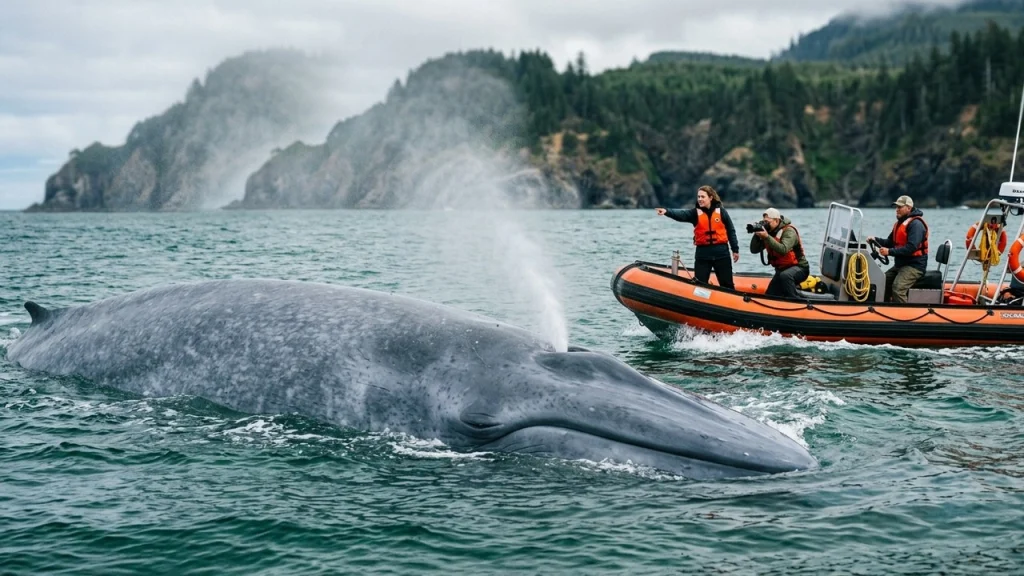
Most western North Atlantic reports of blue whales come from waters off eastern Canada, with the occasional record in the Gulf of Maine, and during spring and summer most of the animals in that ocean gather in the Gulf of St. Lawrence. In the eastern Pacific, the Gulf of California is the place to watch, because calves are regularly observed there from December through March, and it is believed to be an important calving and nursing area. Off Southern California, they are seen fairly frequently from June through December, with the most encounters in July through October.
That is a short list, and the pattern behind it holds elsewhere too: the whales are found where the food is, and the food is offshore.
Why the rarity still matters
Commercial whaling took a heavy toll on the species, and the Endangered Species Act lists it as endangered throughout its range. NOAA Fisheries names vessel strikes and entanglement in fishing gear as the main threats today, and those losses are not interchangeable, since a female killed before she has ever calved removes an entire branch of the population’s future.
Recovery is genuinely under way in places. The Red List records rising numbers in the Antarctic and the North Atlantic up to around the year 2000, with the North Pacific holding at least steady, and off California, counts put the population at about 97 percent of the pre-whaling level. The Antarctic subspecies is still listed separately as Critically Endangered.
So a blue whale is a rare sight because so few individuals remain after a century of whaling, and because it lives where the ocean is wide, not because it knows how to stay hidden. Both of those conditions are changing slowly, which is why a confirmed encounter still matters.
Sources
- IUCN Red List: Balaenoptera musculus (Blue Whale) | IUCN Red List of Threatened Species
- NOAA Fisheries: Blue Whale | NOAA Fisheries
- NOAA Fisheries: The Big-Hearted Blue Whale
- Animal Diversity Web: Balaenoptera musculus (blue whale)
- U.S. National Park Service: Blue Whale – Channel Islands National Park
- Global Change Biology via PubMed Central: Exploring movement patterns and changing distributions of baleen whales in the western North Atlantic using a decade of passive acoustic data