
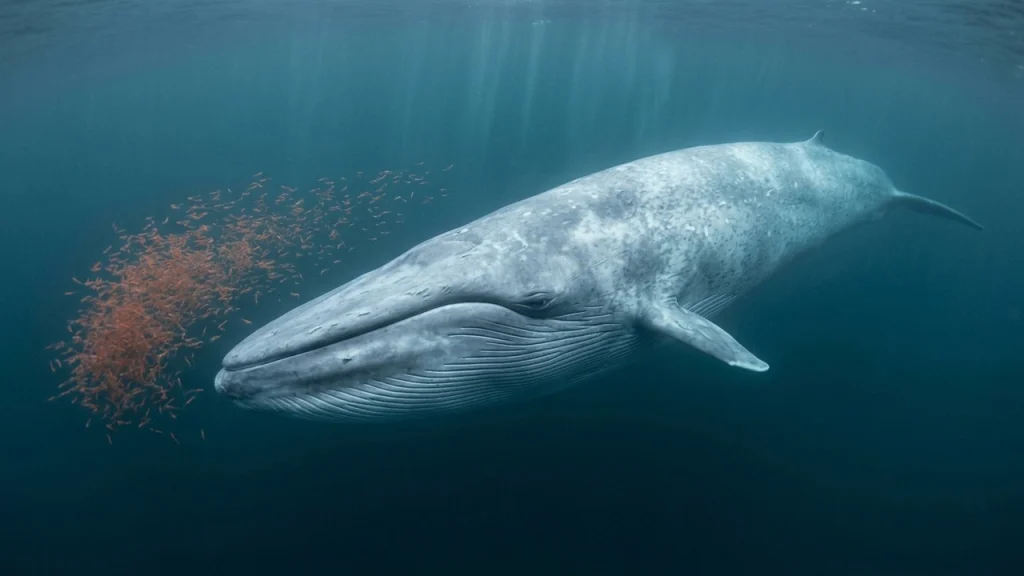
Blue whales eat almost nothing but krill, the small shrimp-like crustaceans that gather in huge swarms in cold, productive waters. An adult can put away 3 to 4 tons of them a day, and none of that food is chased or bitten. Which species fills the menu depends on where the whale feeds: in southern waters the staple is Euphausia superba, a planktonic crustacean of less than 7 cm that is tremendously abundant, while northern whales take Thysanoessa inermis and Meganyctiphanes norvegica, along with other plankton and the occasional small fish.
Feeding looks simple because so little of it involves pursuit. A blue whale accelerates toward a patch of krill, takes one enormous mouthful of prey-laden water, and then filters that water out and swallows whatever food came with it. Everything about the animal, from its bulk to the way it swims, is built around making that one mouthful pay.
Why a giant lives on shrimp-sized food
No animal that has ever lived matches a blue whale for sheer size. Males reach an average head-body length of 25 m and females 27 m, the longest confirmed specimen reached 33.5 m, and the heaviest weighed 190,000 kg. A whale of that bulk has no serious enemies: blue whales have virtually no natural predators, and even calves may be vulnerable to orcas and large sharks.
The real constraint is arithmetic rather than danger. A body that large needs a very high energy intake, and that is what dictates the way the whale feeds, favoring a meal it can strain out of a swarm over prey it would have to chase one animal at a time. Size even helps at the filter itself, since measurements from tagged whales show that the larger the animal, the more each lunge pays, because the energy taken from the prey climbs faster than the effort spent.
What krill are, and why they crowd together
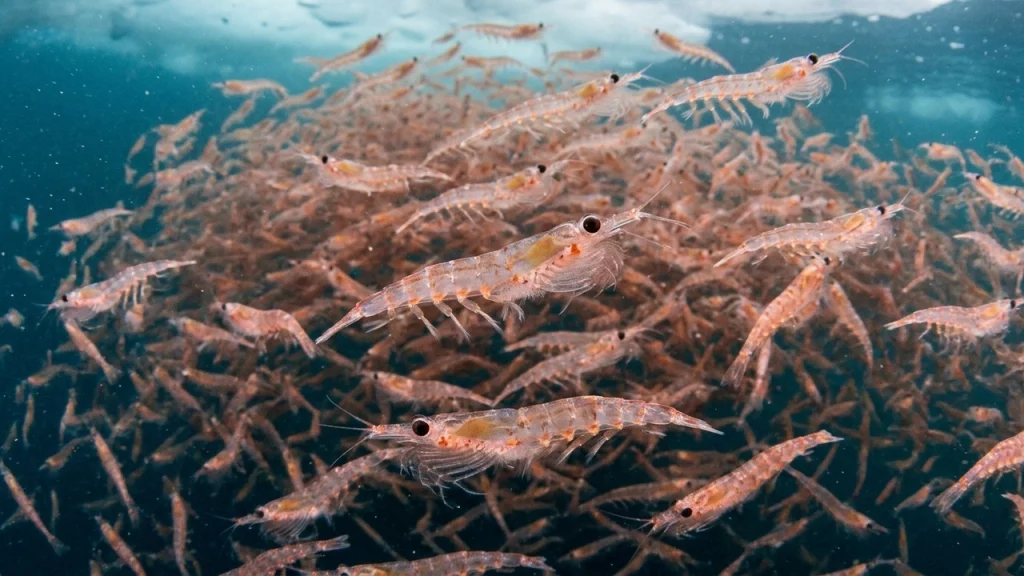
Krill are shrimp-like crustaceans, and the Antarctic species that most blue whales depend on is an obligate schooling animal that moves horizontally along the currents. Its aggregations can be extremely large, averaging 100 m in length and sometimes extending to 100 km.
The crowd is precisely what makes them worth swallowing, since engulfment only pays when the water is thick with prey. Schooling is also the krill’s only real defense against predators, so a dense gathering is at once the meal and the reason most of its members live long enough to be eaten later. Krill are plant eaters themselves, straining algae from seawater and occasionally taking other krill or shed shells, and no other grazer plays the same central role in the Southern Ocean food web, which is why a huge number of the animals found there depend on them for food. In winter they lean heavily on ice algae instead.
Krill also move through the water column, being found from the surface down to 350 m and occasionally as deep as 600 m. That vertical range is why a whale’s hunting depth and its menu shift together over the year.
How a blue whale turns a swarm into a meal
The mechanics are unusual. The underside of the jaw and throat is pleated, with somewhere between 50 and 90 grooves running from the chin to just past the navel, and those folds let the lower jaw and chest balloon outward. During the lunge the tissue around that cavity bulges out like a parachute, which adds a great deal of drag and brakes the animal down while letting it take in more water, and more krill, than it could otherwise. Once the mouth shuts, the water is strained back out and the prey goes down as one dense bolus.
The finishing move is a barrel roll. Tagged whales have been recorded making 360° rolling lunges that tip the body and swing the lower jaws round, engulfing a patch with the whale partly upside down. The same rolling turns up between lunges, which suggests the animal is scanning the prey field with its eyes and steering for the thickest parts of a swarm rather than lunging blind.
Why density matters more than depth
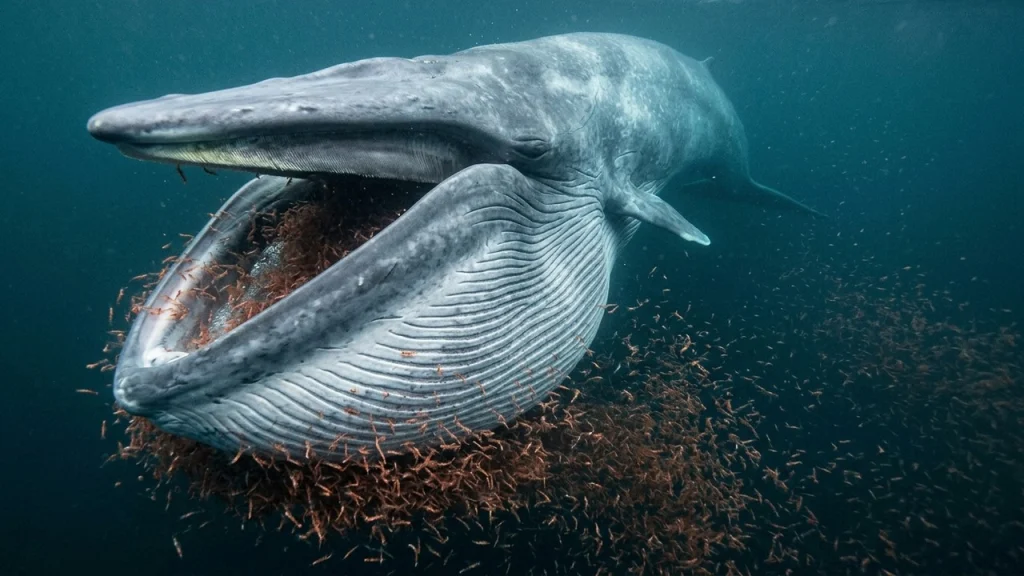
A blue whale cannot graze. Its food comes in clumps that shift around in space and time, so the animal’s real problem is finding water crowded enough to be worth engulfing. Tag studies off California followed 55 adult whales over 374 dives and 631 feeding lunges, with dives reaching 41 to 310 m and lasting 0.4 to 15.9 minutes.
What those records show is a switch in behavior, not in appetite. Where krill was thin a dive brought just two or three lunges, and on richer patches the same whales took four to eight lunges instead, appearing to switch between conserving oxygen and maximizing energy gain as density changed.
The oxygen clock behind that switch
Every extra lunge is spent against a fixed air supply, and a longer dive has to be paid back at the surface with extra recovery time, which raises the cost of the dive and cuts into the time available for feeding. On a rich patch the arithmetic reverses, and the same tag data indicate that raising the lunge rate on dense krill doubled a whale’s foraging efficiency. Below roughly 100 krill per cubic metre, though, there is not enough food to cover even the basic energetic demands of the animal.
Work in the Southern Ocean points the same way: there the animals turned up closest to swarms that were packed with krill, sat higher in the water column and stretched taller. When a swarm was dense, shallow and tall, the models put these whales within at least 40 km of it. Deep water is not off limits, then, but crowded water is worth more.
Dinner is also mostly a private affair. Blue whales usually travel alone or in twos and threes, although gatherings of 60 animals have been reported, which fits a species that gains by finding scattered patches rather than by chasing a target that moves away.
Following the seasons to the food
Because the payoff depends on density, blue whales follow the calendar. Most populations migrate, keeping to low-latitude waters in winter, moving poleward in spring, feeding at high latitudes in summer and returning toward the equator in autumn. Not every whale travels, though: some animals do not migrate at all.
Feeding is mostly a shallow-water business. It usually happens at depths of less than 100 m, a typical dive lasts 10 to 20 minutes, and surfacing blows come 8 to 15 at a stretch, while the deepest reliably documented dives, by harpooned whales, went down to 500 m. The tag records suggest routine foraging stays well above that, which fits a species that gains most when prey comes close to the surface in a thick band.
When a one-item menu becomes a conservation problem
A whale that eats one thing ties its fate to that one thing. Whalers killed an estimated 350,000 blue whales during the 20th century, and by the 1960s the species stood on the edge of extinction. It is listed as Endangered on the IUCN Red List and on the US federal list, and it sits in CITES Appendix I. Today the southern hemisphere stock is put at 400 to 1,400 animals and the northern hemisphere at about 5,000 individuals, although the rigour of those northern surveys has been criticized.
Because the species runs on krill, models suggest that the expansion of krill fishing could set back their recovery. Recovery is slow on top of that, since a lifespan estimated at 80 to 90 years means a population reduced to a few hundred animals has a long climb back. A population scattered across whole ocean basins also keeps in touch over enormous distances: they use the lowest-pitched voice of any whale, reaching down to 14 Hz and up to 200 decibels in volume, and such sounds carry for thousands of miles through the deep ocean.
So the answer is short: krill, in enormous quantities, and almost nothing else. Because the animal is built to strain swarms rather than chase prey, it must find water crowded enough to be worth a mouthful, it must budget the oxygen to pay for those mouthfuls, and it can recover only as fast as its prey base and its own slow life history allow.
Sources
- Animal Diversity Web: Balaenoptera musculus (blue whale)
- Animal Diversity Web: Euphausia superba (Antarctic krill)
- Science Advances (via PubMed Central): Blue whales (Balaenoptera musculus) optimize foraging efficiency by balancing oxygen use and energy gain as a function of prey density
- Biology Letters (via PubMed Central): Underwater acrobatics by the world’s largest predator: 360 degree rolling manoeuvres by lunge-feeding blue whales
- Scientific Reports: The characteristics of krill swarms in relation to aggregating Antarctic blue whales
- Journal of Experimental Biology (via PubMed Central): Fast and Furious: Energetic Tradeoffs and Scaling of High-Speed Foraging in Rorqual Whales