
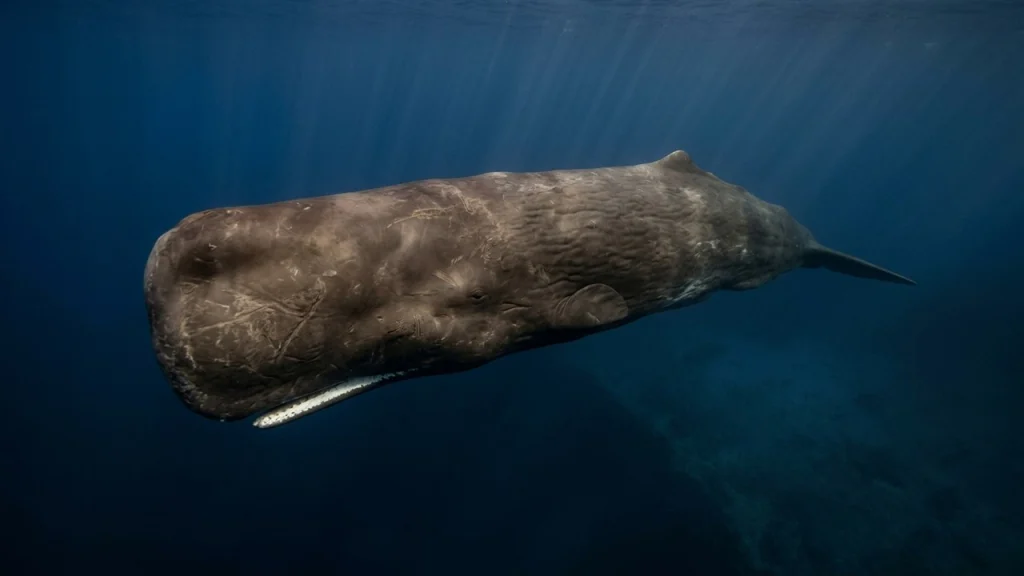
Sperm whales live in every ocean on the planet. They are usually found over the continental slope or in open ocean water deeper than 500 m, which puts most shallow shelf seas and lagoons off limits, and the latest global Red List assessment places records across virtually every marine region, from 75°N in Baffin Bay to 73°S in the Ross Sea.
That is the simple version. The detailed picture depends on the shape of the seafloor, on where the food is, and above all on the sex and age of the animals, because adult males and family groups use very different parts of the ocean.
Deep water and a steep seafloor decide the range
The species occurs everywhere the ocean is deep, from equatorial water to the ice that bounds both poles. The qualifier matters, because a global population model built for the species works from water deeper than 1,000 m. Shelf seas are therefore thin on the map, while the drop from a continental shelf into a deep basin is exactly where the animals concentrate.
In the Northeast Atlantic Arctic they are found mainly in the deep basins of the Norwegian Sea, and they turn up along the shelf breaks north of Norway and west of Svalbard. In that sector sperm whales reach above 80° N, close to the ice. Enclosed seas follow the same logic, since a deep basin beside a coast offers feeding grounds and a refuge from disturbance at the same time.
The seas they enter, and the two they never reach
Semi-enclosed waters are part of the range. The Red List names four of them: the Mediterranean, the Sea of Okhotsk, the Gulf of California and the Gulf of Mexico. Two better known seas are missing, because the Red Sea and the Black Sea both appear to hold no sperm whales at all, and both have shallow sills. A sill is a submarine ridge across the mouth of a basin, and when it is shallow it can stop a deep-diving predator from entering at all, however warm the water inside.
Their furthest confirmed presence sits at both ends of the polar range. Large males are recorded in the Antarctic, where giant Colossal Squid (Mesonychoteuthis hamiltoni) of 500 kg form part of the menu.
Males patrol the cold, family groups hold the tropics
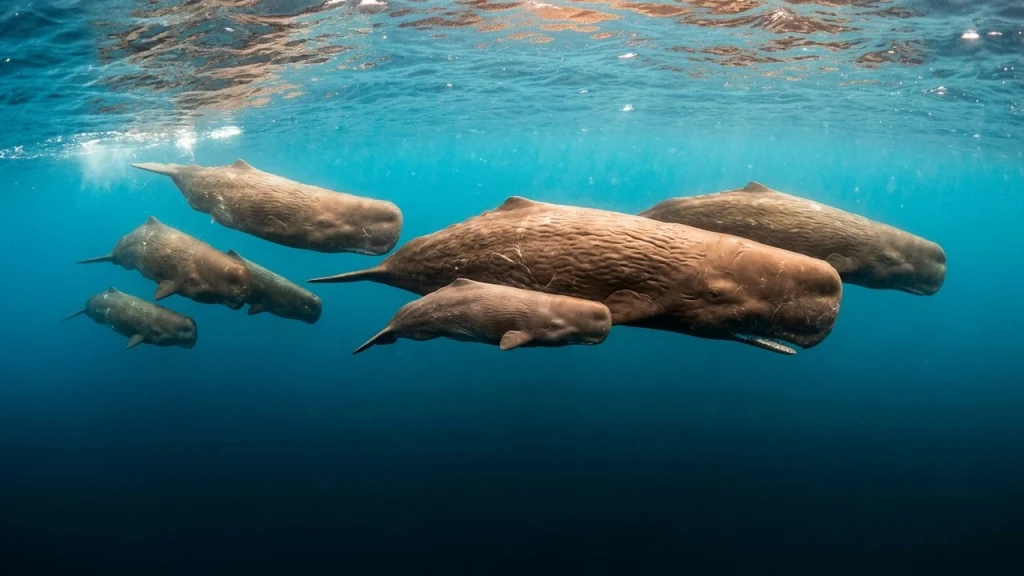
The sharpest divide in the range runs along sex and age. Big males are found in ice-free seas at nearly any latitude, while female groups and young whales stay in the warm end of the ocean: mothers and calves are usually found below about 40–50º latitude, in water where the sea surface is warmer than about 15 ºC. Males are built for the opposite trip: they hold high-latitude feeding grounds and travel to tropical or temperate waters for breeding, where the females and juveniles live in cohesive social groups. Size helps, since adult males reach 19 m against 12 m for females.
The pattern has exceptions. In the western North Atlantic, males in particular turn up in shallower water than the general pattern allows.
A breeding trip measured in thousands of kilometres
Tracking data give the clearest picture yet of this travel. Of 29 adult males carrying satellite tags between 69°N and 79°N in the Northeast Atlantic Arctic, 12 headed south. Reaching breeding areas below 45°N took roughly 40 days, and the journeys ran 3,993 to 7,951 km. The travellers then spent 76 days roaming a region of more than 10 million km², and dives past 1,000 m happened on the journey as well as in the south.
There is no single breeding season. Departures from northern waters were scattered from January to October, so mating is spread across the year instead of clustered in one month. Movement at that scale is not shared by everyone either, because genetic structure shows the opposite of a free-roaming global mix: females cross between ocean basins only rarely, and males tend to stay inside a single basin. Their journeys are also harder to follow than those of baleen whales, and less well understood.
Why food writes the map
Where the whales live is set first by prey, then by places that suit breeding, and it moves with the makeup of any group, by age and sex. Their main prey is squid that lives in the mid-depth and deep scattering layers, caught on dives of roughly 350 to 1,200 m that last about 45 minutes. Typical hunts start shallower, with routine dives that reach 2,000 feet, while the deepest recorded excursions go to 3,280 feet. Sharks, skates and deep ocean fish fill out the menu.
Depth preference turns into geography. Density tracks ocean productivity, with notable departures in the Sargasso Sea and the central North Pacific gyre. Within the deep-water zone, a global model predicts the highest numbers in water of lower salinity and lower nitrate, and in the shallower part of that zone. Local features matter too, because cold-water upwellings lift nutrient-rich deep water toward the sunlit surface, where the plankton that feeds the squid grows.
No other species is thought to have a wider feeding range, and that breadth is one reason the species is expected to cope with a warming ocean better than habitat specialists.
Living at the surface between dives
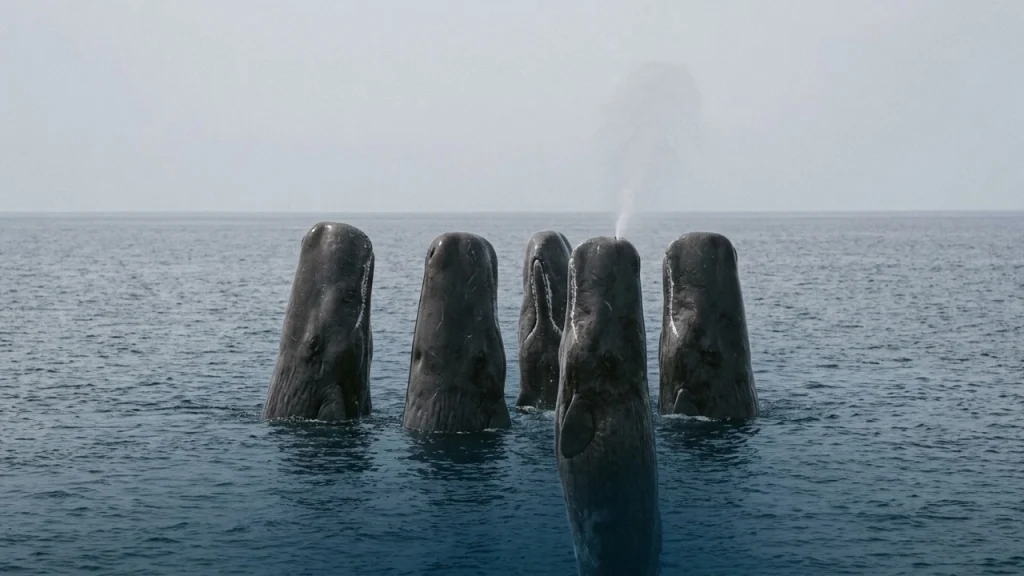
Underwater, a sperm whale is almost always hunting. At the surface the pattern is social. Family units of roughly 30 animals are the usual case, while aggregations of 100 or more are not unusual. Mature bulls spend most of their time alone and join others only to breed. Because the species is so well adapted to deep water, a move inshore carries its own risk: a whale that strays into shallow water risks being stranded, which is why most healthy sightings happen over steep bottom rather than in a bay.
The same geography makes the animals watchable from land. Where deep water comes close to the coast off an island, the whales are often found within sight of shore. The Gulf of Mexico is the cautionary case: the species once teemed in those waters and commercial whaling left them a rare sight there today.
How many are left, and what threatens them now
The Red List assessment rates the species Vulnerable, because a model of the historical trajectory put the three-generation decline at 48.3%, just under the level that threshold requires, and the assessors expect losses of at least 50% across three generations once modern non-whaling threats are added. The count behind that assessment is close to 850,000 animals, against roughly two million before whaling began in 1712, while the survey-based figure used in the model was 736,053 in 1993.
Industrial whaling from 1800 to 1987 came close to wiping out every population, and commercial whaling has been on moratorium since 1986. In the United States the species is listed as endangered and depleted under two laws, the Endangered Species Act and the Marine Mammal Protection Act. Populations are still recovering.
The remaining risks are mostly human-made and invisible from the surface. Where shipping lanes cross good sperm whale habitat, deaths caused by vessel collisions are judged unsustainable in some places, and other human pressures add to the risk. Whales resting close to shore near islands meet boat disturbance on top of that, and the shallow seas they avoid are not the problem; the deep places that humans use and disturb are.
Putting the range together
Sperm whales live wherever there is deep water over a steep bottom and a supply of deep-living squid: along continental slopes, in ocean basins, and around islands where the deep water runs close to the coast. Expect small groups of females and calves in warm tropical and subtropical seas, and lone large males, some travelling thousands of kilometres, in cold high-latitude water right up to the ice.
Sources
- IUCN Red List: Physeter macrocephalus, Sperm Whale (The IUCN Red List of Threatened Species 2025: e.T41755A50382216)
- NOAA Fisheries: Sperm Whale
- Animal Diversity Web, University of Michigan Museum of Zoology: Physeter catodon (sperm whale)
- Scientific Reports (PubMed Central): Migration to breeding areas by male sperm whales Physeter macrocephalus from the Northeast Atlantic Arctic
- Scientific Reports (PubMed Central): Current global population size, post-whaling trend and historical trajectory of sperm whales
- National Geographic: Sperm Whale