
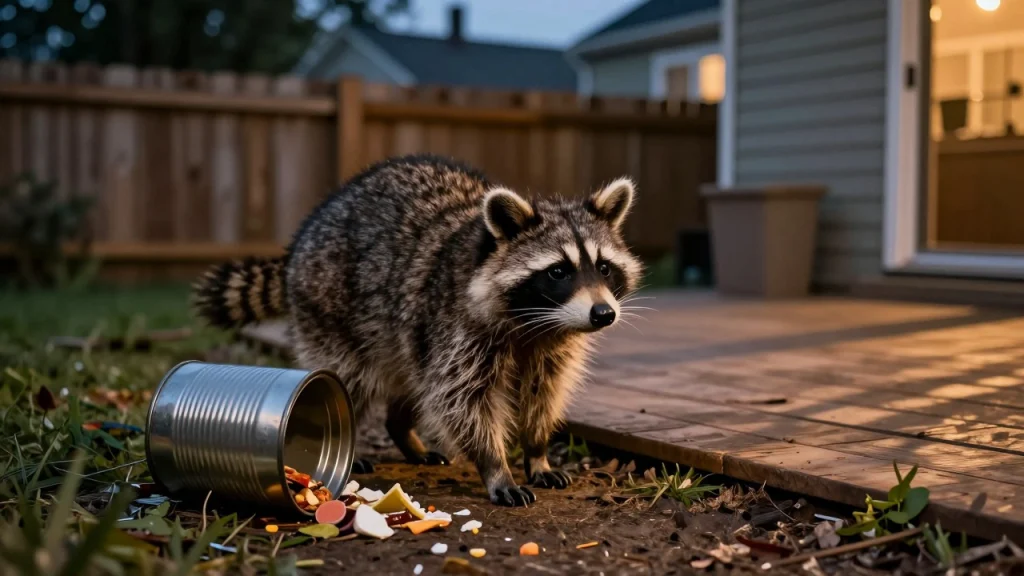
Raccoons rarely hurt people. The image of a masked bandit raiding the trash is a nuisance story, not a predator story, and healthy wild raccoons avoid a confrontation whenever they can. What deserves a second look is disease. A raccoon can be the one animal in your neighbourhood carrying rabies, and it can also shed a roundworm whose eggs are microscopic, long-lived and harmful to anyone who swallows them by accident. The honest answer has two halves: the animal itself is rarely a physical threat, and the germs it carries are a genuine hazard.
Most of the fear comes from mismatched expectations. People picture a large predator and instead meet an animal that would rather be left alone.
What a raccoon is actually equipped with
A raccoon carries real equipment for a brawl. Sharp claws let it climb trunks and prise open shells such as clams and oysters, and it has long canine teeth, though its molars are built for a mixed diet rather than meat alone. Its forepaws resemble slender human hands, which makes it unusually dexterous for a mammal, and it is documented unlocking locks and getting into trash cans for food. Touch is a highly developed sense, and it usually picks food up with those paws first.
Speed and climbing are the other surprises. On the ground it can reach 15 miles per hour, and a fall of 35 to 40 feet does not bother it. It swims well too, though it may be reluctant to, and its fur is not waterproof, which adds weight when it swims.
So a healthy raccoon will not hunt a human, but it is not helpless either. Speed, claws and climbing give a cornered animal real means of defence, and living next to people creates plenty of chances for that corner to happen.
Why rabies is the headline risk
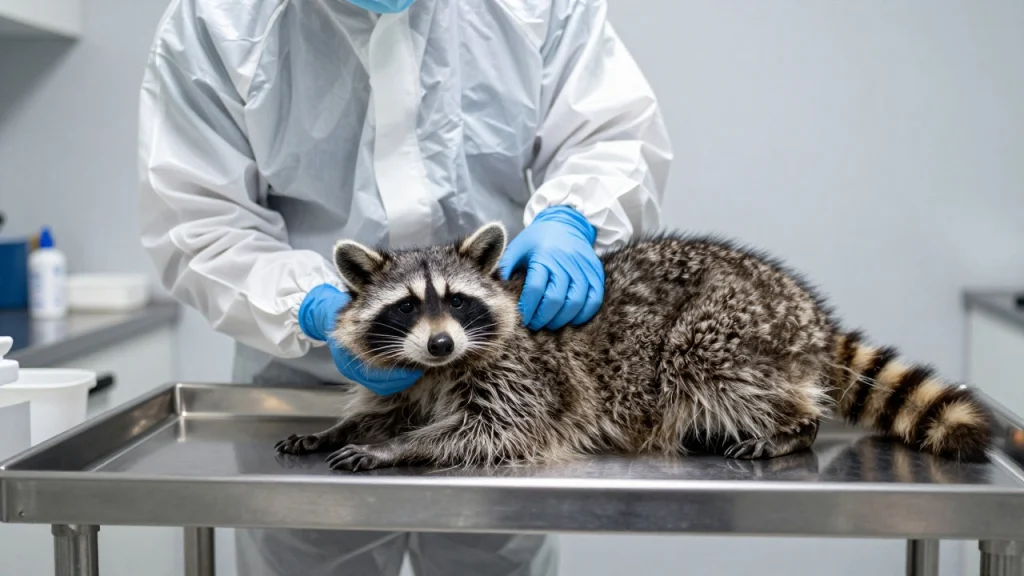
Raccoons count as primary carriers of rabies, and a rabies strain adapted to them has been established in the wild since the late twentieth century. The variant became enzootic, that is continuously present, across the mid-Atlantic and northeastern United States, and it started there because of deliberate translocation: in the late 1970s raccoons were moved from Florida to Virginia, and they seeded the infection in a population that had never encountered it. From there it spread north and east and crossed into Canada.
Two things about that history matter for a person reading the news. First, where the raccoon variant circulates, animal rabies cases are more numerous and post-exposure prophylaxis is given more often than in states carrying other variants. Second, the virus moves easily through raccoons because they reach very high densities in urban and suburban areas, where they live in close contact with people and their pets. Rabies is not limited to raccoons either, since it circulates in wild carnivore populations across North America generally, and it can spill over into other mammals.
The disease itself is what makes this worth attention. It spreads in saliva, most often through a bite or a scratch from an infected animal. It is vaccine-preventable, but without timely post-exposure prophylaxis the virus reaches the central nervous system, and at that point it is close to 100 percent fatal. Each year tens of thousands of people in the country receive treatment after a rabies exposure, most of it following contact with wildlife or with unvaccinated pets. Humans rarely die of rabies in developed countries, and more than 99 percent of human rabies deaths worldwide come from the dog variant rather than the raccoon one. In the United States, a raccoon that bites or scratches a person remains a medical event, and one worth taking seriously, even though direct transmission of rabies from raccoon to human is exceedingly rare.
The roundworm nobody sees
The more underappreciated hazard is Baylisascaris procyonis, the raccoon roundworm. The raccoon is its primary definitive host, the animal in which the parasite matures and reproduces, although dogs can play the same role. Infected raccoons shed more than a million eggs a day, and those eggs need 2 to 4 weeks in the environment to become infective. Estimated prevalence in raccoons of the western United States runs between 68 and 82 percent, which makes it more likely than not that a local raccoon carries it.
Infection does not come from a bite. People become intermediate hosts by ingesting infective eggs, typically by putting contaminated soil, sand or fingers into the mouth. The eggs hatch and the larvae pierce the gut wall before migrating through tissues, which can cause larva migrans affecting the viscera, the eye or the nervous system. The neural form often shows up as acute eosinophilic meningitis. Most migrating larvae settle in muscle, and fewer than 5 percent reach the brain, so a small exposure rarely causes illness, but the outcome when the nervous system is involved can be severe.
Risk is not evenly distributed. Young children and people with developmental delays are most likely to be exposed, because of hand-to-mouth behaviour, and so are people who handle raccoons or work where they are common. The eggs are also built to persist, and raccoons defecate in communal latrines that are frequently close to where people live, on yards, decks, roofs or in attics. Freshly deposited eggs are not infectious right away, which is why prompt removal of droppings lowers exposure.
When encounters actually turn dangerous
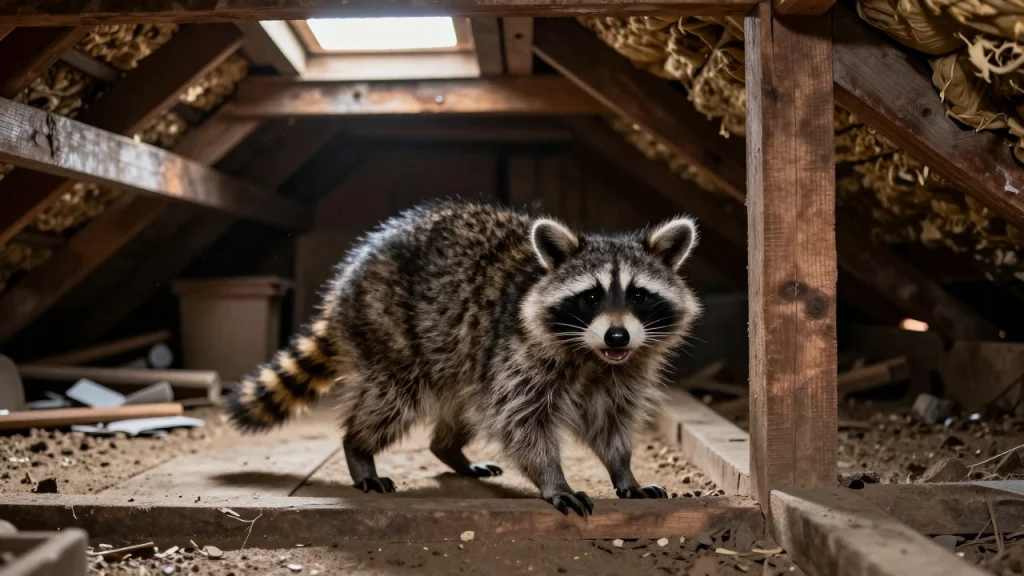
Timing and circumstance decide how a meeting ends. Raccoons are mainly nocturnal, so one seen out in full daylight is often simply hungry, though it could also be sick or an adult with young nearby. A raccoon surprised at a dumpster or in an attic is at its most alert and least tolerant of being blocked.
The animal itself adds a warning. A raccoon is mainly active alone, and the only real groups it forms are a mother with her young, so a defensive adult near cubs is a common source of trouble. Males take no part in rearing cubs, so the protective parent in most encounters is the female. A zoo species account paints the animal as perpetually watchful and liable to turn aggressive once it feels cornered, which describes a defensive animal rather than a hostile one.
Keeping the encounter harmless
Most problems trace back to habitat, not to behaviour. Raccoons are extremely adaptable, live in nearly any habitat, and settle easily near people. Tree hollows come first, yet the species will also settle in abandoned burrows, caverns, mines, outbuildings, barns, garages, drains and houses, and in cities flues, roof voids and the space beneath a home serve the same function. Their diet pushes them into the same places: they eat more invertebrates than vertebrates, and they have adapted to include garbage and other human food in suburban and urban areas.
That closeness produces both the encounters and the disease risk. Wildlife managers in the affected regions rely on oral rabies vaccination baiting to cut transmission, and population monitoring shows rabies has real effects on density, with numbers roughly doubling where incidence is low. Raccoon numbers have risen over recent decades and the range appears to be widening.
So the practical answer is straightforward. Do not feed them, do not reach for a cub, and if one appears in your attic or under the deck, keep clear and call a licensed removal professional rather than cornering it yourself. Secure your garbage, and clean up any latrine promptly. A wild raccoon that acts unusually tame, unafraid, or aggressive deserves a phone call to local animal control rather than an encounter. Handle a bite or a scratch from any wild mammal as a medical question the same day.
A species doing well, with caveats
Despite the notoriety, the northern raccoon is not a conservation problem in its own range. The IUCN Red List does not treat it as threatened, and its talent for living in human-dominated landscapes explains much of that success. A wild raccoon can reach 16 years of age, though most die well before their second birthday, and the leading causes of death are people, through hunting, trapping or cars, along with malnutrition. They are not true hibernaters, spending winter weeks in the den on fat reserves and shedding up to 50 percent of body weight. They raise one litter a year of 3 to 7 young, typically 4, and cubs arrive blind and helpless, opening their eyes at 18 to 24 days and weaning after 70 days. Six other raccoon species exist besides the familiar North American one, most of them on tropical islands, and those isolated island populations, not the widespread northern species, carry the real conservation risk.
In short: the raccoon is a capable but unaggressive neighbour, and the real hazard is what it carries. Keep the distance, keep the food out of reach, and treat any scratch as urgent.
Sources
- Animal Diversity Web: Procyon lotor (North American Raccoon)
- San Diego Zoo Wildlife Alliance: Raccoon
- U.S. National Park Service: Raccoon
- Peer-reviewed article (PLOS Neglected Tropical Diseases, via PubMed Central): Raccoon rabies control and elimination in the northeastern USA and southern Quebec, Canada
- Peer-reviewed article (via PubMed Central): Molecular epidemiology, evolution, and transmission dynamics of raccoon rabies virus in Connecticut
- Peer-reviewed article (Emerging Infectious Diseases, via PubMed Central): Baylisascaris procyonis Roundworm Infection in Child with Autism Spectrum Disorder, Washington, USA, 2022