
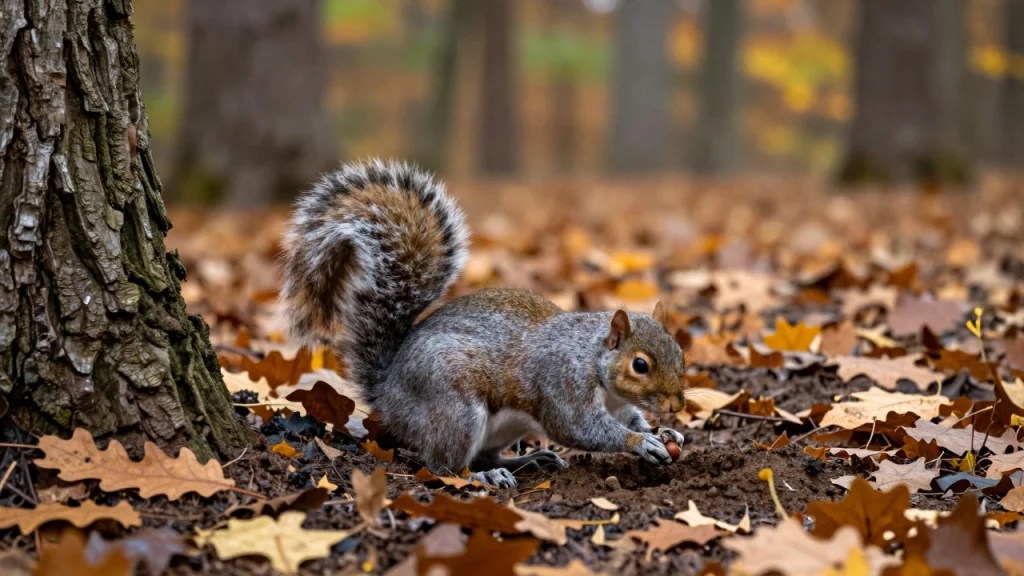
Yes: eastern gray squirrels spread their winter food across many underground caches and later find them again using spatial memory and acute smell. Rather than stumbling upon buried seeds by chance, tree squirrels systematically map their surroundings to retrieve concealed stores when cold weather arrives.
Since Eastern Grays remain active year-round while many squirrel species hibernate, burying provisions is necessary to sustain them through lean times. These resilient animals cannot sleep through winter, meaning they regularly dig up previously cached meals to meet daily energy needs across changing seasons.
The mechanics of scatter hoarding
Burying seeds serves as vital preparation for harsh cold weather when forest resources become scarce. By dividing food into hundreds of independent caches across the woodland floor, an individual limits the risk of losing its entire winter supply to a single competitor.
Over an active autumn, a solitary squirrel may cash hundreds or sometimes thousands of nuts by concealing them in soil. The animal digs a shallow hole, presses the seed into the earth, and conceals the disturbance with leaves and topsoil to ensure adequate winter nutrition.
In natural ecosystems, Sciurus carolinensis demonstrates a clear affinity for continuous mature forests spanning greater than 40 hectares that feature diverse understory vegetation. Broad woodland canopies provide shelter from predators alongside the expansive terrain required to distribute stored provisions without overcrowding.
Squirrel populations reach their highest densities within woodland stands rich in trees that yield durable cold-weather mast, particularly oaks (Quercus) and walnuts (Juglans). Hard-shelled seeds resist rot and moisture far better than soft fruits, supplying the durable nourishment necessary for winter storage.
The regular diet of Sciurus carolinensis centers on buds, flowers, and seeds gathered from more than 24 oak species, in addition to 10 hickory species, pecan, walnut, and beech trees. These varied trees provide dependable seasonal sustenance:
- Acorns from oak species that supply essential lipids
- Durable hickory and pecan nuts that resist soil moisture
- Hard walnuts and beech mast that endure freezing temperatures
- Buds and flowers that provide nutrients in early spring
Ecologically, squirrels prefer to inhabit mixed forests, yet they remain remarkably versatile and may thrive in almost any environment. Whether in continuous wilderness tracts or suburban green spaces, their behavioral flexibility allows them to exploit varied mast trees across diverse habitats.
Evaluating seeds before burial
Throughout temperate zones, cyclical seasonal changes exert predictable effects on resource availability and food scarcity. Tree squirrels continually adjust their foraging effort, handling time, and caching decisions according to the abundance of seeds in the surrounding woods.
Detailed measurements showed that squirrels invested more effort per cache during the summer months when wild food is scarce. During summer shortages, squirrels spend substantial time selecting optimal sites, digging deeper holes, and carefully camouflaging caches to safeguard precious provisions.
In contrast, hoarding routines turn increasingly stereotyped in the autumn, leading squirrels to bury seeds as rapidly as possible with reduced deliberation as massive amounts of food become accessible. When tree seeds drop in high volumes, autumn foragers prioritize rapid storage over individual inspection before rivals consume the harvest.
Physical inspection behaviors
Before burying a seed, a squirrel inspects each item carefully to determine whether it deserves storage:
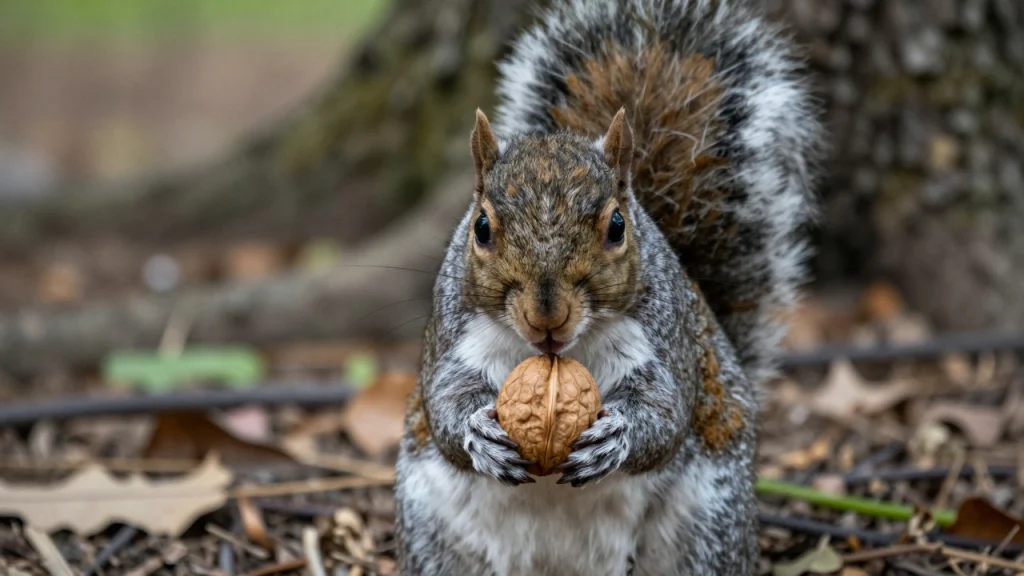
- Paw manipulation: During seed evaluation, squirrels paw manipulate a harvested item by turning it smoothly between their forepaws and mouth.
- Head flicking: Animals firmly grip the nut with their teeth and execute a diagnostic head flick, shaking the head back and forth rapidly.
- Assessment of traits: Experimental findings substantiate that head flicking functions as an assessment routine designed to evaluate seed weight, structural soundness, and perishability.
Lightweight or damaged seeds indicate internal decay or insect infestation, prompting immediate consumption. Intact, heavy seeds with durable shells represent premium assets worthy of long-term underground caching.
Spatial memory and cognitive chunking
Every scatter-hoarding animal confronts the continuous challenge of maximizing recovery of its scattered stores while minimizing cache loss to competitive pilferers. Balancing quick retrieval against the threat of theft requires highly sophisticated spatial cognition.
Evolutionary researchers note that the eastern gray squirrel operates as a scatter-hoarder endowed with exceptional spatial learning memory developed directly through its specialized caching ecology.
Standardized memory trials proved that squirrels who learned the task were capable of retaining spatial representations across at least 25 days. This durable memory allows squirrels to locate buried stores weeks after the initial caching event.
How spatial chunking organizes memory
In behavioral cognition, chunking describes a process where an individual groups items sharing distinctive commonalities to distinguish them from other categorical sets. Squirrels apply this mental strategy to organize food storage across physical space.
A primary mental mechanism is spatial chunking, where caches containing similar food varieties are linked together in physical space and memory. Rather than scattering seeds randomly, squirrels designate specific spatial areas for distinct seed types to simplify mental mapping.
Field mapping showed that squirrels spatially chunked their cache sites by seed species when harvesting resources from a single focal station. By grouping identical nut types in separate zones, individuals establish clear spatial boundaries that simplify later navigation.
Controlled experiments offer empirical evidence that a scatter hoarder can use spatial chunking during cache distribution to reduce cognitive load and enhance retrieval accuracy. Organizing items into distinct territorial clusters prevents memory overload and boosts foraging efficiency during recovery.
Foragers routinely transport preferred food varieties farther from the original discovery site and bury them at lower densities across the territory. Dispersing valuable nuts thinly over greater distances makes them harder for competitors to locate.
Deception and defenses against cache theft
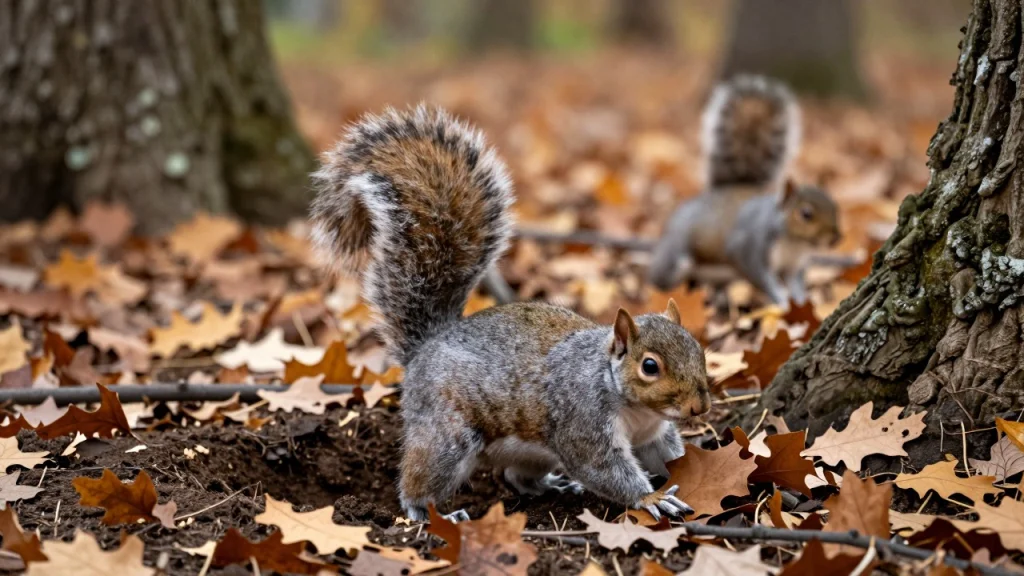
Underground food storage carries significant risk because the local squirrel community is rampant with opportunistic nut theft. Passing competitors actively watch other foragers, turning the forest floor into a competitive environment of mutual observation.
Pilfering competitors are remarkably persistent, and animals frequently forfeit up to 25% of stored reserves to thieves. In response to severe theft pressures, squirrels have developed strategic maneuvers to protect their caches.
The visible presence of nearby rivals prompted squirrels to increase the time spent covering caches, showing greater meticulousness under elevated social competition. Foragers pack soil firmly and scatter ground litter over the spot to eliminate visual clues.
To thwart thieves, an animal will occasionally pretend to bury food to deceive a nearby bird or rival squirrel. The squirrel digs a hole, covers the empty cavity with soil, and conceals the nut in its mouth to bury it safely elsewhere.
When an animal detects suspicious onlookers, it alters tactics and begins to hide nuts across challenging spots, including muddy ground or dense areas under bushes. Choosing obscured terrain shields caching actions from watching thieves.
Behavioral researchers have observed gray squirrels repeatedly digging up and reburying their cached nuts across the landscape. Regularly moving nuts allows squirrels to relocate vulnerable stores to safer locations as local activity shifts.
Investigators posited that this cyclical behavior helps the animal maintain a fresh memory regarding where each cache is positioned. Continually handling stored nuts reinforces spatial orientation and keeps mental maps current throughout the winter.
Ecological consequences of unrecovered caches
The combination of vast quantities of food and extensive subterfuge means a squirrel cannot remember the location of each cache, allowing abandoned seeds to sprout into mature woodland trees. With thousands of caches buried annually, total recovery remains impossible.
According to research conducted at the University of Richmond, squirrels fail to retrieve as many as 74% of the seeds they bury. Unrecovered nuts remain sheltered beneath topsoil, where moisture and insulation create ideal conditions for germination.
The accidental loss of so many buried acorns, representing seeds of oak trees, is regarded as a primary driver of oak forest regeneration. By dispersing seeds away from parent trees, squirrel memory limitations actively support woodland growth and ecological renewal.
Sources
- Animal Diversity Web: Sciurus carolinensis (eastern gray squirrel)
- Smithsonian Science Education Center: Why Do Squirrels Bury Nuts? (and other mysteries)
- National Park Service: Mammals – Minute Man National Historical Park
- Royal Society Open Science: Caching for where and what: evidence for a mnemonic strategy in a scatter-hoarder
- PLOS ONE: Fox Squirrels Match Food Assessment and Cache Effort to Value and Scarcity
- Frontiers in Ecology and Evolution: Cognitive Performance of Wild Eastern Gray Squirrels (Sciurus carolinensis) in Rural and Urban, Native, and Non-native Environments