
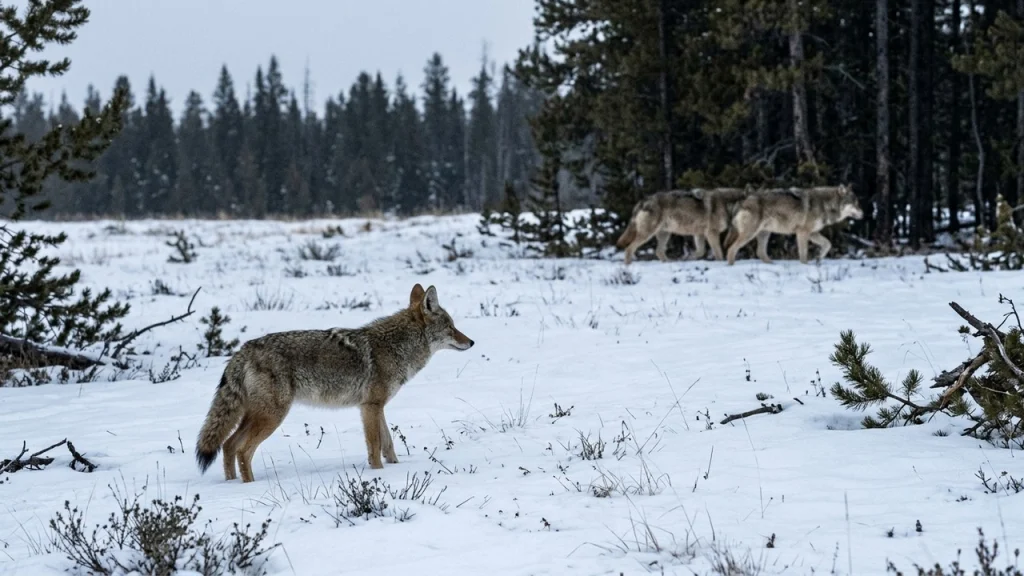
Coyotes are afraid of a short list, and almost everything on it is bigger than a coyote. The animal account compiled by University of Michigan researchers on Animal Diversity Web calls humans and wolves the greatest enemies of the species, and its known-predator list names the gray wolf and the mountain lion. Vehicles and anticoagulant rat poison add two more dangers that no wild animal would choose to meet. Researchers do not ask a coyote what frightens it; they read fear indirectly, in the animals’ watchfulness, in the hours they choose to move, and in the places where dead coyotes turn up.
Which threat dominates depends on the landscape, and fear gets documented behaviorally rather than by interview. On the northern range of Yellowstone, where wolves and cougars share the habitat, coyotes and red foxes alike steer around the danger of meeting those larger carnivores, especially at shared carcasses.
Wolves rank first among the wild threats
Camera traps and GPS collars used in northern Yellowstone, in a study published in Ecology, recorded 18 coyotes killed by wolves along with one red fox, and 11 of those coyote deaths happened at wolf feeding sites. Wolves rarely ate the animals they took, which suggests the attacks defended a carcass rather than filled a stomach.
Numbers explain much of it. The Smithsonian’s National Zoo describes wolves as cooperative pack hunters able to bring down animals bigger than themselves, and a wolf pack is essentially a family group built around an adult pair and its offspring. Coyotes meet that kind of force on different terms: they are less likely to form a pack than wolves are, and much of their hunting happens alone, as a pair, or in family groups, depending on how much prey is around.
Fear, though, does not mean coyotes vanish from wolf country. The same Yellowstone analysis put coyote occupancy at 0.75 in wolf country and 0.35 in areas without them, so the smaller canid holds its ground inside its rival’s range.
Mountain lions are the predator that hunts coyotes outright
Wolves mostly compete with coyotes; cougars prey on them. In Yellowstone, cougars took coyotes as prey and ate them, and every kill there was a standalone predation event rather than a fight over a scavenged ungulate.
Terrain decides many of those encounters. Cougars ambush prey in forested, topographically rough country, and that combination can leave coyotes vulnerable there. The open, flatter terrain that wolves favor gives coyotes more visual and olfactory cues to judge a threat and slip away before it closes in.
The daily schedule shows the same awareness. Where winter apex carnivore densities were high, coyotes were most active mid-day, when those carnivores were least active. Nearby areas with lower apex carnivore densities had coyotes that were more crepuscular, active around dawn and dusk instead, which suggests the midday pattern tracks predation pressure rather than a fixed habit.
Pups have the least room for error
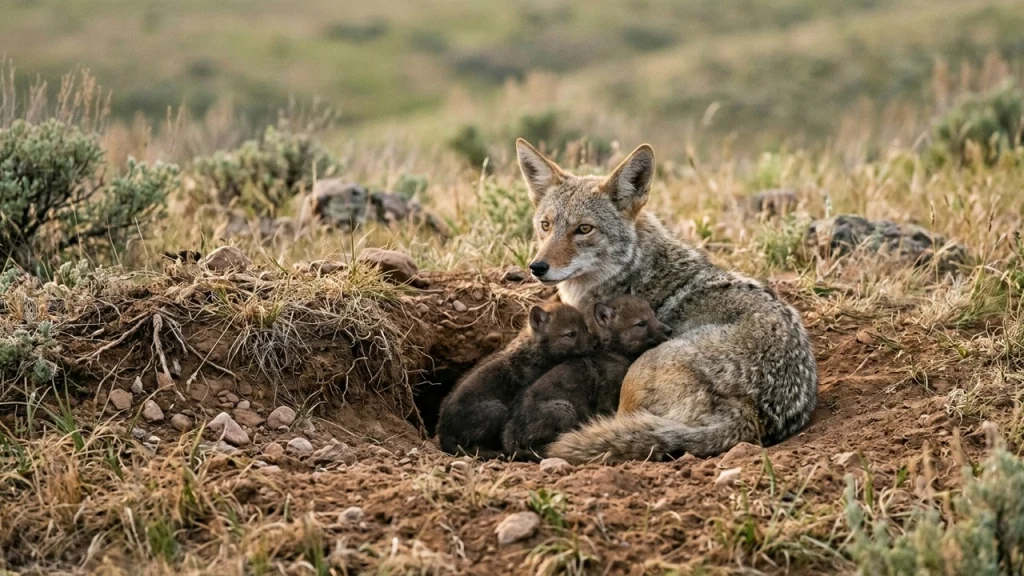
Both parents hold pups inside or beside the den while the litter is still tiny, precisely because pups are easy prey for wolves, mountain lions, and other predators. The young are fully weaned by 35 days, and male pups strike out on their own between 6 and 9 months, while females tend to remain with the family group.
Watching pups is expensive. In a camera study of three coyote families at urban, suburban, and rural sites near Calgary, Canada, the authors found the city adults more alert and more focused on guarding pups than the rural ones, and that vigilance can force a trade-off between guarding pups and foraging that ends in riskier behavior, such as eating garbage.
Fear of people, and the dangers people bring
National Park Service researchers describe coyotes as fearful of people by nature, while also being curious and highly adaptable. A park study that ended in 2004 had tracked 131 coyotes, and those animals went out of their way to avoid people, passing the majority of their time in wilder ground. The top causes of death in that study were vehicle collisions and anticoagulant poisoning from rat poison.
Vigilance numbers point the same way. Urban coyotes in the Calgary study were on high alert about 17% of the time, compared with roughly 5% for rural ones. The rural ranch was not predator free, since grizzly bears and cougars were caught on the same cameras, but it had almost no people, and the rural adults were also less alert when pups were present. Urban coyotes also cut back on activity at twilight, the period when human activity rises, which the study cites as an avoidance technique.
When fear wears thin
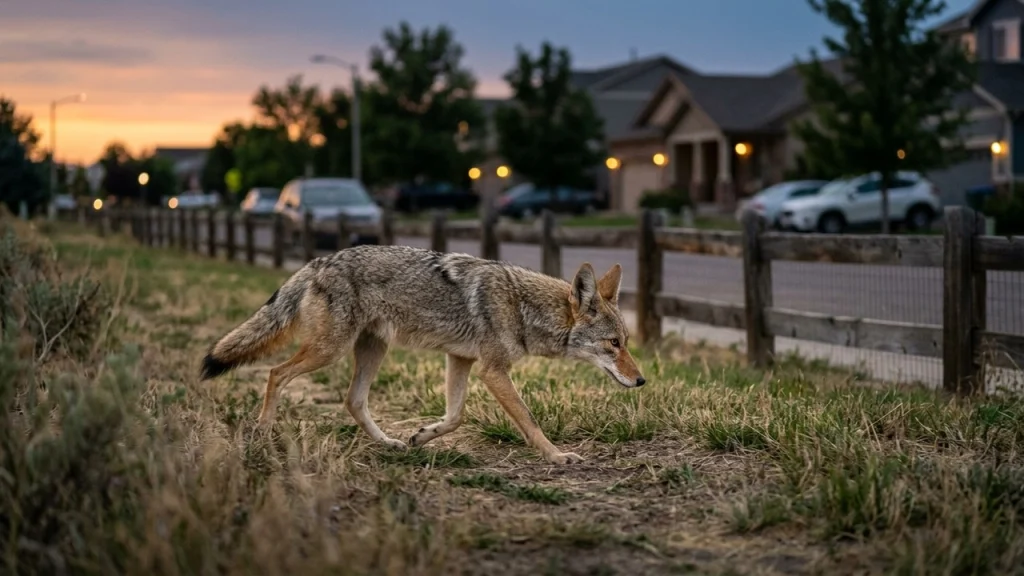
Managers who want a coyote to keep its distance from people sometimes use aversion conditioning, an approach meant to make coyotes warier of humans, and it comes into play when coyotes start treating neighborhoods as food sources. The Calgary authors warn that urban coyotes already carry an elevated baseline fear, so piling on more fear can create a dangerous trade-off rather than a safer animal.
Fear is learned, and it can be unlearned. Hand-fed coyotes proved likelier to come closer to people later on, and harder than others to condition back toward avoidance, and parental habituation can pass that tolerance to offspring. Genetics can tilt the balance as well: among coyotes living in New York City, researchers identified a male of mixed parentage carrying 46% dog ancestry, and members of that family carried genetic insertions associated with canine hypersociability, which likely influenced how tolerant they were of human activity.
Coyotes are more feared than fearsome
The fear in a coyote’s world runs both ways. Red foxes in Yellowstone became nocturnal, which the study links to avoiding peak coyote activity, and the authors describe the arrangement as layered, with apex carnivores shaping coyotes and coyotes shaping red foxes.
For all that caution, the species itself is not in danger, since the IUCN Red List places it in the Least Concern category. A coyote is not a nervous animal. It eats a diet that is 90% mammalian, partners with badgers, which are built for digging prey out of burrows, is an excellent swimmer but a poor climber, and does most of its moving in the small hours near human habitation. Its repertoire of 3 calls makes it the most vocal of any North American wild mammal: a squeak call, a distress call and a howl call, the last combining a quick series of yelps with a falsetto howl. The howl is the long-range signal, announcing to other packs where a territory begins.
Keeping wariness in place
That wariness is worth protecting, because a coyote that treats people as safe is a coyote that ends up removed, and National Park Service staff stress that coyotes need to stay wary of us, most of all in densely populated areas. A coyote fed at a backyard may become habituated to people through no fault of its own, which is why leaving food outside turns a wary animal into a problem. If a coyote approaches you, make yourself look big and noisy, wave and clap your hands, and keep your eyes on it until it turns away. Keeping dogs leashed and small children close handles the rest, since park guidance is that a coyote in a natural area calls for no action at all unless the animal walks toward you.
Sources
- Animal Diversity Web, University of Michigan: Canis latrans (coyote) | INFORMATION | Animal Diversity Web
- U.S. National Park Service: Coyotes – Santa Monica Mountains National Recreation Area
- Ecological Society of America, via PubMed Central: Species-specific interactions with apex carnivores yield unique benefits and burdens for mesocarnivores (Ecology, 2026)
- Nature Publishing Group, via PubMed Central: Coyote family activity in a landscape of fear (Scientific Reports, 2025)
- MDPI, via PubMed Central: Coyotes in New York City Carry Variable Genomic Dog Ancestry and Influence Their Interactions with Humans (Genes, 2022)
- Smithsonian’s National Zoo: Gray wolf